
The History of Aquariums: From Ancient Fish Ponds to Modern Living Ecosystems
This guide is created by Green Chapter — Nature Workshop Studio, where we focus on creating living ecosystems through hands-on experience. We share practical insights across terrariums, aquascaping, plants, and natural systems to help you build and care for your own.
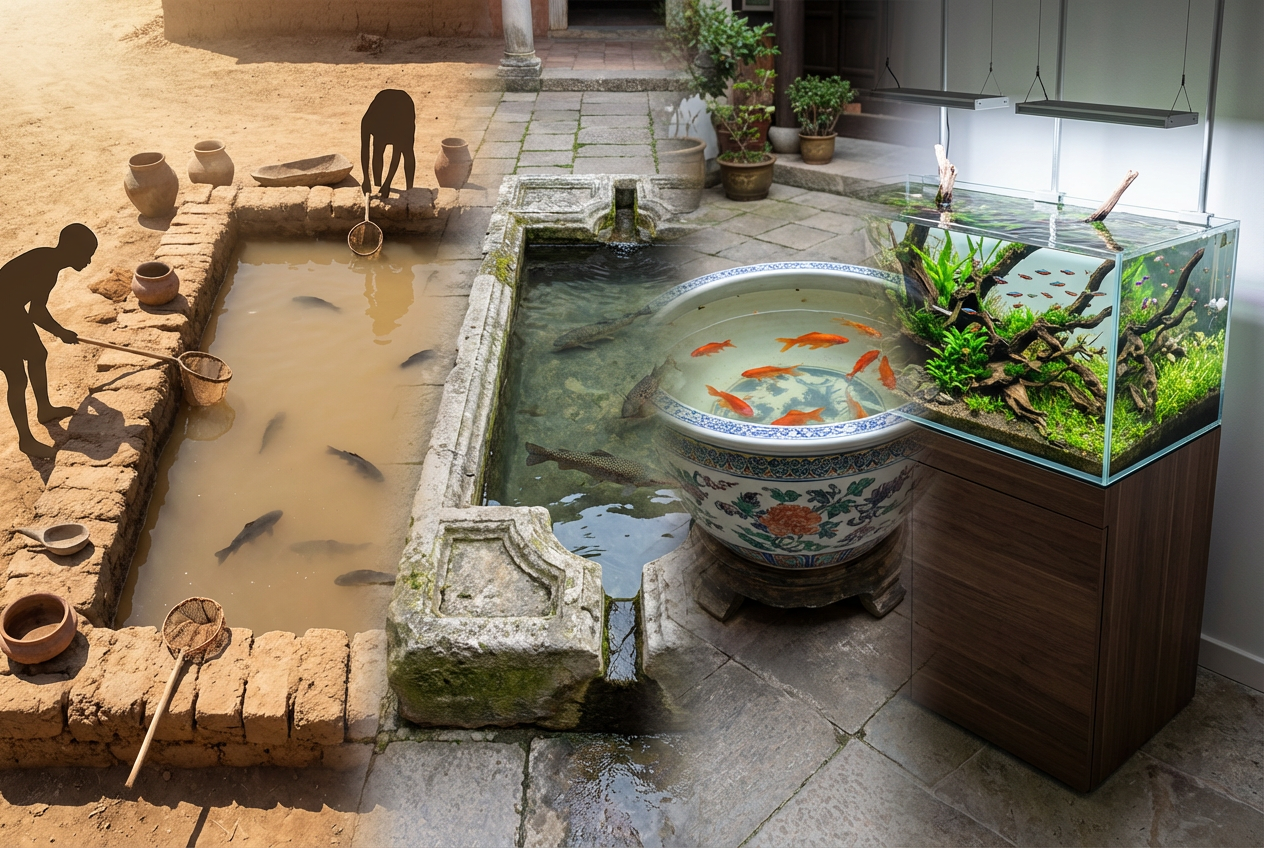
Aquariums Before Glass
When most people think of aquariums, they imagine a clear glass tank—plants, fish, perhaps a carefully arranged aquascape sitting quietly in a home.
But that idea is surprisingly recent.
Long before glass tanks existed, humans were already keeping fish. Not for decoration, not for relaxation—but for survival, ritual, and power. The story of aquariums is not the story of technology alone. It is the story of how our relationship with nature evolved—from control, to admiration, to recreation, and finally, to ecosystem design.
Before Cleopatra — Fishkeeping for Survival and Ritual

Thousands of years before Cleopatra ruled Egypt, early civilizations were already managing fish.
The Sumerians, around 2500 BCE, created some of the earliest known artificial fish ponds. These were not decorative—they were practical systems. Fish were stored alive to ensure a steady food supply, especially in unpredictable environments.
In ancient Egypt, fishkeeping became more structured. The Nile was not just a river—it was a life system. Egyptians constructed ponds connected to the Nile to cultivate species like tilapia. These fish were not only food; they carried symbolic meaning, representing rebirth and regeneration.
Fish appeared in tomb paintings, carvings, and even burial rituals. In many ways, this was the first step where fishkeeping began to move beyond pure survival.
Did Aquariums Begin with Cleopatra?
It is tempting to associate aquariums with Cleopatra—images of palace pools and exotic displays feel aligned with her legacy.
But Cleopatra did not invent aquariums.
By her time (69–30 BCE), Egypt already had a long-established system of fish ponds and aquaculture. What existed during her era were controlled water systems, not transparent viewing tanks. These were meant for storage, cultivation, and symbolism—not observation.
So while her era represents refinement and luxury, the true origins of fishkeeping go back much further.
Rome — When Fish Became a Status Symbol

If Egypt represented structure, ancient Rome transformed fishkeeping into spectacle.
Wealthy Romans built elaborate marine fishponds known as piscinae. These were often connected directly to the sea, allowing fresh seawater to circulate naturally. Unlike earlier ponds, these systems were engineered not just for function, but for display.
Elite Romans kept species like moray eels and mullet—not simply as food, but as living symbols of wealth and control. Some accounts even describe owners naming their fish or mourning them when they died.
This was one of the first major shifts in aquarium history:
fish were no longer just resources—they became possessions.
China — The Birth of Ornamental Fishkeeping

While Rome explored display through engineering, China developed something even more influential: selective breeding for beauty.
As early as 1000 BCE, carp were raised for food. But over time, selective breeding began producing variations in color and form. This eventually led to the creation of the goldfish.
By the Song Dynasty, ornamental fishkeeping had become an art form. Goldfish were kept in ceramic vessels, garden ponds, and decorative containers. Unlike Roman systems, these setups were not about scale—they were about refinement and aesthetic appreciation.
This marks a critical turning point:
fishkeeping became artistic.
The Glass Revolution — Seeing Into Water

For thousands of years, humans kept fish—but rarely observed them clearly.
That changed in 1832, when Jeanne Villepreux-Power developed one of the first glass aquariums to study marine life. Her goal was scientific, not decorative. She wanted to observe organisms in controlled conditions without removing them entirely from their environment.
For the first time, humans could look through water, not just into it.
This was the moment the modern aquarium truly began.
The Victorian Aquarium Craze

The idea of the aquarium quickly spread.
In 1853, Philip Henry Gosse introduced the term “aquarium” and helped popularize it through the London Zoo’s public “Fish House.”
Suddenly, aquariums were no longer just scientific tools—they became public attractions and home hobbies.
Victorian households began keeping small aquariums filled with plants and fish. However, these early systems were unstable. Without modern filtration or understanding of biological balance, many tanks failed quickly.
Even so, the fascination had begun.
The 20th Century — Technology Makes Aquariums Possible

For the first time in history, technology made aquariums practical.
Electricity introduced lighting, pumps, heaters, and filtration systems. This allowed stable environments to be maintained, especially for tropical fish.
Aquariums transitioned from fragile experiments into sustainable systems.
This era also introduced mass-produced tanks, accessible equipment, and a growing global hobby. What was once reserved for elites or scientists became something anyone could explore.
Today — Aquariums as Living Ecosystems

Today, aquariums have evolved again.
They are no longer just containers for fish—they are living ecosystems.
Modern aquarists design planted tanks, reef systems, paludariums, and biotopes that replicate natural environments. The focus has shifted from control to balance.
Aquariums now serve many roles:
- A form of nature connection
- A design element in living spaces
- A tool for education
- A source of calm and mental clarity
At studios like Green Chapter, aquariums are approached not as decoration—but as systems that teach people how nature works.
Conclusion — From Survival to Living Art
The history of aquariums is not a straight line of invention. It is a transformation of purpose.
From Sumerian food ponds…
to Egyptian symbolism…
to Roman luxury…
to Chinese artistry…
to scientific observation…
to modern ecosystem design.
What began as a way to control nature has become a way to understand and recreate it.
And today, when you build an aquarium, you are not just setting up a tank—you are continuing a story that has been evolving for thousands of years.


