
Mosses — The Ancient Survivors Still Living In Your Terrarium
This guide is created by Green Chapter — Nature Workshop Studio, where we focus on creating living ecosystems through hands-on experience. We share practical insights across terrariums, aquascaping, plants, and natural systems to help you build and care for your own.
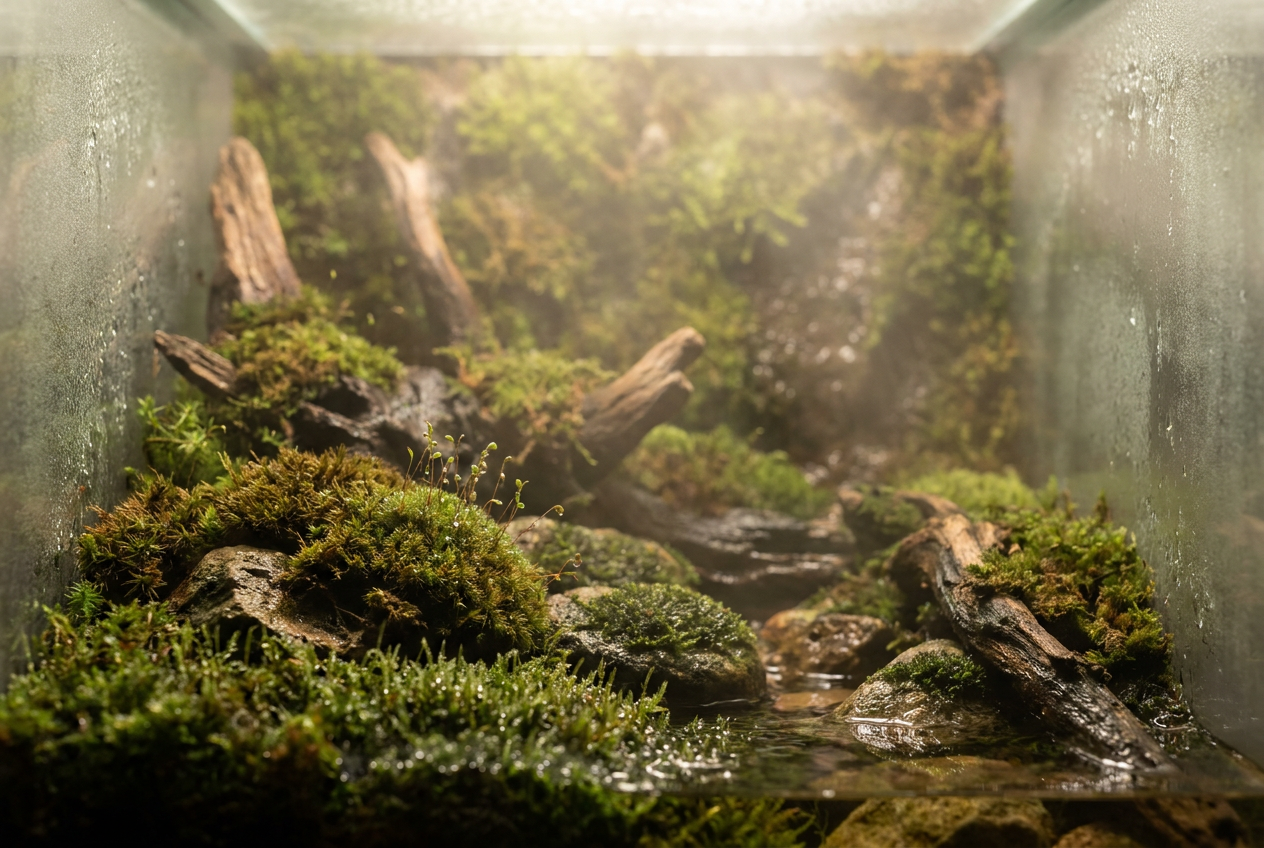
Mosses Are Older Than Forests
Most hobbyists treat moss as a finishing touch.
A little green texture on driftwood.
A carpet over stone.
Something to mist occasionally.
But the moss sitting inside your terrarium today belongs to one of the oldest surviving groups of land plants on Earth.
Long before flowering plants existed…
Long before giant forests covered the continents…
Long before dinosaurs or even terrestrial animals appeared…
Ancient moss-like plants were already beginning to transform barren rock into living ecosystems.
The world they entered was harsh and alien. Early Earth had no forests, no grasslands, and almost no soil. Vast volcanic landscapes sat exposed beneath intense ultraviolet radiation and violent climate shifts.
Yet primitive moss ancestors slowly began colonizing land, helping create the conditions needed for complex terrestrial life to eventually evolve.
When hobbyists understand this, moss stops feeling like decoration.
It starts feeling like ancient biology still functioning exactly as it did hundreds of millions of years ago.
Before Mosses, Earth Was Mostly Bare Rock
The ancestors of mosses likely evolved from freshwater green algae known as charophytes.
These ancient algae lived entirely underwater. Moving onto land was incredibly dangerous because early organisms suddenly faced:
- drying out
- gravity
- ultraviolet radiation
- unstable temperatures
To survive, early plant ancestors evolved protective reproductive spores coated with an extremely durable material called sporopollenin. These microscopic spores could resist drying and travel through the air safely.
Scientists believe these primitive plant pioneers began appearing on land roughly 470 million years ago during the Ordovician Period.
Because early mosses were soft-bodied, they rarely fossilized well. Instead, scientists track their emergence using ancient fossilized spores called cryptospores found in prehistoric rock layers.

Over immense periods of time, these tiny primitive plants helped reshape the entire planet.
Mosses Helped Create Earth’s First Soil
Mosses were not passive survivors.
They were ecosystem engineers.
Unlike modern plants with deep roots, mosses use tiny hair-like structures called rhizoids to anchor themselves onto surfaces. These rhizoids do not absorb nutrients like true roots. Instead, mosses absorb moisture and nutrients directly across their surfaces.
As ancient mosses spread across rock surfaces, they released organic acids that slowly broke down stone through a process called biological weathering.
Combined with decaying organic matter, this gradually produced some of Earth’s earliest layers of terrestrial soil.
Without primitive plants like mosses, complex forests and terrestrial ecosystems may never have developed in the way we know today.
Why Moss Behaves So Differently From Normal Plants
One reason moss confuses many hobbyists is because it does not behave like ordinary plants.
That is because mosses never evolved proper vascular plumbing systems like modern plants.
Trees and flowering plants use internal transport tubes called xylem and phloem to move water throughout the plant body.
Mosses do not.
Instead, moss absorbs water directly through its leaves and outer surfaces almost like a sponge.

This is why moss responds so strongly to:
- humidity
- airflow
- moisture cycles
- misting frequency
- evaporative cooling
- surface wetness
It also explains why moss performs so well in:
- paludariums
- ripariums
- waterfalls
- fog systems
- hygrolon walls
- moisture-guiding surfaces
Moss is not trying to pull water from deep underground.
It is interacting directly with the surrounding atmosphere itself.
This ancient survival strategy is known as poikilohydry.
Instead of preventing dehydration completely, moss can dry up dramatically, pause its metabolism, and rapidly recover once moisture returns.
That “revival” ability is one reason mosses survived for hundreds of millions of years despite extreme environmental instability.
Moss Reproduction Is Surprisingly Similar To Amphibians
One of the most fascinating things about mosses is that they still reproduce in a very primitive way.
Like frogs and salamanders, moss reproduction still depends heavily on water.
Most amphibians must return to water to reproduce because their sperm need a liquid environment to swim toward eggs.
Moss works similarly.
Instead of pollen or seeds, mosses produce swimming sperm equipped with tiny flagella. These sperm require a thin film of water — such as rain, dew, or condensation — to physically swim from male reproductive structures to female ones.

This is one reason moss thrives in environments with:
- condensation
- flowing moisture
- humid air
- rain cycles
- splash zones
In nature, moss often grows near stream edges, waterfalls, wet forests, cloud forests, and constantly humid surfaces where water movement regularly assists reproduction.
The Tiny Stalks Growing Out Of Moss Are Not Random
Many hobbyists notice small stalks growing upward from moss carpets and assume they are:
- roots
- flowers
- dead growth
- random fibers
But these structures are actually reproductive organs called sporophytes.
The green moss carpet itself is the gametophyte phase.
After successful fertilization, the moss produces a completely different structure: a capsule growing on a stalk.
Inside this capsule are enormous numbers of spores.
Once mature, these spores are released into the air and eventually develop into new moss colonies elsewhere.

Suddenly, those tiny stalks inside a terrarium become much more interesting.
They are evidence that ancient reproductive systems are actively functioning inside your enclosure.
Why Moss Thrives In Paludariums And Ripariums
Modern hobby systems accidentally recreate many conditions moss evolved to love.
Paludariums and ripariums naturally create:
- evaporative humidity
- moisture gradients
- wet surfaces
- airflow
- intermittent drying
- constant condensation
These environments mimic the unstable wet terrestrial zones early mosses originally colonized hundreds of millions of years ago.

This is also why some moss systems fail.
Completely stagnant wetness can suffocate moss.
Extremely dry airflow can desiccate moss.
Poor moisture distribution creates dead zones.
Understanding moss biology helps hobbyists design better systems instead of simply guessing through trial and error.
Sphagnum Moss Quietly Controls Global Climate
While most mosses are small, one particular group became globally powerful.
Sphagnum moss — commonly called peat moss — helped create peatlands, one of Earth’s largest carbon storage systems.
Peatlands cover only a tiny percentage of Earth’s land surface, yet they store more carbon than all the world’s forests combined.
As Sphagnum grows, it acidifies the surrounding environment and creates waterlogged oxygen-poor conditions.
Normally, bacteria and fungi rapidly decompose dead plant matter.
But inside peat bogs:
- oxygen becomes extremely limited
- acidity becomes intense
- decomposition slows dramatically
Dead moss does not fully rot.
Instead, it slowly compresses into thick carbon-rich peat deposits over thousands of years.

These peat layers can grow meters deep and trap enormous quantities of carbon for geological timescales.
In many ways, peat moss acts like a planetary-scale carbon vault.
When Peatlands Dry Out, Ancient Carbon Escapes
Today, peatlands face serious threats from:
- drainage
- agriculture
- logging
- climate warming
- drought
When peat dries out, oxygen suddenly re-enters the system.
Dormant bacteria rapidly begin decomposing ancient organic matter again, releasing huge amounts of stored carbon dioxide back into the atmosphere.
Some peatlands even ignite into underground “zombie fires” that can continue smoldering beneath snow and soil for months.

Tiny mosses that once helped cool Earth’s climate are now deeply connected to modern climate change discussions.
The Moss In Your Terrarium Is Far More Ancient Than It Looks
The moss inside a terrarium is not a weak primitive plant.
It is part of an ancient survival strategy that endured:
- mass extinctions
- volcanic worlds
- ice ages
- climate collapse
- continental shifts
for hundreds of millions of years.
Even today, moss still behaves like its prehistoric ancestors:
- absorbing water directly from the atmosphere
- depending on moisture for reproduction
- reviving after dehydration
- slowly reshaping surfaces over time
Once hobbyists understand this, moss stops feeling like background decoration.
It becomes living ancient biology quietly continuing its journey inside modern glass ecosystems.


