
Why Emergent Plants Grow Differently
This guide is created by Green Chapter — Nature Workshop Studio, where we focus on creating living ecosystems through hands-on experience. We share practical insights across terrariums, aquascaping, plants, and natural systems to help you build and care for your own.
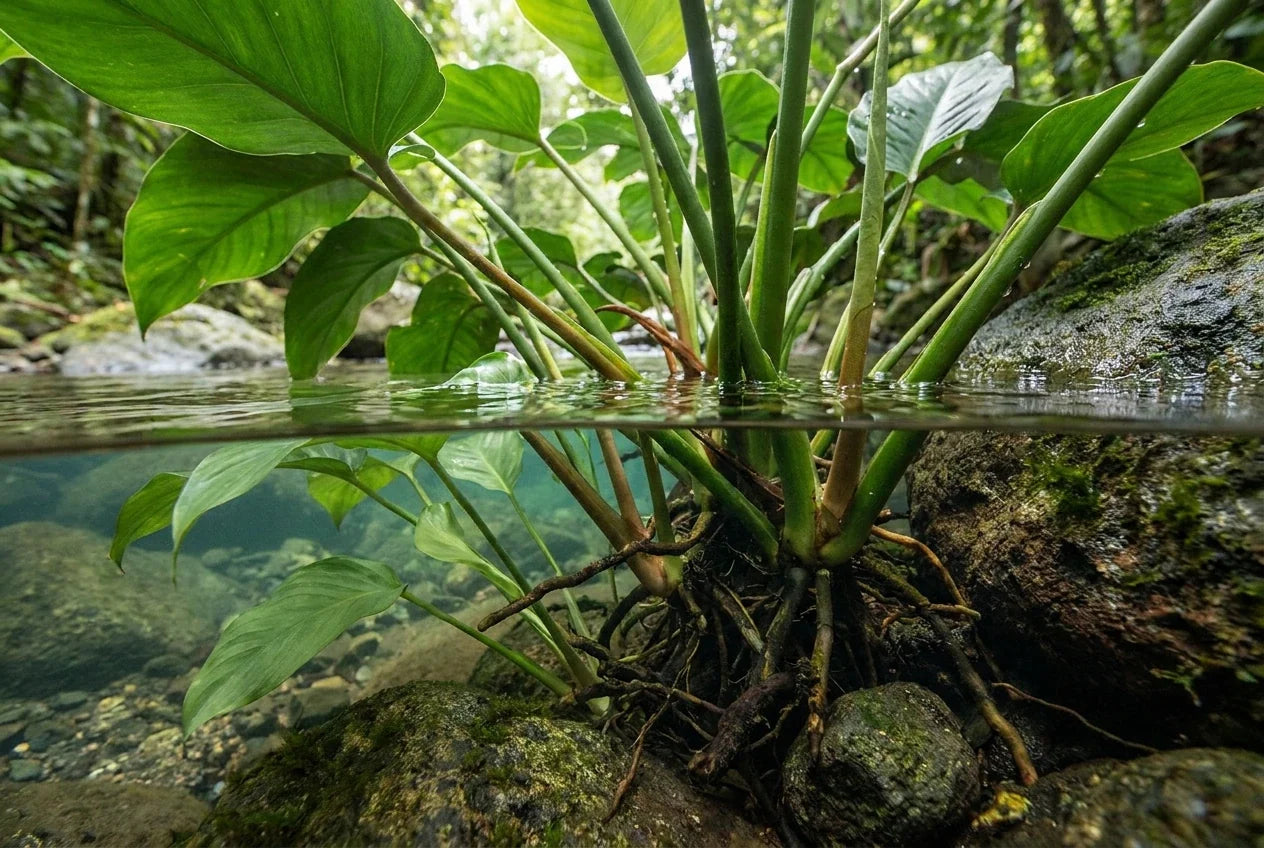
Walk through an aquarium shop and you may see Cryptocoryne, Anubias, Bucephalandra and other plants grouped together as “aquatic plants.”
Yet take some of these plants out of the aquarium and place their roots beside water, and something interesting happens. New leaves may become firmer, shorter, thicker or differently shaped. Growth that seemed slow underwater may become vigorous above it.
Meanwhile, a plant described as loving boggy, permanently wet conditions may struggle if you simply submerge the whole thing.
The reason is simple, but important:
A plant's relationship with water depends on which part of the plant is in it.
Understanding this changes how we choose plants for planted aquariums, ripariums, paludariums and terrariums.
Instead of asking only:
“Does this plant like water?”
A more useful question is:
“Where should the water meet this plant?”
“Aquatic Plant” Can Be a Misleading Label
Plants sold for aquariums do not all live the same way in nature.
Some are adapted to remain submerged for long periods. Others come from riverbanks, wetlands, floodplains or stream margins where water levels rise and fall. Some grow with their roots constantly saturated while their leaves remain completely above water.
For practical plant selection, it helps to think about several broad strategies.
True or predominantly submerged aquatics
These plants are adapted to spending most or all of their active growth underwater.
Examples include plants such as Vallisneria, Ceratophyllum and Hydrilla.
They possess adaptations that allow them to function in a submerged environment, although the exact mechanisms differ between species.
Amphibious plants
These plants can experience both submerged and exposed conditions.
Many familiar aquarium plants fall somewhere within this broad ecological strategy. Changing water levels can result in very different submerged and emersed growth forms.
Emergent and marginal plants
Their roots may remain underwater or in saturated substrate while much of their foliage grows above the surface.
For these plants, wet roots do not mean submerged leaves.
Bog and wetland plants
Some plants naturally inhabit extremely wet soils but still depend on having their foliage exposed to air.
They may tolerate saturated root zones beautifully while being poorly adapted to prolonged complete submergence.
Terrestrial plants
These may appreciate moist soil and high humidity but still require an aerated root zone. High humidity does not automatically make a terrestrial plant suitable for saturated substrate.
These differences matter because an aquarium, riparium, paludarium and terrarium place the waterline in very different positions relative to the plant.

Crossing the Waterline Changes the Rules
Imagine a plant growing at the edge of a stream.
Its roots sit among wet rock and saturated substrate. Some leaves remain underwater while a new shoot reaches through the surface.
Only a few centimetres separate the submerged leaf from the aerial one.
But physically, they occupy very different worlds.
Underwater, the plant is surrounded by abundant water, but gases such as carbon dioxide move much more slowly through water than through air. A relatively still boundary layer can further restrict movement of dissolved substances close to the leaf surface.
Above water, access to atmospheric carbon dioxide becomes much easier.
But the plant acquires a new problem.
It can now lose water to the atmosphere.
The aerial leaf therefore needs to manage transpiration, stomatal behaviour, temperature and dehydration in ways that a permanently submerged leaf does not.
There is a fundamental trade-off at the water surface:
Below water, obtaining carbon can be difficult.
Above water, retaining water becomes difficult.
Plants adapted to the water's edge have evolved different ways of dealing with both conditions.

Why the Same Plant Can Produce Different Leaves
This helps explain something aquarium keepers frequently encounter.
A plant purchased from a nursery may look different several weeks after being planted underwater.
Likewise, an aquarium plant allowed to grow out of the water may begin producing leaves that look different from its submerged foliage.
For many amphibious plants, this is normal.
Plants can alter aspects of their morphology according to their environment, a phenomenon that can include heterophylly—the production of different leaf forms under different conditions.
Submerged leaves may be thinner, softer or more flexible. Water provides physical support, and the leaf operates in an environment where dehydration is not the same challenge it is in air.
Aerial leaves may need greater structural strength and better control over water loss. Leaf thickness, texture, shape and orientation can therefore change.
The exact response varies greatly between species.
But the important lesson is broader:
A plant's appearance is not completely fixed.
A leaf is partly a record of the conditions under which it developed.
That is why identifying a plant from a single photograph without considering how it was grown can sometimes be misleading.
Why CO₂ Becomes Important Underwater
The waterline also helps us understand one of the most discussed subjects in planted aquariums: carbon dioxide.
Plants require inorganic carbon for photosynthesis, but obtaining it underwater presents different physical challenges from obtaining CO₂ from air.
Some genuinely aquatic plants possess adaptations that help them operate effectively while submerged. Depending on the species, these can include thin tissues, reduced barriers to exchange, internal air spaces and, in some aquatic plants, the ability to use bicarbonate as an additional inorganic carbon source.
This is one reason some submerged plants can grow successfully in aquariums without injected CO₂.
That does not mean they do not need carbon, nor does it mean additional CO₂ cannot increase growth.
It means they possess adaptations for living in an environment where carbon acquisition is fundamentally different.
Now consider an amphibious plant that naturally spends part of its life with foliage exposed to air.
When we grow that plant completely underwater, we are asking its leaves to operate permanently in a medium where gas diffusion is much slower.
Supplying additional dissolved CO₂ can make carbon more readily available under those conditions.
This gives us a more useful way to think about aquarium CO₂.
Rather than simply dividing plants into:
“CO₂ plants” and “non-CO₂ plants,”
ask:
How is this plant naturally adapted to obtain carbon, and how much of its foliage normally spends time underwater?
CO₂ injection cannot turn a terrestrial bog plant into a true aquatic plant. The species must still possess the anatomical and physiological ability to tolerate prolonged submergence.
But understanding its natural growth strategy helps explain why different plants respond so differently underwater.

The Most Important Distinction: Wet Roots Are Not Submerged Leaves
This is perhaps the most useful principle when selecting plants.
A bog plant may naturally grow with its roots in saturated mud.
That does not mean the entire plant can live underwater.
Consider its natural arrangement:
Roots: continuously wet or saturated
Stem: crossing the wet margin
Leaves: exposed to air
Now place the whole plant underwater.
The roots may experience almost the same amount of water as before.
The leaves do not.
Their entire gas-exchange environment has changed.
The reverse misunderstanding also occurs in terrariums.
A plant may come from a humid tropical environment, but that does not necessarily mean its roots tolerate permanent saturation. Moist, oxygenated substrate and stagnant waterlogged substrate are physically different root environments.
So phrases such as:
“likes humidity”
“likes wet soil”
“aquatic plant”
are not enough information by themselves.
We need to know which part of the plant normally experiences which condition.
Water Levels in Nature Do Not Stay Still
Aquariums encourage us to think of the waterline as permanent.
Nature often does not work that way.
Streams rise after rain. Floodplains inundate. River margins disappear underwater and later re-emerge. Wetlands expand and contract.
A plant growing in these environments may experience very different conditions through the year.
During high water, some or all of its foliage may become submerged.
As water levels fall, new growth can emerge into humid air.
Later, the same plant may be growing on what appears to be a wet terrestrial bank.
The plant has not necessarily moved.
The waterline has.
This is why plants such as Cryptocoryne can be especially interesting. What we know as an aquarium plant is only one expression of a plant adapted to habitats where the relationship between land and water can change.
The same principle helps us better understand many plants associated with stream margins and wet tropical habitats, including Anubias, Bucephalandra and Bolbitis.
Instead of asking whether these are “land plants” or “water plants,” it is often more useful to understand the range of hydrological conditions they naturally encounter.

So Which Plants Belong in Your Setup?
Once we understand these different strategies, plant selection becomes much easier.
Instead of memorising long lists of “paludarium plants” or “aquarium plants,” start by understanding the environment you are actually creating.
Planted Aquarium: Can the Foliage Remain Submerged?
A conventional planted aquarium keeps both roots and foliage underwater continuously.
The first requirement is therefore straightforward:
Choose species capable of sustained submerged growth.
True aquatic plants are obvious candidates, but many amphibious plants also adapt extremely well to permanent aquarium cultivation.
The important distinction is that a plant being sold near an aquarium does not automatically prove that it can remain submerged indefinitely.
When evaluating an unfamiliar plant, ask whether it genuinely produces a stable submerged growth form.
Then consider its secondary requirements—light, flow, temperature, substrate and carbon availability.
For a planted aquarium, the question is not simply whether the plant likes water.
It is:
Can its leaves function underwater for the long term?

Riparium: Keep the Roots Wet and Let the Leaves Breathe
A riparium creates almost the opposite opportunity.
Here, plants can have their roots in or immediately beside the aquarium while their foliage grows into the air.
This opens the door to many emergent and marginal species that would not necessarily make good permanently submerged aquarium plants.
It also allows amphibious aquarium plants to express their aerial growth forms.
The key selection question becomes:
Can the root system tolerate constant access to water while the foliage lives in normal room air?
Humidity becomes important too.
A plant that grows beautifully emersed inside a humid propagation enclosure may not automatically tolerate the much drier air above an open aquarium.
So riparium plant selection needs to consider both ends of the plant:
wet root zone below + aerial environment above.
Paludarium: Don't Choose Plants for the Tank—Choose Them for the Zone
A paludarium is particularly interesting because it does not contain one plant habitat.
It contains several.
From bottom to top, there may be:
submerged water → waterline → saturated bank → humid terrestrial substrate → elevated drier surfaces
Each can support a different plant strategy.
A true aquatic may belong completely underwater.
An amphibious plant may occupy the transition zone.
An emergent or bog species may perform best with roots in the saturated margin and foliage above water.
A terrestrial tropical plant may prefer the higher bank where substrate remains moist but aerated.
This changes the way we should design paludariums.
Instead of asking:
“Is this a paludarium plant?”
ask:
“Which part of the paludarium recreates the conditions this plant needs?”
A plant struggling underwater may not require less moisture at all.
It may simply need its leaves above the waterline.
And a terrestrial plant struggling beside the water may not require lower humidity.
Its roots may simply need more air.

Terrarium: Humidity Is Not the Same as Saturation
Terrariums create another common source of confusion.
High atmospheric humidity can dramatically reduce water loss from leaves.
But humid air tells us very little about how much water should surround the roots.
Many tropical terrestrial plants enjoy humid air while growing in loose, oxygenated forest substrate.
If we place those roots permanently in stagnant saturated soil simply because the plant “likes humidity,” we have recreated the wrong part of its habitat.
For terrarium selection, therefore, ask:
Does this plant want humid leaves, wet roots, or both?
Those are three different conditions.
A good terrarium substrate should reproduce the root environment the species requires, not simply remain as wet as possible.
A Simple Way to Choose Plants
When considering an unfamiliar plant for any of these systems, ask three questions.
1. Where are its leaves normally found?
Underwater, above water, or both?
This tells you whether sustained submergence is realistic.
2. What happens around its roots?
Open water, saturated mud, constantly moist but aerated soil, or periodically drying substrate?
This tells you where to position the root system.
3. Does its habitat stay that way?
Is the water level permanent, seasonal or highly variable?
This tells you whether the plant is likely to tolerate changing conditions and whether it may produce different growth forms.
With these three questions, a plant you've never used before becomes much easier to evaluate.
Stop Choosing Plants by Labels
Aquarium, riparium, paludarium and terrarium are useful hobby categories.
Plants did not evolve according to those categories.
They evolved in streams, wetlands, riverbanks, floodplains, forests, bogs and countless transitional habitats where water can surround the roots, cover the leaves, disappear seasonally or sit only centimetres away.
Understanding that relationship gives us a much better way to select plants.
A planted aquarium asks a plant to live below the waterline.
A riparium lets it exploit water below and air above.
A paludarium gives us an entire gradient between the two.
A terrarium moves us primarily onto land, where humidity and root-zone moisture become separate considerations.
Once you see plants this way, the question changes.
Don't simply ask:
“How much water does this plant need?”
Ask:
“Where should the water meet this plant?”
That answer often tells you where the plant truly belongs.


