
Why Water Flow Matters in a Planted Aquarium
This guide is created by Green Chapter — Nature Workshop Studio, where we focus on creating living ecosystems through hands-on experience. We share practical insights across terrariums, aquascaping, plants, and natural systems to help you build and care for your own.
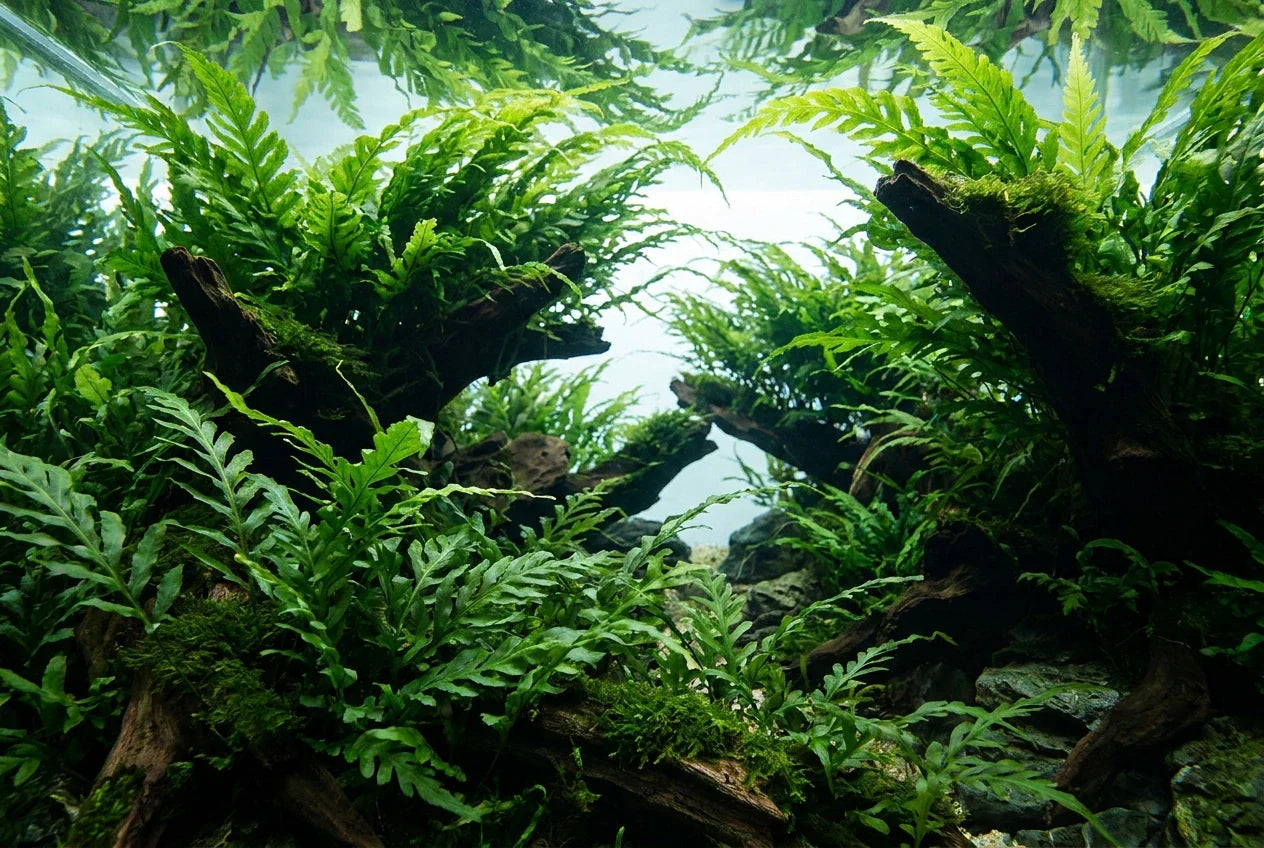
How circulation changes as your tank matures—and why some plants need more movement than others.
A planted aquarium can have good lighting, regular fertilisation and a filter that is still running—and yet the plants may gradually stop growing as well as they once did.
We recently saw this happen in an established 8-foot planted aquarium.
The tank had been running for about 1.5 years. Much of the planting consisted of Bolbitis heudelotii, an African water fern. Growth had never been particularly vigorous, but over time it became increasingly stagnant. Algae also became more noticeable on the older foliage.
One thing had changed gradually: the canister filter was no longer producing the circulation it once did.
Two strong powerheads were added, one at each side of the aquarium, to improve water movement across the long tank.
The response was striking. New Bolbitis growth accelerated dramatically.
It is tempting to draw a simple conclusion:
More flow makes aquatic plants grow better.
But that isn't quite the lesson.
Different aquatic plants come from very different environments. Some occur in flowing streams, while others inhabit marshes, flooded ground or quiet river margins.
The more useful question is:
Is water moving through your aquarium in a way that suits the plants growing there?

Filtration and Circulation Are Not the Same Thing
A filter performs several jobs.
It traps particles, provides surfaces for microbial communities and continuously processes aquarium water.
But a filter also happens to be one of the main devices moving water around an aquarium.
These two functions are related, but they are not identical.
A canister filter can continue filtering water while circulation in parts of the aquarium becomes relatively poor.
This is especially easy to encounter in a long aquarium.
Water leaving the filter outlet follows particular paths. Hardscape, wood and plants redirect those paths. Some areas receive substantial movement while others remain comparatively sheltered.
The aquarium therefore does not have one uniform "flow rate."
It has a flow landscape.
Why We Often Recommend a Larger Canister Filter
Filter specifications can make aquarium circulation appear straightforward.
If a pump is rated for a certain volume of water per hour, it is tempting to assume that this is what the aquarium will always receive.
Real systems are different.
Water has to travel through hoses, bends, valves and filter media. As the system operates, material accumulates within the filter and plumbing. Media becomes loaded. Biofilm develops. Hoses and impellers require cleaning.
Actual output can therefore be lower than the number printed on the box—and it can decline further between maintenance cycles.
The aquarium changes too.
A newly planted tank may contain small plants and large open spaces. Months later, the same aquarium may contain dense bushes, extensive root systems, large fern colonies and hardscape covered in vegetation.
All of these structures influence where water can travel.
This is one reason we often prefer some reserve capacity when selecting a canister filter, particularly for large or heavily planted aquariums.
Oversizing does not mean trying to create the strongest possible current.
It provides useful capacity so that normal losses and a maturing aquascape do not immediately leave the aquarium struggling for circulation.
Why Add a Powerhead If You Already Have a Filter?
Sometimes increasing filtration isn't actually what is needed.
The aquarium may already have adequate biological and mechanical filtration. The problem may simply be getting water to move through a particular area.
That is where a powerhead can be useful.
A powerhead can be positioned specifically to redistribute water through a long aquarium, behind hardscape or around dense plant growth without adding another complete filtration system.
This was particularly relevant in our 8-foot aquarium.
Adding powerheads at both sides did more than increase a number measured in litres per hour.
It changed where the water travelled.

What Does Moving Water Actually Do for a Plant?
Aquatic plants live surrounded by water, so it is easy to imagine that anything dissolved in the aquarium is automatically available to every leaf.
At very small scales, it is more complicated.
Immediately beside the surface of a submerged leaf is a thin region of water where movement is slower than in the surrounding water. This is commonly described as a boundary layer.
Dissolved substances must move across this region as they travel between the surrounding water and the plant surface.
That includes resources involved in plant metabolism, such as carbon dioxide and dissolved nutrients.
Water movement can affect this exchange.
When water around a leaf moves differently, the physical conditions immediately surrounding that leaf change as well.
This helps explain an important planted-aquarium principle:
Having nutrients and CO₂ in the aquarium is not exactly the same as delivering them equally to every plant surface.
But this still does not mean that continuously increasing flow will continuously improve plant growth.
Plants evolved in different hydraulic environments.

Not Every Aquatic Plant Lives in the Same Kind of Water
Look at several familiar aquarium plants and their natural environments and the differences quickly become apparent.
Bolbitis heudelotii is associated with tropical streams and rivers in West and Central Africa, often growing attached to rocks or wood in flowing-water habitats.
Microsorum pteropus, the Java fern, similarly occurs attached to surfaces around streams and other wet habitats in Southeast Asia.
Various Anubias species occur around shaded streams, riverbanks and other wet habitats in tropical Africa, often attached to rocks and wood and capable of experiencing both submerged and emersed conditions.
The Madagascar lace plant, Aponogeton madagascariensis, is associated with clear freshwater habitats in Madagascar, including flowing streams and rivers.
Compare those environments with many familiar marsh and wetland plants.
Echinodorus species occur across tropical and subtropical parts of the Americas in habitats that include wetlands, marshes, river margins and seasonally flooded ground.
Many Rotala species occur in shallow wetlands, marshy ground, rice fields and river margins across Asia and other regions.
Likewise, numerous Ludwigia species inhabit wetlands, ponds, marshes, ditches and slow-water margins.
Then there is Cryptocoryne, a diverse genus whose species occupy a wide range of Southeast Asian aquatic and semi-aquatic habitats. Different species can encounter very different water chemistry, water levels and flow conditions.
Calling all of these simply "aquatic plants" hides much of their ecology.

Even a Fast River Doesn't Have One Flow Speed
There is another problem with saying that a plant comes from "fast-flowing water."
A river is not a pipe.
Water accelerates through some areas and slows in others.
A rock sitting in a stream may experience substantial current on its upstream face while creating a sheltered wake immediately behind it.
Roots, fallen branches, riverbanks, depressions and vegetation create countless small hydraulic environments.
A plant growing in a fast-moving stream may therefore occupy a position where it receives continuous water exchange without being exposed to the strongest part of the current.
This distinction matters in an aquarium.
Knowing that Bolbitis occurs in flowing streams does not mean pointing a powerful pump directly at its leaves.
The relevant question is how water moves around and through the plant where it is actually growing.
Natural Flow Also Changes With Time
Natural aquatic habitats are rarely static.
In tropical regions, wet and dry seasons can dramatically alter water depth, discharge, flooded area and the position of shorelines.
During wetter periods, a stream may expand beyond its normal channel and submerge plants that previously grew along its banks.
During drier periods, water may retreat and expose rocks, roots and plants to humid air.
But lower water does not automatically mean slower water.
When the remaining flow becomes concentrated into a narrower or shallower channel, water can still move rapidly through that channel.
Likewise, a landscape containing enormous amounts of floodwater can include sheltered areas where local water movement is relatively slow.
Water depth, water volume and local flow velocity are related, but they are not the same thing.

Some Plants Change With the Seasons Too
Many plants sold for aquariums are not organisms that spend their entire natural lives permanently underwater.
Species of Cryptocoryne, Echinodorus, Rotala, Ludwigia and many other aquarium genera can grow submerged when water levels are high and emersed when conditions become shallower or exposed.
Their appearance can change accordingly.
Submerged and emersed leaves may differ in thickness, shape, texture or orientation. Stem growth can change. Roots may develop differently. Flowering and reproduction may occur under particular conditions.
The plant is responding not simply to "water," but to an environment that changes through both space and time.
Three questions therefore tell us much more about a plant's habitat:
Where does it grow?
How does water move around that location?
How does that environment change through the year?
This is why simple statements such as "river plant" or "swamp plant" can only take us so far.
Your Aquarium Changes With Time Too
Most aquariums appear much more stable than natural habitats.
Water depth remains almost constant. Pumps operate every day. Lighting follows a timer. There is no monsoon or dry season.
Yet the physical environment inside an aquarium still changes.
Imagine the aquarium immediately after planting:
Clean hoses → clean filter → small plants → open spaces
Now imagine it eighteen months later:
More plant biomass → larger root and rhizome systems → denser foliage → accumulated material in filtration → reduced pump performance → altered water pathways
The equipment may be the same.
The aquarium is not.
Dense plants can redirect water around themselves. Hardscape that was once exposed may become covered. Areas inside large plant colonies can become increasingly sheltered.
At the same time, declining filter output may mean less energy is available to move water through this increasingly complex landscape.
In nature, seasons change the hydraulic environment.
In an aquarium, growth, accumulation and equipment performance can change the hydraulic environment.
That is one reason a circulation pattern that worked when an aquarium was new may not remain suitable indefinitely.

What About the Algae?
It would be convenient to conclude that poor circulation caused the algae in our Bolbitis aquarium.
We cannot establish that from this observation alone.
Algae is influenced by many interacting factors, including light, nutrients, plant health, organic material and the conditions on individual surfaces.
What we can say is that the Bolbitis had stagnated while circulation had declined.
Slow-growing older leaves remain available for algae to colonise, while changes in circulation can also influence debris deposition and conditions around leaf surfaces.
The algae was therefore useful as a clue that the system deserved investigation, rather than a diagnosis of one particular problem.
Instead of immediately asking:
How do I remove this algae?
It can be more useful to first ask:
Why has this plant stopped growing well?
Revisiting the 8-Foot Bolbitis Tank
This brings us back to where we started.
The aquarium had matured for approximately 1.5 years.
Filter output had weakened.
Bolbitis growth was stagnant and algae had become increasingly apparent.
When two powerheads were added to improve circulation across the long aquarium, new Bolbitis growth increased dramatically.
That observation strongly suggests that the previous circulation had become an important limitation in this particular system.
It does not tell us that one mechanism was solely responsible.
Improved circulation could simultaneously influence carbon dioxide delivery, dissolved nutrient transport, oxygen conditions, debris movement and the physical environment around plant surfaces.
And it certainly does not prove that every aquarium plant would respond to the same amount of flow in the same way.
The important result was not simply more flow.
It was that the hydraulic environment around these plants had changed.
Before Adding More Fertiliser, Look at the Water
When an established planted aquarium begins behaving differently, it is natural to look first at fertiliser, lighting or CO₂.
Circulation deserves a place on that checklist too.
Watch the aquarium rather than relying only on the filter specification.
Has the filter output become noticeably weaker?
Are dense plants preventing water from reaching areas that were once open?
Does debris repeatedly settle in particular locations?
Do plants at one end of a long aquarium receive noticeably different water movement from those at the other?
Has the aquascape become dramatically denser since it was originally designed?
If circulation appears to have deteriorated, the first solution does not have to be a larger pump.
Start by restoring what the system should already be capable of providing:
Clean the filter and hoses → inspect the impeller and plumbing → reconsider outlet position → observe how water moves through the plants.
If circulation remains inadequate, greater filter capacity or strategically positioned circulation pumps may be appropriate.
A powerhead should not simply blast the nearest plant.
Its job is to help create useful water movement through areas that otherwise receive too little.
The Goal Is Not Maximum Flow
There is no universal flow setting for a planted aquarium.
A good aquascape can contain exposed areas, moderate circulation and sheltered pockets at the same time—much like a natural stream or wetland.
The plants growing in those locations may also have very different ecological histories.
That is why we often prefer canister filters with some capacity in reserve, particularly for large and heavily planted aquariums, and why additional circulation can sometimes become useful as an aquarium matures.
It isn't about making the aquarium as turbulent as possible.
It is about maintaining enough circulation, in the right places, for the system you have built.
A filter can still be running.
The water can still look clear.
Your test results can still look normal.
But eighteen months after planting, the water may no longer be moving through the aquarium in the way it once did.
The goal is not stronger flow. It is the right water movement, reaching the right places, for the plants growing there.


