
Why Constantly Wet Doesn't Always Mean Waterlogged
This guide is created by Green Chapter — Nature Workshop Studio, where we focus on creating living ecosystems through hands-on experience. We share practical insights across terrariums, aquascaping, plants, and natural systems to help you build and care for your own.
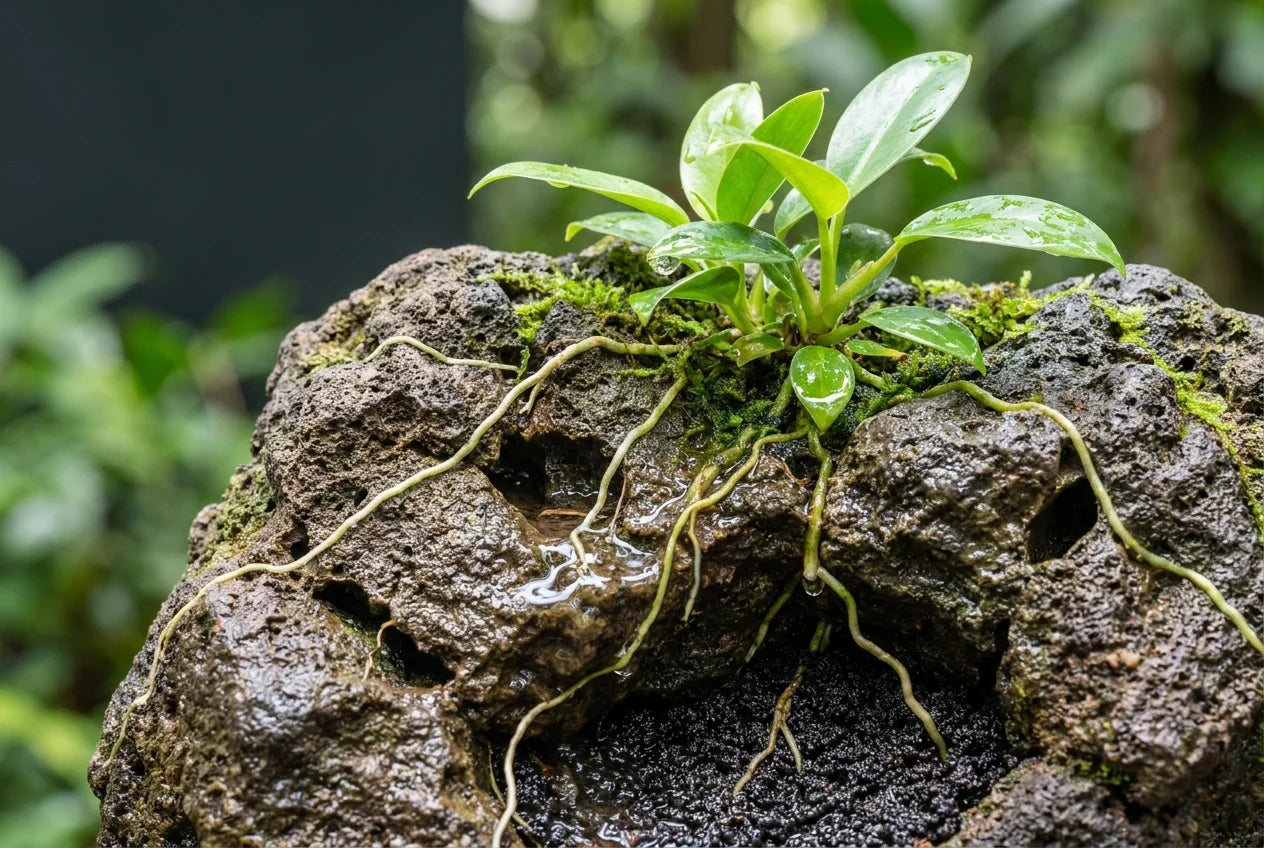
A root growing across a dripping piece of porous rock may remain wet almost all day.
A root buried in saturated fine soil may also remain wet all day.
Yet these two roots can experience very different environments.
One may continue receiving both moisture and oxygen. The other may be surrounded by water-filled pores where oxygen is replenished much more slowly.
This is why describing a planting position simply as “wet” can be misleading.
For plants, the important question is not only:
How much water is available?
It is also:
What is happening to the air and water immediately around the roots?

Two Roots, Both Constantly Wet
Imagine two plants.
The first is growing on a porous rock beside a continuously dripping paludarium wall. Water moves across the surface and into small pores in the stone. The root follows the damp surface, entering cracks and cavities along the way.
The second is planted in a pocket of fine substrate at the bottom of the same paludarium. The substrate has become completely saturated.
If we touched either location, we might describe both as constantly wet.
But physically, they are not the same.
Around the rock-grown root, water may exist as films coating mineral surfaces while larger cavities remain connected to the surrounding air. Water can also move through and across the rock rather than remaining trapped.
Inside saturated fine substrate, many of the spaces between particles may instead be filled with water.
That difference changes how easily oxygen can reach the root.
Water Availability Is Not Oxygen Availability
Roots need water, but living root tissues also respire.
They consume oxygen to release energy needed for processes such as nutrient uptake, growth and cellular maintenance.
In an aerated substrate, oxygen from the atmosphere can diffuse through interconnected air spaces and continually replenish the root zone.
Once those spaces become filled with water, gas exchange becomes much slower.
The problem therefore isn't simply that the root is too wet.
The problem is that prolonged saturation can remove much of the air-filled pore space through which oxygen would otherwise move.
This gives us an important distinction:
Wetness describes water availability.
Waterlogging describes a condition in which prolonged saturation restricts normal gas exchange within the root zone.
The two are related, but they are not interchangeable.

A Wet Surface Can Still Contain Air
A porous rock can hold surprising amounts of water without behaving like a container filled completely with water.
Look closely at a rough piece of volcanic rock and its structure is irregular.
There are large cavities, tiny pores, cracks, channels and exposed mineral surfaces.
Water can move through some of these spaces by gravity and capillary action. It can also remain as thin films around particles and pore walls.
At the same time, other spaces may remain filled with air.
This creates an environment where water and air can exist very close together.
A fine root growing across this surface can therefore encounter continuous moisture without necessarily being sealed inside a completely saturated medium.
This helps explain why some plants can thrive attached to persistently damp rock, wood or other porous surfaces even though the same plants may struggle when buried deeply in dense, saturated substrate.
It isn't because their roots somehow prefer being “overwatered.”
Their roots are experiencing a different physical environment.
What Changes When Fine Substrate Becomes Saturated?
Now consider a fine substrate.
Between every substrate particle is a small space called a pore.
When the substrate is relatively aerated, some pores contain water while others contain air.
As more water enters, increasingly small pores become filled.
Eventually, under sustained saturation, most of the connected pore space can become occupied by water.

The root may still have abundant water.
What it begins losing is rapid access to oxygen.
Oxygen can dissolve in water, so saturated substrate is not necessarily instantly oxygen-free. But oxygen moves through water far more slowly than through air.
Meanwhile, oxygen is continuously being consumed.
Roots respire.
Microorganisms respire.
Decomposing organic matter can further increase oxygen demand.
If oxygen is being consumed faster than it can be replenished, the root zone becomes increasingly oxygen-poor.
This is why a plant can suffer in saturated substrate even though lack of water is clearly not the problem.
Porosity Alone Isn't Enough
It is tempting to turn this into another simple rule:
Porous rock is good. Fine soil is bad.
But that would also be misleading.
A material can be highly porous and still become poorly aerated if its pores remain completely saturated or become disconnected from fresh air or renewed water.
Likewise, a coarse substrate can gradually clog with fine particles and decomposing organic material.
What matters is not simply whether pores exist.
It is whether those pores are:
- large or small,
- filled with air or water,
- interconnected,
- exposed to the atmosphere,
- connected to moving water,
- or isolated inside a stagnant saturated zone.
This is why the same material can behave differently depending on where it is used.
A piece of porous rock sitting above the waterline and continuously wicking moisture can have a very different internal environment from the same rock buried beneath stagnant water and organic sediment.
Moving Water Changes the Situation Again
There is another reason we should not equate wetness with waterlogging.
Not all water is equally stagnant.
Consider a root growing beside a stream, seep or waterfall.
The root may remain continuously wet. Parts of it may even remain submerged for long periods.
But the surrounding water is being renewed.
Fresh water can bring dissolved oxygen while metabolic products are carried away.
That is very different from water trapped inside a poorly connected pocket of saturated substrate.
This does not mean that moving water automatically guarantees an oxygen-rich root zone. Temperature, organic load, flow rate, depth and the structure of the substrate still matter.
But it demonstrates why the statement “the roots are always wet” tells us surprisingly little about the actual conditions experienced by the plant.

Nature Rarely Divides Roots Into Simply Wet or Dry
Natural habitats contain many environments that would appear permanently overwatered by conventional gardening standards.
Along stream margins, roots may grow through saturated gravel.
On seepage faces, plants can remain attached to rock that rarely dries completely.
Rheophytic plants may grow in cracks where water repeatedly passes across their roots.
Riverbank plants may experience changing water levels that alternately expose and submerge portions of the root system.
In these habitats, the important variables are not simply wet versus dry.
They include the structure of the material, water movement, oxygen supply, depth, seasonal changes and how much of the root system remains connected to the atmosphere.
This is useful when designing planted enclosures because paludariums and ripariums recreate many of these boundaries on a much smaller scale.
A Paludarium Can Contain Several Kinds of “Wet”
Consider a single paludarium.
At the top of a rock wall, porous stone may wick water upward while remaining largely exposed to humid air.
Lower down, water may continuously trickle across the surface.
Beside the waterline, coarse substrate may remain saturated but still interact with moving water.
Inside a deep soil pocket, however, fine material may remain completely saturated with little circulation.
At the lowest point, decomposing organic matter may accumulate in persistently stagnant conditions.
Every one of these locations could reasonably be described as wet.
Yet they are not equivalent planting zones.

This changes how we should think about planting a paludarium.
Instead of asking:
“Does this plant like wet conditions?”
ask:
“What kind of wet conditions will its roots experience here?”
That is a much more useful question.
Terrariums Have the Same Problem
The distinction also matters in terrariums.
A porous rock positioned partly above a moist substrate or shallow reservoir may continuously wick water upward.
Mosses and suitable plants growing on its upper surface can therefore receive persistent moisture without being buried in saturated soil.
A planting pocket filled with fine organic substrate can behave very differently.
If water continually enters that pocket faster than it can leave, air-filled pore space decreases.
The surface may look perfectly healthy while conditions deeper around the roots become increasingly oxygen-poor.
This is one reason judging moisture only by looking at the substrate surface can be unreliable.
The root experiences the conditions inside the planting medium, not what we see through the glass.
Riparium Roots Can Be Permanently Wet
Ripariums make the distinction even clearer.
Many riparian and emergent plants naturally grow with roots extending into water while their stems and leaves remain above it.
Their roots being permanently wet is therefore not automatically a problem.
Species adapted to these environments may possess anatomical and physiological adaptations that help them tolerate or transport oxygen through flooded tissues.
The surrounding water conditions also matter.
Roots suspended in open, oxygenated water experience a different environment from roots buried beneath compact, organic-rich sediment—even though both are underwater.
So again:
Submerged does not automatically mean waterlogged in the same functional sense, and permanently wet does not automatically mean oxygen-starved.
The root environment has to be considered as a whole.
A Planting Zone Can Change With Time
There is another complication that becomes important in mature systems.
A planting area that begins porous does not necessarily stay porous.
Fine particles migrate.
Roots grow and die.
Leaves decompose.
Biofilms develop.
Organic debris settles into cavities.
Over time, material can accumulate between larger substrate particles and gradually reduce the size and connectivity of the pore spaces.

A coarse planting pocket that originally allowed good exchange can slowly become denser.
Water may continue entering exactly as it did before.
But the root environment has changed.
This helps explain why a planting method can work successfully for months or years and then gradually become less forgiving even though the keeper has not dramatically changed the watering routine.
Sometimes the problem isn't more water.
It is less effective pore space.
How to Read a Planting Position
When choosing where to place a plant in a terrarium, paludarium or riparium, don't stop at deciding whether the location is dry, moist or wet.
Look at how the location actually functions.
Where is the water coming from?
Is it being sprayed onto the surface?
Wicked upward through porous material?
Flowing continuously past the roots?
Rising from a saturated zone below?
Or simply collecting because it has nowhere else to go?
What is the root growing through?
A root attached to rough rock experiences a different physical structure from one buried in fine peat-rich soil.
Coarse mineral substrate, porous rock, sphagnum, clay and fine organic substrate all create different combinations of water retention and pore space.
Can air still reach the root zone?
A constantly damp surface exposed to humid air is fundamentally different from a deeply buried saturated pocket.
Is the water being renewed?
Flow and exchange can help replenish dissolved oxygen.
Stagnant water surrounded by decomposing organic matter can move in the opposite direction.
What will happen six months from now?
Consider where sediment, dead roots and organic debris are likely to accumulate.
A planting zone should be understood not only when it is newly built, but also as it matures.
Don't Design for “Wet” or “Dry”
It is easy to reduce plant care to simple labels.
Keep this plant moist.
Don't overwater that one.
This species likes wet conditions.
Those descriptions can be useful starting points, but they hide much of what roots actually experience.
A better way to design a planting environment is to think about water and air together.
Can the root obtain enough water?
Can oxygen still reach the root tissues?
Does the structure preserve connected pore space?
Can water move or drain?
Will organic accumulation eventually change those conditions?
Once we start asking these questions, some apparently contradictory observations make much more sense.
A root can remain wet on porous rock and thrive.
Another can sit in equally wet fine substrate and decline.
The difference isn't necessarily how much water the plant received.
It is what that water did to the environment around the root.
The Takeaway
Constantly wet and waterlogged are not synonyms.
Roots can experience continuous moisture while remaining connected to air-filled pores, exposed surfaces or renewed oxygenated water.
Problems arise when saturation restricts oxygen replenishment faster than the root zone can tolerate.
So when deciding whether a planting position is suitable, don't ask only:
“Is it too wet?”
Ask:
“Where is the water—and where is the oxygen?”
Because for roots, the opposite of waterlogged isn't dry. It's aerated.


