
Why Add Springtails to Bioactive Setups?
This guide is created by Green Chapter — Nature Workshop Studio, where we focus on creating living ecosystems through hands-on experience. We share practical insights across terrariums, aquascaping, plants, and natural systems to help you build and care for your own.
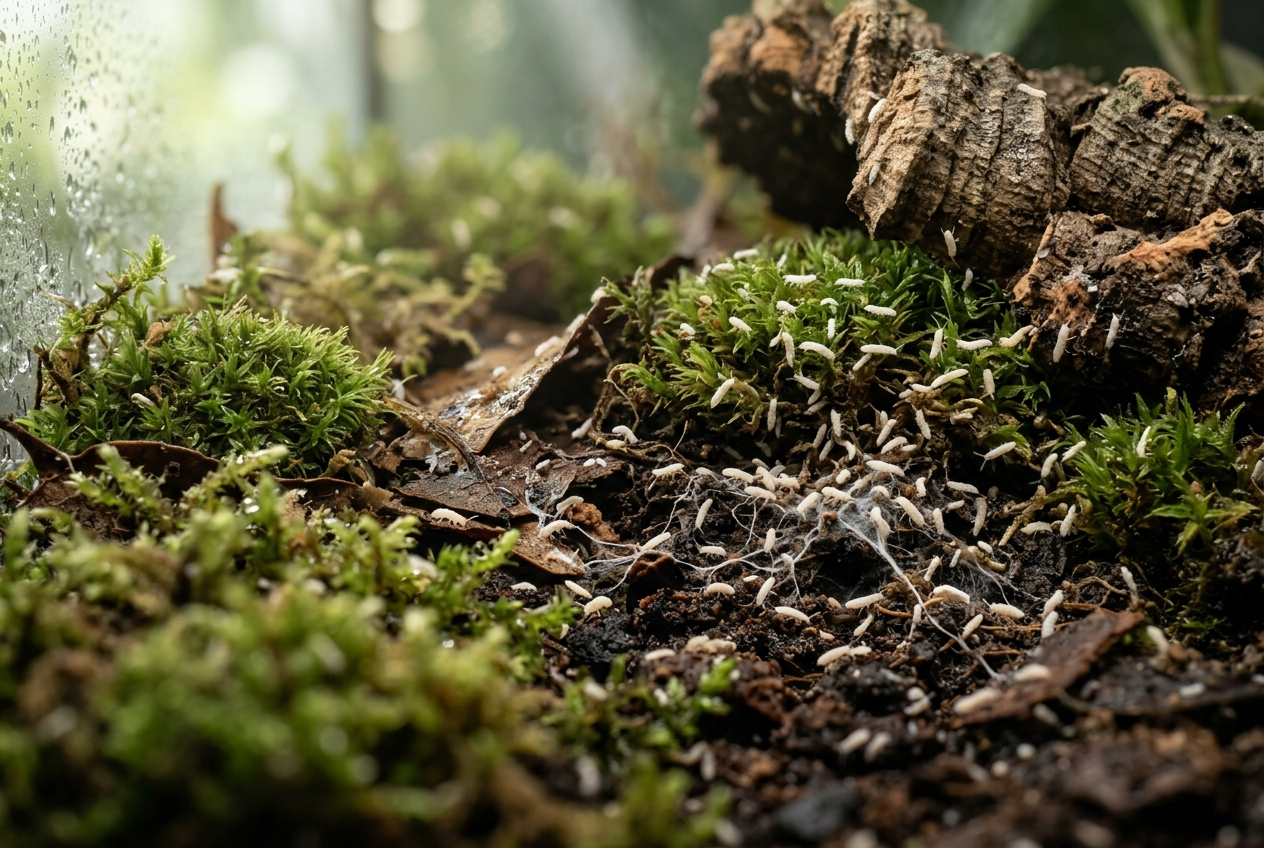
Why Add Them to Bioactive Setups?
When people first build a bioactive terrarium, most of the attention goes toward plants, wood, moss, or the animals inside the enclosure. But underneath the visible layers is an entire microscopic ecosystem constantly working to keep the environment stable.
This is where springtails become important.
Springtails are tiny soil-dwelling organisms that act as one of the main clean-up crew members inside a bioactive setup. While isopods handle larger debris such as dead leaves or leftover food, springtails focus on the microscopic waste layer that many beginners never notice until problems appear.
In humid terrariums especially, they quietly become one of the most valuable organisms in the entire enclosure.
What Do Springtails Actually Do?
Springtails constantly move through the substrate feeding on organic material that naturally builds up in moist environments.
This includes:
- Mold spores
- Fungal growth
- Biofilm
- Decaying plant matter
- Tiny pieces of organic waste
Because of this, they help prevent many of the common issues that appear in enclosed humid terrariums.
Without a functioning micro clean-up crew, excess moisture and organic debris can slowly create unstable conditions over time.

Do Springtails Really Control Mold?
One of the biggest reasons hobbyists add springtails is for fungus and mold control.
The short answer is yes — they are highly effective.
However, it is important to understand how they work.
Springtails are not instant “mold removers.” Instead, they function more like a preventative maintenance system for the terrarium. They constantly graze on fungal spores and early mold growth before it spreads across the enclosure.
This becomes especially useful during the early stages of a new terrarium.
Fresh wood, moist substrate, and high humidity often trigger temporary white mold blooms while the ecosystem stabilizes. A healthy springtail colony helps keep these outbreaks under control naturally by feeding on the mold before it fully spreads.
In many setups, this is enough to prevent the enclosure from becoming visually overrun.

They Work Best as Prevention, Not Emergency Cleanup
Springtails are incredibly effective at maintaining balance, but they do have limits.
If an enclosure is already heavily covered in thick mold or decaying waste, a small starter colony may struggle to catch up immediately. In those situations, manual cleanup is still important before allowing the springtails to maintain the environment afterward.
Their real strength is long-term ecosystem stability.
A healthy population continuously processes waste before major problems develop.
Why They Matter More in Tropical Terrariums
Warm and humid environments naturally encourage fungal activity. This is why springtails are considered almost essential in many tropical bioactive setups.
In rainforest-style enclosures, organic material breaks down faster due to constant moisture and heat. Without enough biological activity inside the substrate, the enclosure can slowly become stagnant.
Springtails help reduce this by:
- Breaking down excess organic material
- Reducing fungal buildup
- Keeping the substrate biologically active
- Supporting healthier moss growth
- Preventing stale wet zones
Over time, this creates a cleaner and more balanced ecosystem overall.

They Also Improve Soil Health
Springtails do more than just consume mold.
As they move through the substrate, they help aerate the soil by creating tiny pathways between substrate particles. This reduces compaction in constantly moist setups and improves airflow within the lower substrate layers.
At the same time, their feeding activity helps break organic waste into smaller nutrients that can be reused by plants and mosses.
In a healthy bioactive enclosure, springtails become part of the nutrient cycling system that keeps the terrarium functioning naturally over time.
Tropical vs Temperate Springtails
Not all springtails behave the same way.
For warm bioactive terrariums, tropical springtails are usually the better option because they are adapted for higher temperatures and humidity levels.
Popular tropical species include:
- Tropical White Springtails
- Tropical Pink Springtails
- Red Thai Springtails
- Orange Yuuki Springtails
These species thrive in environments around 24–30°C and continue reproducing actively in tropical conditions where temperate springtails may slow down or decline.
This makes tropical varieties especially suitable for:
- Dart frog terrariums
- Tropical moss setups
- High-humidity vivariums
- Warm isopod enclosures
- Tropical plant terrariums

Are Springtails Necessary?
Technically, a terrarium can survive without springtails.
But in most humid bioactive setups, they significantly improve long-term stability and reduce many common beginner problems.
They help control mold before it spreads, keep the substrate active, recycle organic waste, and support a healthier ecosystem overall.
They may be tiny and mostly hidden beneath the surface, but in many bioactive terrariums, springtails quietly become one of the most important organisms holding the entire system together.


