
Understanding Humidity Needs in a Bioactive Terrarium
This guide is created by Green Chapter — Nature Workshop Studio, where we focus on creating living ecosystems through hands-on experience. We share practical insights across terrariums, aquascaping, plants, and natural systems to help you build and care for your own.
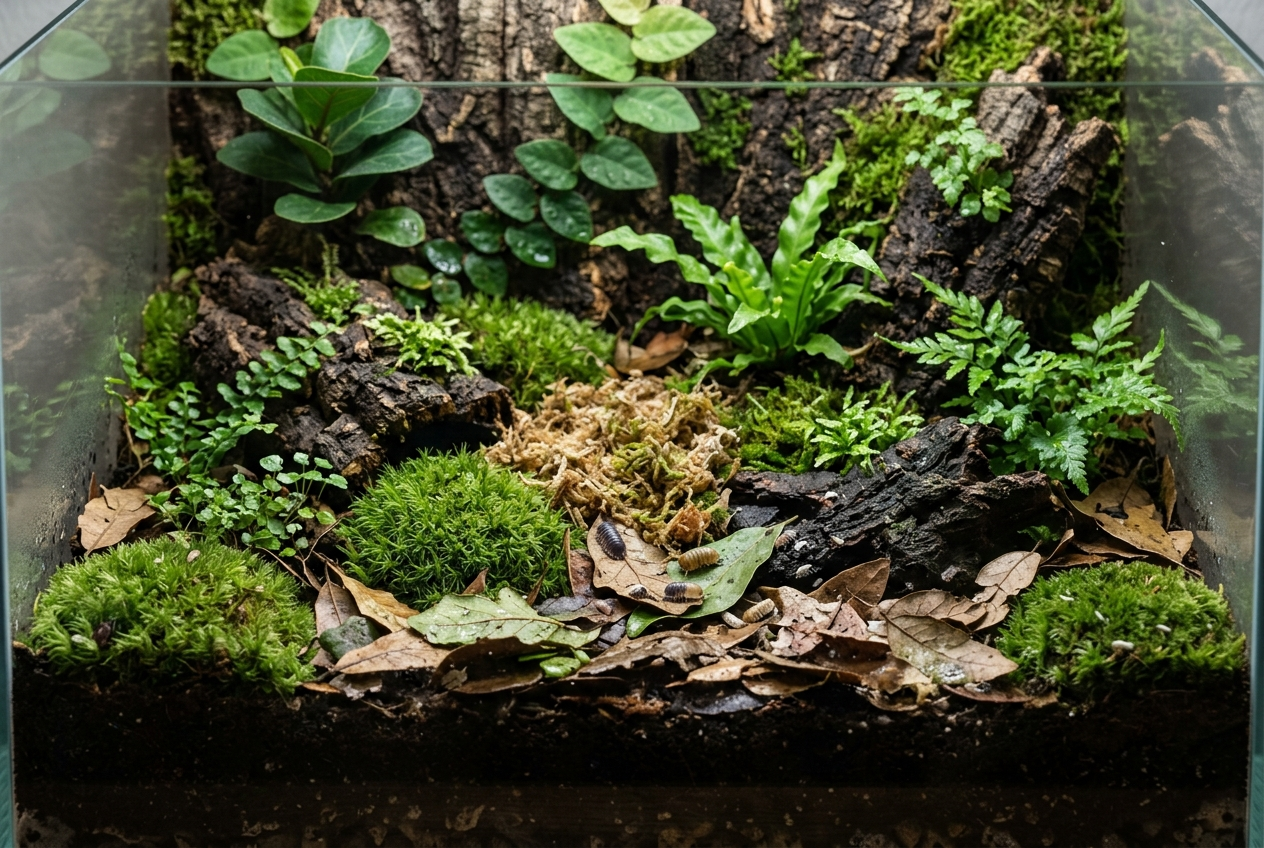
A bioactive terrarium is more than a planted container. It is a living ecosystem where plants, microorganisms, isopods, and springtails all rely on stable environmental conditions to function properly together.
Among all these conditions, humidity is one of the most important — and also one of the most misunderstood by beginners.
Many people assume that a humid terrarium should always look wet, fogged up, or covered in condensation. In reality, healthy humidity management is less about making the enclosure constantly wet and more about creating stable moisture conditions that support life over time.
For most tropical bioactive terrariums designed around isopods and springtails, the ideal humidity range usually falls between 60% and 90%, depending on the species being kept and the enclosure design.
The key is not simply “high humidity,” but balanced humidity.
Why Humidity Matters in a Bioactive Terrarium
Humidity affects almost every part of the ecosystem.
Isopods and springtails are especially sensitive because both rely heavily on moisture to survive.
Isopods are terrestrial crustaceans. Even though they live on land, they still depend on modified gill-like breathing structures that must remain moist to function properly. If the environment becomes too dry for long periods, they struggle to breathe, fail to molt correctly, and become stressed very quickly.
Springtails are even more moisture-dependent. Most tropical species require consistently damp conditions to survive and reproduce. If the enclosure repeatedly dries out, the colony can crash surprisingly fast.
Humidity also influences:
- microbial activity in the substrate
- decomposition of waste and leaf litter
- moss growth
- plant hydration
- overall ecosystem stability
Without stable moisture, the bioactive cycle begins to weaken.

Humidity Does Not Mean Soaking Wet
One of the most common beginner mistakes is overwatering the enclosure.
A healthy bioactive terrarium should feel humid, but not flooded.
When the entire enclosure becomes constantly waterlogged:
- oxygen levels in the substrate drop
- roots struggle to breathe
- mold can become excessive
- stagnant conditions develop
- cleanup crews avoid overly saturated areas
Many successful bioactive terrariums actually appear relatively normal from the outside. The glass may not always be fogged up, and the substrate surface may even look slightly dry in some areas.
What matters most is the moisture retained deeper within the enclosure.
The goal is long-term stability — not permanent wetness.
Understanding the Moisture Gradient
Rather than keeping the entire terrarium evenly wet, experienced keepers usually create what is known as a moisture gradient.
This means:
- one side stays more damp
- another side remains slightly drier
- the cleanup crew can move freely between these conditions
This is extremely important because isopods naturally self-regulate by moving between moisture zones depending on their needs.
A common setup includes:
- a damp sphagnum moss corner
- moist substrate beneath cork bark
- drier leaf litter zones elsewhere in the enclosure
This creates natural environmental variation while still maintaining overall humidity.
Sphagnum moss is commonly used because it holds moisture very effectively without immediately becoming stagnant.
Instead of forcing a single condition throughout the tank, the terrarium becomes a small ecosystem with multiple microclimates.

Ventilation and Humidity Must Work Together
Humidity alone is not enough.
A terrarium also needs airflow.
Without ventilation, stagnant air can lead to:
- fungal outbreaks
- sour substrate conditions
- excessive condensation
- unhealthy bacterial buildup
This is why most bioactive enclosures include some form of ventilation, such as:
- mesh panels
- cross ventilation holes
- partial mesh tops
- ventilation strips
However, too much airflow can create the opposite problem.
Enclosures with excessive ventilation often dry out too quickly, especially in air-conditioned environments. Tropical springtails and moisture-loving isopods may struggle unless moisture is constantly replenished.
The healthiest setups balance:
- moisture retention
- airflow
- evaporation
- substrate hydration
Good humidity management is really about finding equilibrium between these factors.
Misting vs Deep Moisture Retention
Many beginners rely only on misting.
While misting helps temporarily increase humidity, it mainly affects the surface layer of the enclosure.
Light misting is useful for:
- refreshing moss
- raising humidity temporarily
- hydrating surface leaf litter
- simulating rainfall cycles
But deeper substrate moisture is what provides long-term stability.
This is why experienced keepers occasionally add water directly into:
- moss corners
- lower substrate zones
- drainage-supported areas
This keeps the lower substrate layers humid even after the surface begins drying slightly.
In mature bioactive terrariums, the deeper substrate often remains moist and biologically active even when the top layer looks relatively dry.

Monitoring Humidity as a Beginner
Experienced keepers often judge humidity by observing:
- condensation patterns
- moss texture
- substrate color
- springtail activity
- isopod behavior
But for beginners, using a hygrometer can make humidity management much easier.
A hygrometer helps prevent:
- accidental over-drying
- excessive saturation
- unstable humidity swings
As a general guideline:
| Humidity Condition | Common Result |
|---|---|
| Below 60% for long periods | Dry substrate, stressed isopods, declining springtail populations |
| 70–90% stable humidity | Ideal range for most tropical bioactive systems |
| Constantly soaked enclosure | Stagnant substrate, root problems, excessive mold growth |
Different species may still prefer slightly different conditions, but stable humidity is usually far more important than chasing exact numbers.
Stability Is the Real Goal
A healthy bioactive terrarium does not need to constantly look wet.
In fact, many mature systems appear surprisingly balanced:
- humid underneath
- breathable above
- moist without becoming swampy
When humidity, airflow, substrate composition, and moisture retention work together properly, the enclosure begins functioning like a true ecosystem instead of simply a planted container.
That stability is what allows isopods, springtails, microorganisms, and plants to thrive together long-term.
Final Thoughts
Humidity is one of the foundational elements of a successful bioactive terrarium.
Too dry, and the cleanup crew struggles to survive. Too wet, and the enclosure becomes stagnant and unstable.
The goal is not maximum moisture, but controlled and balanced humidity supported by:
- proper substrate composition
- moisture gradients
- ventilation balance
- consistent maintenance habits
Once these conditions stabilize, the bioactive system becomes far more resilient, active, and self-sustaining over time.


