
The Roles of Isopods and Springtails in Nature
This guide is created by Green Chapter — Nature Workshop Studio, where we focus on creating living ecosystems through hands-on experience. We share practical insights across terrariums, aquascaping, plants, and natural systems to help you build and care for your own.
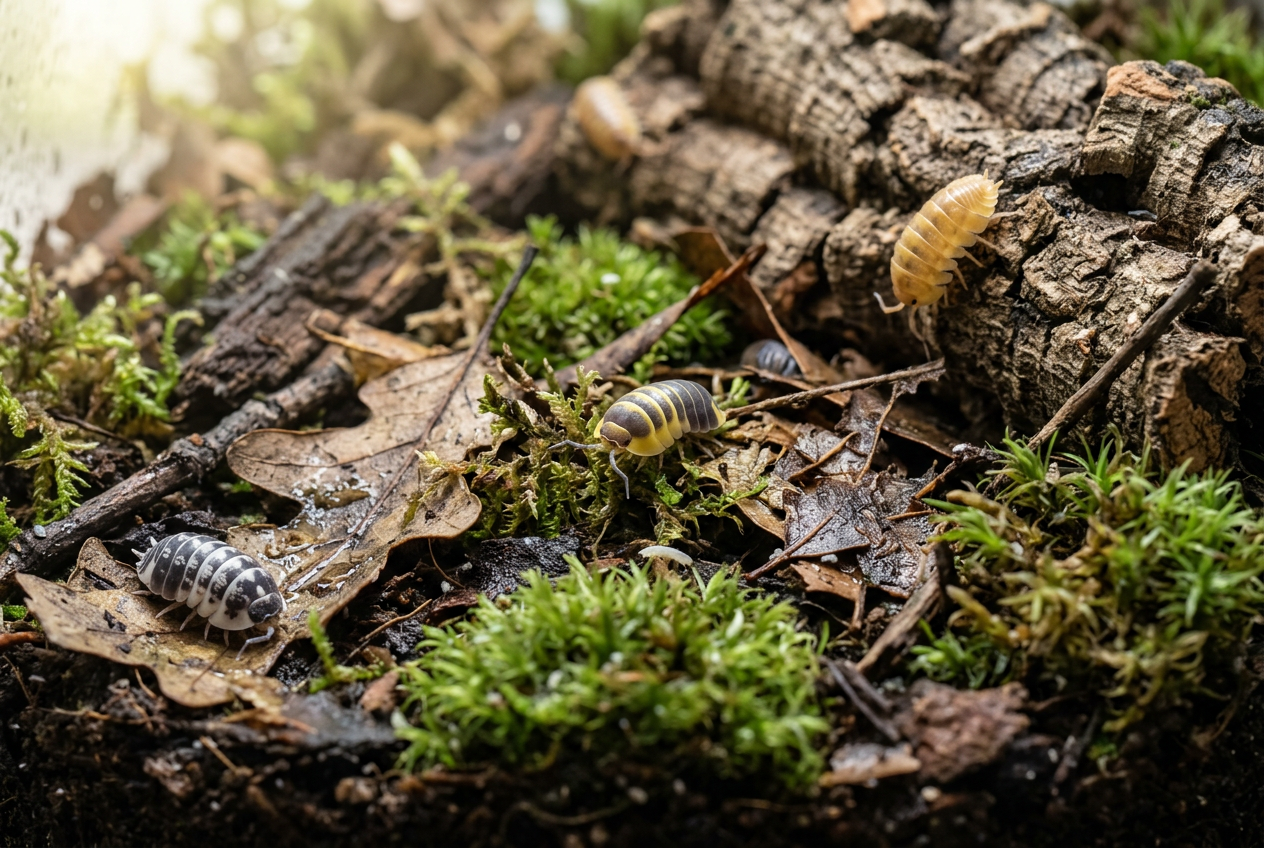
To many people, isopods are simply cute little creatures hiding beneath leaves and wood. Kids often describe them as “mini armored tanks” or “land shrimps,” while springtails are usually noticed as tiny white dots jumping through the soil.
But in nature, these small organisms are far more important than they appear.
Together, isopods and springtails form part of the natural cleanup system that keeps forests, soil, and ecosystems functioning properly. Without them, dead leaves, waste, mold, and decaying matter would slowly pile up across the environment.
For educators, parents, and beginner hobbyists, understanding their role often changes how people see bioactive terrariums entirely. Instead of just keeping tiny creatures in a container, you begin observing a miniature ecosystem constantly recycling and sustaining itself.

Nature’s Cleanup Crew
In forests and natural habitats, plants and animals constantly produce waste.
Leaves fall. Wood decays. Animals shed skin. Organic matter breaks down. Tiny fungi and bacteria spread through the soil.
If nothing processed this material, ecosystems would quickly become overwhelmed with debris.
This is where decomposers become essential.
Isopods and springtails belong to a larger group of organisms responsible for recycling organic matter back into the environment. Together, they help transform dead material into usable nutrients that plants and microorganisms can absorb again.
This continuous recycling process is one of the foundations of healthy ecosystems.
Isopods — The Heavy Lifters of the Forest Floor
Isopods specialize in handling larger organic debris.
Scientists classify them as detritivores, meaning they feed primarily on decaying organic matter. Using surprisingly strong mouthparts, they slowly break down materials that many smaller organisms cannot process efficiently on their own.
Their diet often includes:
- Dried leaves
- Decaying wood
- Moss
- Vegetable matter
- Animal waste
- Shed skin and exoskeletons
- Dead insects and organic debris
As they chew through larger materials, they fragment them into much smaller particles. This mechanical breakdown becomes incredibly important because it allows fungi, bacteria, and other microorganisms to continue decomposing the material further.
Without decomposers like isopods, forest floors would slowly accumulate thick layers of undecomposed waste.
In bioactive terrariums, isopods continue performing this same role on a miniature scale, helping keep the enclosure cleaner and more stable over time.

Springtails — Tiny Specialists in Sanitation
Springtails are much smaller and often harder to notice, but they are equally important.
Unlike isopods, springtails focus on microscopic waste and fungal growth. They thrive in moist environments where decomposition naturally occurs.
Their diet commonly includes:
- Mold
- Fungal spores
- Biofilm
- Microscopic organic particles
- Bacteria-rich decaying matter
Because of this, many hobbyists affectionately call them “mold police.”
In humid terrariums and natural forest soil, mold growth appears constantly as organic material breaks down. Left unchecked, excessive fungal growth can destabilize environments and create unhealthy conditions.
Springtails help manage this naturally by continuously grazing on fungal growth before it spreads aggressively.
For many terrarium keepers, springtails are one of the key reasons bioactive systems can remain balanced over long periods.

Why Isopods and Springtails Work Together So Well
One fascinating aspect of nature is that these organisms rarely compete directly with one another.
Instead, they operate at different scales within the same ecosystem.
Isopods process larger debris:
- leaf litter
- wood
- decaying plant material
Springtails handle the microscopic layer:
- fungal growth
- mold spores
- tiny organic particles
As isopods break materials into smaller fragments, springtails continue processing the remaining micro-waste and fungal growth that follow.
This creates a layered decomposition system that mirrors how real forests naturally recycle nutrients.
It is one of the reasons healthy bioactive terrariums often contain both organisms together rather than individually.
Soil Builders Beneath the Surface
Beyond decomposition, both isopods and springtails actively improve soil quality.
As they move through the substrate, they naturally:
- loosen compacted soil
- improve airflow
- assist water drainage
- help oxygen reach plant roots
Their waste, known as frass, also becomes nutrient-rich organic matter that plants and microorganisms can use.
In nature, this nutrient cycling supports long-term ecosystem stability. Forests remain fertile not because waste disappears, but because countless decomposers continuously recycle nutrients back into the environment.
Even inside small terrariums, these same biological processes continue happening quietly beneath the surface.

Natural Mold and Pest Suppression
Another important role of springtails and isopods is helping suppress unwanted outbreaks before they become severe.
By rapidly consuming decaying matter and fungal growth, they reduce the resources available for:
- fungus gnats
- excessive mold growth
- harmful bacterial buildup
- certain unwanted mites
This does not mean they completely eliminate every problem, but they help ecosystems stabilize naturally over time.
In many bioactive systems, they quietly form the foundation of long-term cleanliness and environmental balance.
An Important Part of the Food Web
In nature, isopods and springtails are not only decomposers — they are also an important food source.
Many animals depend on them as part of the natural food chain, including:
- frogs
- small reptiles
- predatory insects
- spiders
- centipedes
- small forest creatures
Because they reproduce efficiently and recycle nutrients quickly, they help transfer energy upward through ecosystems.
Although tiny, they support much larger life forms around them.
Why They Fascinate Children and Educators

One reason isopod terrariums have become increasingly popular in homes and classrooms is because they naturally encourage curiosity.
Children begin observing:
- how decomposition works
- why forests stay clean
- how nutrients return to the soil
- the relationship between plants, fungi, and animals
- how ecosystems balance themselves naturally
Unlike fast-moving pets that are difficult to observe closely, isopods encourage slower exploration and observation.
Over time, kids may notice:
- tiny baby isopods appearing
- leaves slowly disappearing
- mold blooms forming and being consumed
- springtail populations increasing
- moss responding to humidity changes
The enclosure slowly becomes a living science lesson.
For many educators and parents, this is what makes bioactive ecosystems so engaging — they quietly teach ecology through observation rather than memorization.
More Than Just Tiny Bugs
At first glance, isopods and springtails may seem insignificant.
But beneath the soil, they are constantly performing some of nature’s most important work.
They recycle waste.
They enrich soil.
They suppress mold.
They support plant growth.
They help ecosystems remain balanced.
Whether in a rainforest, beneath fallen leaves in a garden, or inside a terrarium at home, these tiny cleanup crews are always working behind the scenes.
And once you begin understanding their role, it becomes much easier to see why so many people become fascinated by them.


