
The Science of Micro-Ecosystems: A Guide to Mineral-Based Springtail Culturing
This guide is created by Green Chapter — Nature Workshop Studio, where we focus on creating living ecosystems through hands-on experience. We share practical insights across terrariums, aquascaping, plants, and natural systems to help you build and care for your own.
Springtails are the essential "cleanup crew" of any bioactive system, recycling waste into nutrients and preventing mold outbreaks. However, traditional soil-based cultures often suffer from compaction and "sour" anaerobic bacteria.
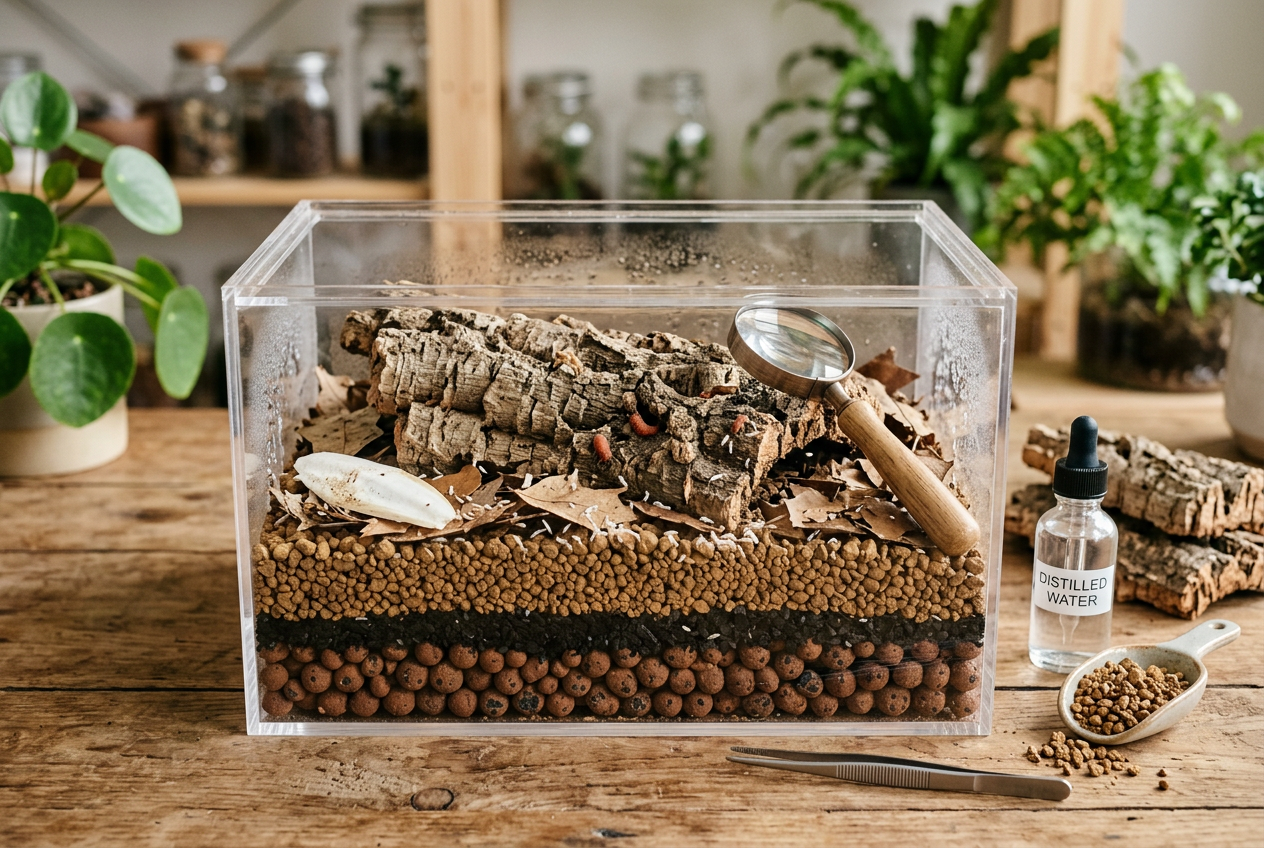
To solve this, many professional keepers have moved toward a Mineral-Based Master Culture. This system uses volcanic clays and drainage stones to create a more stable, sterile, and high-yielding environment. In this guide, we will break down the science behind this method using the components found in our Springtail Master Culture Kit—a professional-grade setup designed for both common White and sensitive Red Gummy species.
1. The Physics of Drainage
In a small, enclosed environment, water management is the biggest challenge. If the substrate is too wet, the springtails drown; too dry, and they desiccate.
The Science: Using a coarse bottom layer creates a "water table." This allows for high humidity without saturating the upper layers where the springtails live.
|
📦 Inside the Kit: Pour the Mini LECA (clay pebbles) into your acrylic container first. This creates the essential 1-inch drainage zone that keeps your culture from ever becoming "muddy." |
2. Chemical Filtration & Humidity

As springtails eat and reproduce, they release CO2 and waste. In a sealed container, this can lead to a population "crash."
The Science: Activated Charcoal acts as a molecular sieve, trapping impurities and odors. Meanwhile, Akadama (a Japanese volcanic clay) wicks moisture upward, providing a massive, mineral-rich surface area for the springtails to roam.
|
📦 Inside the Kit Layer the Activated Charcoal Chips over the LECA, then top with the Akadama. Add distilled water until it hits the top of the LECA—the Akadama will automatically wick up the perfect amount of moisture. |
3. Biological Security (Sterilization)
Wild-harvested materials often carry mites or fungus gnat larvae that can quickly outcompete your springtails.
The Science: Thermal sterilization (baking) is the only way to ensure your culture remains a "monoculture" (only the species you want).
|
📦 Inside the Kit Before setup, follow the Pre-Setup Pro-Tip in your manual to "flash-bake" the included Cork Bark and Leaf Litter. This guarantees your springtails have no competition from wild pests. |
4. Specialized Nutrition & Molting
Springtails don't just need calories; they need minerals. To grow their exoskeletons, they require a constant source of calcium.
The Science: A lack of calcium is a leading cause of slow breeding rates. Providing a slow-release mineral source ensures every generation is stronger than the last.
|
📦 Inside the Kit: Place the Cuttlefish Bone near the bark. Use your Magnifying Glass after a few days—you’ll likely see the springtails congregating there to "recharge" their calcium levels. |
5. Managing Photophobic Species
Species like the Red Gummy are highly sensitive to light. In a bare container, they will become stressed and stop breeding.
The Science: Providing "visual cover" is essential. Deep-ridged bark allows them to hide in total darkness while remaining in a high-humidity zone.

|
📦 Inside the Kit Position the Cork Bark rough-side down. This creates the "dark zone" Red Gummies love. To observe them without stress, lean the bark against the acrylic wall to create a side-view "window." |
Summary
By focusing on drainage, filtration, and behavioural needs, you can maintain a culture that produces for years. Our Springtail Master Culture Kit was engineered to provide all these scientific requirements in one box, taking the guesswork out of your cleanup crew's success.


