
What Is an Isopod (Really?)
This guide is created by Green Chapter — Nature Workshop Studio, where we focus on creating living ecosystems through hands-on experience. We share practical insights across terrariums, aquascaping, plants, and natural systems to help you build and care for your own.
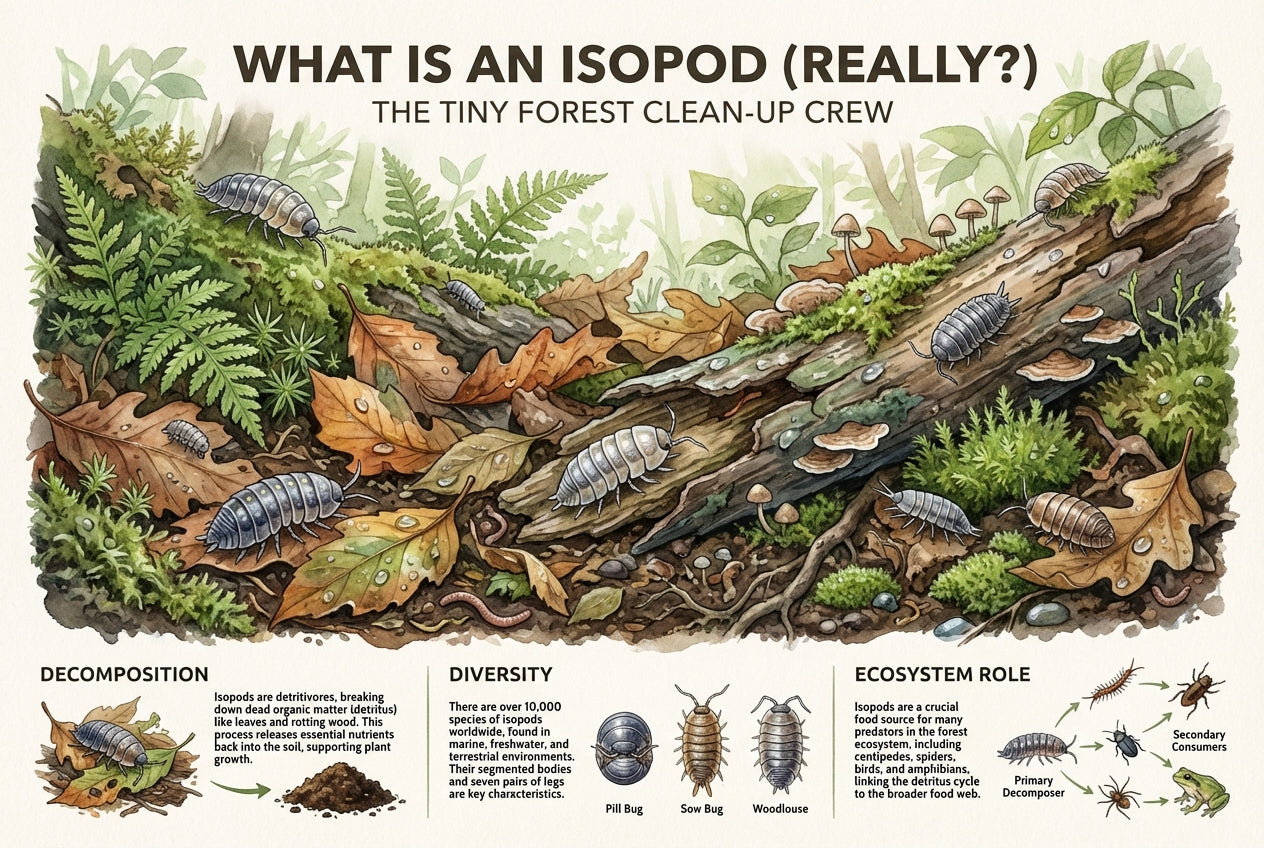
The Tiny Forest Clean-Up Crew Living Beneath Our Feet
Most people see isopods as small grey bugs crawling under leaves or inside terrariums. Some people even think they are pests. But in reality, isopods are one of the most important animals in the natural ecosystem. Without them, forests would slowly fill up with dead leaves, rotting wood, and organic waste.
Isopods are not insects. They are terrestrial crustaceans, which means they are related to shrimp, crabs, and lobsters. Millions of years ago, their ancestors lived in the ocean. Over time, they evolved to live on land, but they never fully left the water — they still breathe using gill-like organs, which means they must live in moist environments to survive.
In simple terms, isopods are like tiny land shrimp that live in the soil.
They are usually found:
- Under leaf litter
- Inside rotting wood
- Under bark
- Under stones
- In moss patches
- In humid soil
These environments are cool, dark, humid, and full of decaying organic matter — exactly the environment we should recreate in a terrarium.
The Role of Isopods in Nature — The Forest Recyclers

Isopods are detritivores, which means they eat dead and decaying organic matter. In nature, they feed on:
- Dead leaves
- Rotting wood
- Mold
- Dead plants
- Animal waste
- Occasionally dead insects
By eating decaying material, isopods break down waste into nutrient-rich soil, which plants can then use to grow. This makes them one of the most important recyclers in the forest ecosystem.
In other words, isopods turn waste into nutrients, and nutrients into new plant life.
If you look at a forest floor, there is a continuous cycle happening:
- Leaves fall from trees
- Leaves and wood begin to decay
- Isopods and fungi break down the material
- Nutrients are released into the soil
- Plants absorb nutrients and grow
- New leaves grow
- Leaves fall again
This is called the nutrient cycle, and isopods are a critical part of this system.
Without decomposers like isopods, dead organic matter would pile up, and the soil would slowly lose nutrients. Plants would not grow well, and the ecosystem would collapse.
This is why isopods are often called: The Clean-Up Crew of the Forest
Isopods Are Not Alone — They Are Part of a Community

In nature, isopods do not live alone. They live as part of a micro-ecosystem that includes many other organisms working together.
A typical soil ecosystem includes:
- Isopods — break down leaves and waste
- Springtails — eat mold and fungus
- Fungi — break down wood and organic matter
- Bacteria — break down waste into nutrients
- Moss and plants — absorb nutrients and retain moisture
- Soil microorganisms — maintain soil health
Together, these organisms form a self-sustaining ecosystem.
This is why isopods are commonly used in bioactive terrariums. They act as the clean-up crew, keeping the environment clean and balanced by breaking down waste and preventing mold from taking over.
A terrarium with isopods is not just a container with animals.
It is a living ecosystem.
How Isopods Breathe, Grow, and Molt

Because isopods evolved from aquatic animals, they still breathe using gill-like structures. These gills must stay moist in order for them to breathe properly. If the environment becomes too dry, they will lose moisture and eventually die.
This is why isopods always live in humid environments and why a terrarium must always have a moist area.
Isopods also grow in a very interesting way. Instead of growing slowly like mammals, they grow by molting, which means they shed their exoskeleton as they grow.
What makes isopods special is that they molt in two stages:
- First, they shed the back half of their shell
- A few days later, they shed the front half
During this period, they are very vulnerable, so they hide in moist areas under moss, bark, or soil. After molting, many isopods will eat their old shell to recycle calcium, which helps harden their new exoskeleton.
This is why isopods need:
- Moist areas
- Hiding places
- Calcium sources such as eggshell or cuttlebone
How Isopods Reproduce and Form Colonies

Isopods reproduce differently from insects. Female isopods carry their eggs in a brood pouch filled with fluid, similar to how some shrimp carry eggs.
Inside the pouch:
- Eggs are kept moist and protected
- Babies hatch into tiny isopods called mancae
- They look like miniature adults
- They live in the soil and grow slowly
- As the habitat becomes stable, the colony grows
If a terrarium has:
- Moist soil
- Leaf litter
- Rotting wood
- Calcium
- Stable humidity
The isopods will begin to breed naturally, and over time the colony will grow on its own. A healthy isopod colony is a sign that your terrarium ecosystem is stable and healthy.
Should You Add Isopods to Your Terrarium?

If you have a:
- Moss terrarium
- Closed terrarium
- Humid plant terrarium
- Paludarium
- Vivarium
Then the answer is yes — isopods are very beneficial.
Without isopods:
- Mold may grow
- Dead leaves and plant waste build up
- Soil becomes poor over time
- The ecosystem becomes unstable
With isopods:
- Waste is broken down
- Mold is controlled
- Nutrients are returned to the soil
- Plants grow better
- The terrarium becomes a balanced ecosystem
Adding isopods turns a terrarium from a decoration into a living ecosystem.
The Big Idea — What Is an Isopod, Really?
If you remember only one thing from this article, remember this:
Isopods are not pets.
They are ecosystem engineers.
They recycle nutrients, clean the environment, build soil, and support plant life. They are one of the most important organisms in the forest floor ecosystem.
When we keep isopods in a terrarium, we are not just keeping small animals — we are recreating a miniature forest floor, where waste becomes nutrients, and nutrients become new life.
And that is what makes isopods so fascinating.


