
What Do Isopods Eat?
This guide is created by Green Chapter — Nature Workshop Studio, where we focus on creating living ecosystems through hands-on experience. We share practical insights across terrariums, aquascaping, plants, and natural systems to help you build and care for your own.
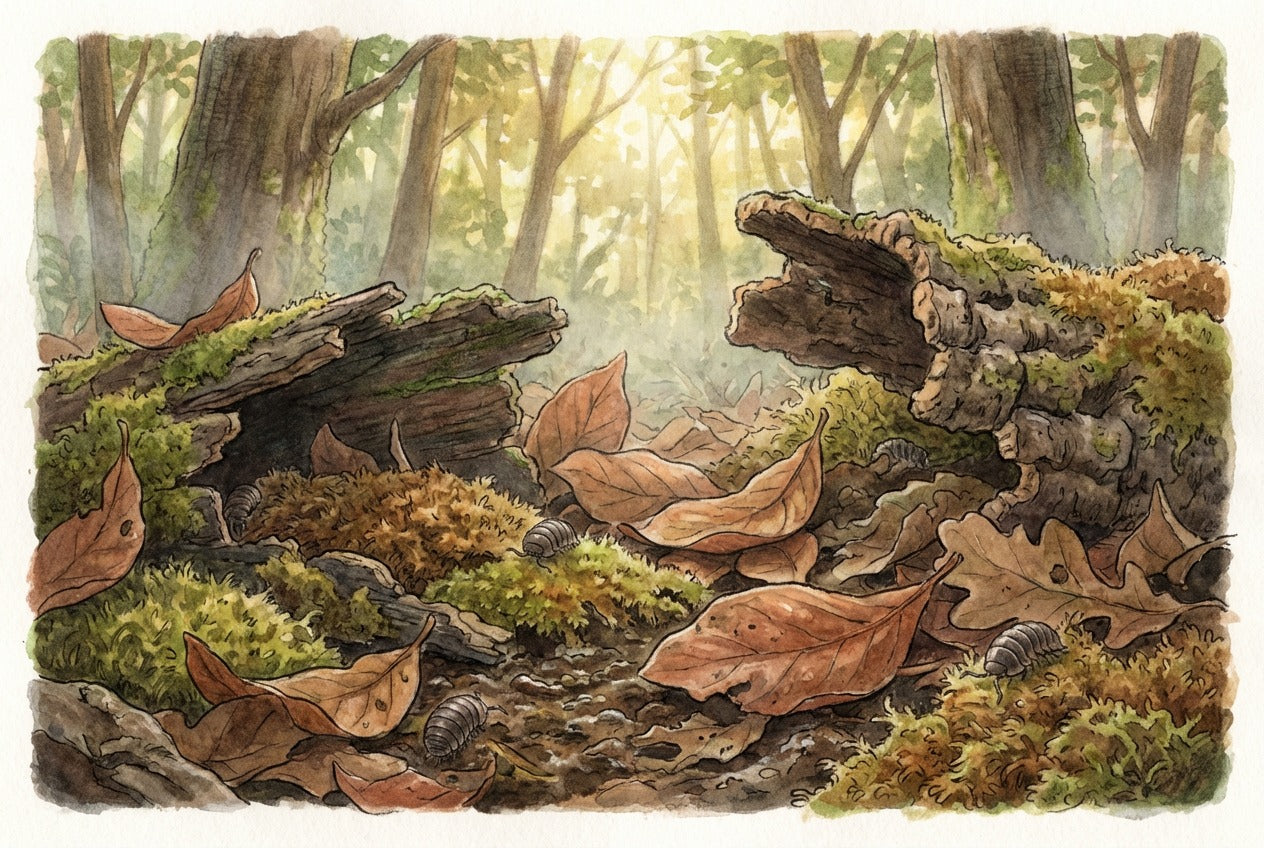
Understanding Nature’s Clean-Up Crew
Isopods are often seen as simple terrarium inhabitants, but they play a much bigger role than most people realize.
They are not plant eaters.
They are decomposers — organisms that break down dead material and recycle nutrients back into the ecosystem.
Understanding what isopods eat is the key to:
- Keeping them alive
- Helping them breed
- Maintaining a healthy terrarium
What Isopods Really Are (Detritivores)
Isopods are classified as detritivores, meaning they feed on dead and decaying organic matter.
In nature, they live on the forest floor where leaves fall, wood rots, and organic material breaks down. Their role is to:
- Break down leaf litter
- Consume rotting wood
- Feed on fungi and bacteria
- Recycle nutrients into the soil
Without decomposers like isopods, forests would be covered in layers of undecomposed plant matter.
Isopods are nature’s recycling system.

What Isopods Eat in the Wild
In natural environments, isopods feed on a wide variety of materials:
- Leaf litter (their main food source)
- Rotting wood
- Fungi
- Moss
- Algae
- Dead insects
- Animal waste
However, an important detail is often overlooked:
Isopods do not eat fresh leaves — they eat decomposing leaves.
Fungus and bacteria grow on fallen leaves and begin breaking them down. This process softens the material, making it digestible for isopods.
So in reality, isopods are feeding on:
- Decaying plant matter
- Microorganisms
- Organic waste

What Isopods Eat in a Terrarium
To keep isopods healthy in captivity, we need to replicate the forest floor.
A proper isopod diet includes five key components:
- Leaf litter — main food source
- Rotting wood — fiber and microbial growth
- Calcium — for exoskeleton development
- Protein — supports growth and breeding
- Vegetables — provides moisture and nutrients
A balanced setup ensures:
- Stable population
- Healthy molting
- Active colony behavior

Isopod Food Pyramid
A simple way to understand feeding is through a pyramid structure.
Main Diet (Majority)
- Leaf litter
- Rotting wood
Moderate Feeding
- Vegetables
- Calcium
Occasional Feeding
- Protein
- Fruits
Leaf litter should always be available in the enclosure.
Without it, isopods may:
- Eat moss
- Damage plants
- Compete for food
- Decline in population

How Isopods Actually Eat
Isopods do not chew hard material like insects or mammals.
Instead, they rely on a natural process:
- Leaves fall and begin to decay
- Fungus and bacteria soften the material
- Isopods scrape and consume the softened surface
- Waste is returned to the soil
This is why newly added leaves may not be eaten immediately — they need time to break down.
Why Isopods Sometimes Eat Live Plants
If isopods start eating moss or live plants, it is usually a sign that something is wrong.
Common causes include:
- Lack of leaf litter
- Insufficient calcium
- Low protein availability
- Dry environment
- Overpopulation
This behavior is not random — it is a response to missing nutrients.
Healthy isopods prefer dead material, not live plants.

Mold, Fungus and Isopods
Mold and fungus are often misunderstood in terrariums.
In reality, they are part of the ecosystem:
- Mold and fungus break down organic material
- Isopods feed on these microorganisms
- Springtails help control mold growth
- Nutrients are returned to the soil
- Plants absorb these nutrients
This creates a balanced micro-ecosystem.
Mold is not always harmful — it is part of the food chain.

Foods You Should NOT Feed Isopods
Not all food is safe for isopods.
Avoid feeding:
- Citrus fruits
- Onion and garlic
- Spicy or salty food
- Oily or processed food
- Pesticide-treated vegetables
- Bread (can cause excessive mold growth)
Safe options include:
- Carrot
- Pumpkin
- Zucchini
- Leaf litter
- Fish flakes
- Eggshell or cuttlebone
Providing clean, natural food sources helps maintain a stable colony.

Feeding Schedule Guide
A simple feeding routine helps maintain balance:
- Leaf litter — always available
- Rotting wood — always available
- Calcium — always available
- Vegetables — 2–3 times per week
- Protein — 1–2 times per week
- Fruits — occasionally
Avoid overfeeding, especially protein, as it can lead to:
- Mold outbreaks
- Odor issues
- Pest problems

Conclusion — Feed the Ecosystem, Not the Isopods
The key to keeping isopods is not just feeding them — it is building a functioning ecosystem.
When your terrarium contains:
- Leaf litter
- Rotting wood
- Microbial life
- Proper moisture
The isopods will naturally:
- Find food
- Recycle waste
- Improve soil quality
- Support plant growth
Isopods turn dead matter into life.


