
How Do Isopods Breed?
This guide is created by Green Chapter — Nature Workshop Studio, where we focus on creating living ecosystems through hands-on experience. We share practical insights across terrariums, aquascaping, plants, and natural systems to help you build and care for your own.
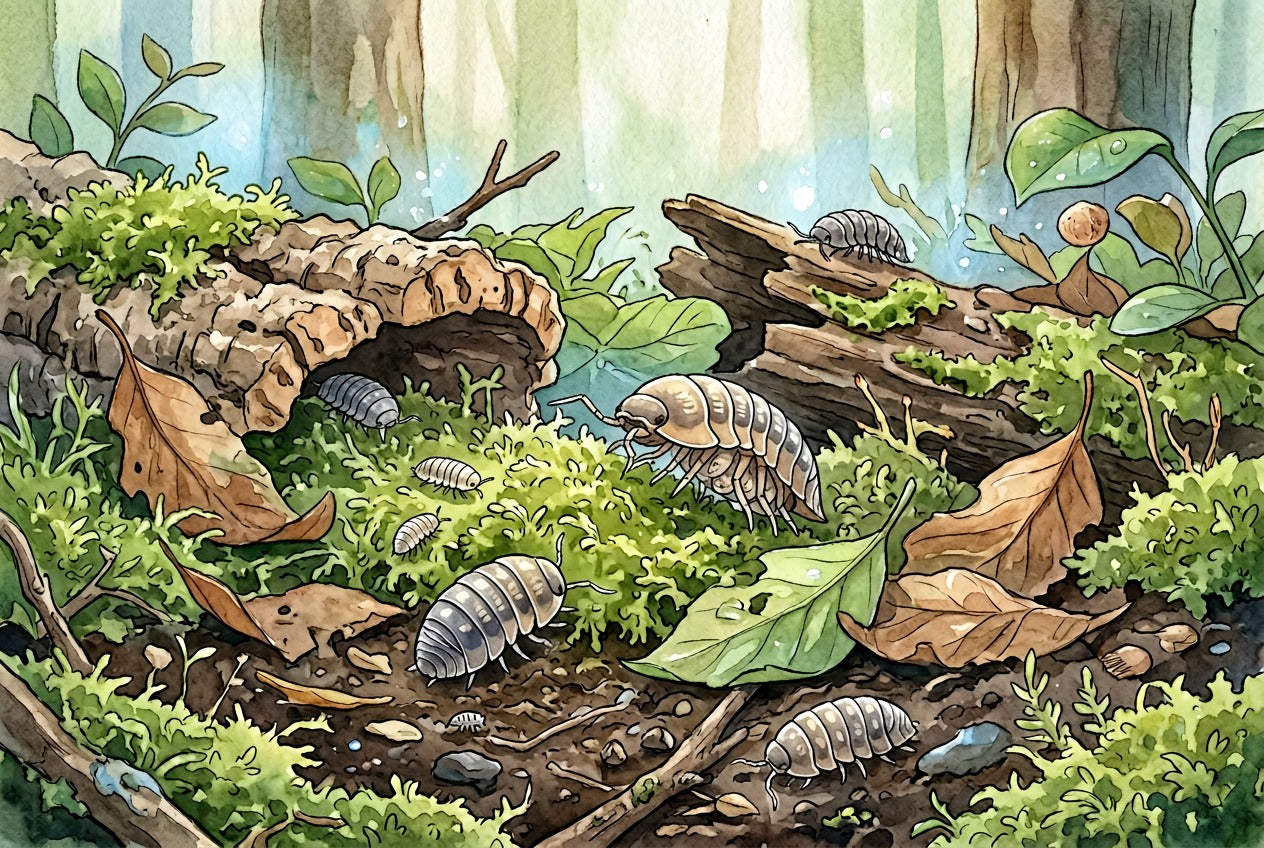
Understanding the Isopod Life Cycle From Mating to Baby
Isopods are one of the most fascinating creatures in a terrarium ecosystem. Unlike insects that lay eggs in soil, isopods carry their young in a specialized brood pouch under their body.
This unique reproductive method makes their breeding highly dependent on humidity, environment stability, and nutrition.
In this guide, we break down exactly how isopods breed, their life cycle, and how you can encourage a thriving colony in your terrarium.
How to Tell Male and Female Isopods Apart

Before breeding can happen, you need both male and female isopods.
- Males are generally slimmer and slightly smaller
- Females are broader and develop a brood pouch (marsupium) when reproducing
This pouch is the key to isopod reproduction, allowing females to safely carry developing eggs.
The Isopod Breeding Process Explained

Isopods reproduce through internal fertilization.
After mating:
- The female stores sperm
- Eggs are transferred into a brood pouch
- Eggs develop in a protected fluid environment
- Baby isopods hatch inside the pouch
- Young are released as mancae
This cycle repeats continuously when conditions are stable.
Where Baby Isopods Develop

The brood pouch, or marsupium, is a fluid-filled chamber located under the female’s body.
This structure:
- Keeps eggs moist
- Protects developing embryos
- Mimics the aquatic environment isopods evolved from
Timeline inside the pouch:
- Eggs develop: ~3–4 weeks
- Mancae remain inside: ~1–2 weeks
Only after this do the babies emerge into the environment.
What Are Mancae?

Baby isopods are called mancae.
They:
- Look like tiny white isopods
- Are missing their final pair of legs at birth
- Develop fully after their first molt
From here, they grow through multiple molts until reaching adulthood.
Isopod Breeding Timeline

Isopods reproduce steadily when conditions are right.
Typical timeline:
- Week 0: Mating
- Week 3–4: Eggs develop
- Week 5–6: Mancae released
- Month 2: Juveniles grow
- Month 3–4: Adults
Some fast species breed rapidly, while others take longer depending on environment and species type.
How to Make Isopods Breed Faster

Successful breeding is not about forcing mating — it’s about creating the right environment.
Key factors:
- Moisture gradient (wet + dry zones)
- Leaf litter (primary food source)
- Calcium (for exoskeleton development)
- Protein (for growth and reproduction)
- Stable temperature (20–26°C)
- Hiding spaces (bark, wood, moss)
- Low disturbance
When these conditions are met, breeding happens naturally.
Common Problems and Fixes

If your isopods are not breeding, the issue is usually environmental.
Common causes:
- Too dry → mancae cannot survive
- Too cold → breeding slows or stops
- Lack of calcium → molting issues
- Lack of protein → slow reproduction
- Too clean → no food source
- Too much disturbance → stress
Fixing these conditions usually restores breeding quickly.
Focus on the Ecosystem, Not Just Breeding
Isopods are naturally efficient breeders when kept in the right conditions.
Instead of trying to control the process, focus on building a stable, humid, and nutrient-rich ecosystem.
When the environment is right, your isopods will reproduce on their own — and your colony will grow into a healthy, self-sustaining system.


