
Springtail Species Guide: White, Gummy, Rambutan & Tropical Types — Which One Should You Use?
This guide is created by Green Chapter — Nature Workshop Studio, where we focus on creating living ecosystems through hands-on experience. We share practical insights across terrariums, aquascaping, plants, and natural systems to help you build and care for your own.
INTRODUCTION
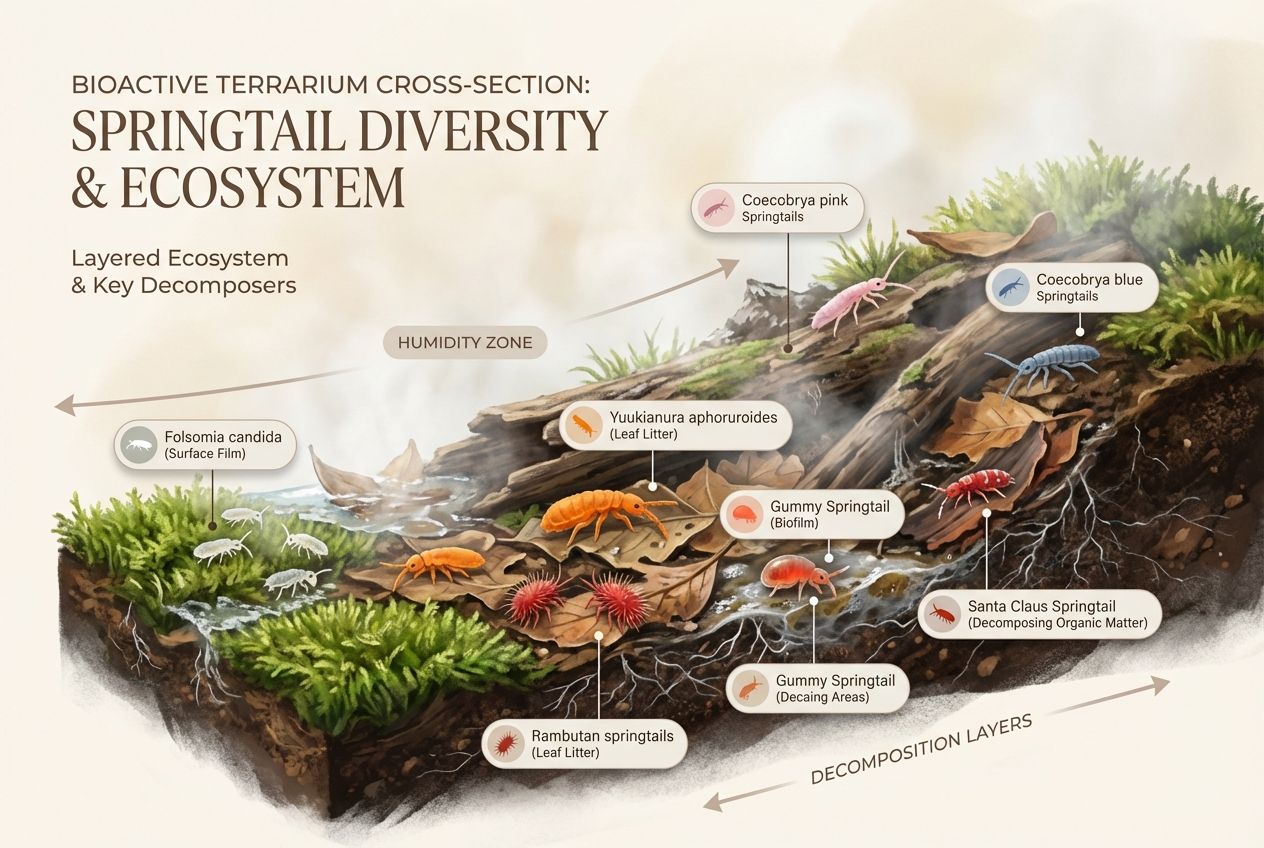
Springtails (Collembola) are often introduced as a simple “clean-up crew,” but in reality, they are a diverse group of microfauna with very different roles and behaviours.
Some species reproduce rapidly and thrive on simple diets, while others depend on complex fungal ecosystems and require far more stable environments to succeed.
If you’ve ever struggled with:
- springtails not multiplying
- cultures crashing unexpectedly
- or inconsistent performance in your terrarium
…it’s usually not a care issue — it’s a species mismatch.
In this guide, we’ll break down the most common springtail types in the hobby, including:
- White Springtails
- Tropical Pink & Blue
- Orange Springtails
- Gummy, Rambutan, and Santa Claus morphs
…and help you understand which species to use, and why it matters.
THE 3 SPRINGTAIL GROUPS
Not all springtails behave the same. In practice, they can be grouped into three functional categories based on how they feed and reproduce.
Workhorse Species (Fast & Reliable)
This group includes:
- White springtails
- Pink springtails
- Blue springtails
These are the most commonly used species because they:
- reproduce quickly
- tolerate a wide range of conditions
- feed readily on simple foods like yeast
They are ideal for beginners and form the backbone of most bioactive systems.
Collector / Display Species (Advanced)
This includes:
- Orange springtails
- Gummy types (orange / red)
- Rambutan springtails
- Santa Claus springtails
These species are visually striking, but they behave very differently. Instead of relying on simple food sources, they depend on fungal growth and natural decomposition processes.
They are best suited for established terrariums, not fresh setups.
Microfauna Fillers
Globular springtails fall into this category.
They are extremely small and often go unnoticed, but they contribute to microbial balance and nutrient cycling within the ecosystem.
Key Insight:
The biggest difference between springtail species is not color —
it is whether they are yeast-driven or fungi-driven.

SPECIES COMPARISON (WHAT YOU ACTUALLY GET)
Now that we understand the groups, let’s look at how each species performs in real setups.
White Springtails (Folsomia candida)
This is the industry standard for a reason. They reproduce extremely fast, are highly resilient, and thrive in simple culture systems.
They are the best choice for:
- starting cultures
- seeding new terrariums
- large-scale use
Pink & Blue Springtails (Coecobrya sp.)
These are tropical counterparts to white springtails, offering slightly larger size and better visibility.
They still reproduce quickly, but perform best in warm, humid environments.
They are an excellent upgrade from white springtails once your setup is stable.
Orange Springtails (Yuukianura aphoruroides)
These are one of the most popular “display” springtails due to their bright color and larger size.
However, they:
- reproduce slower initially
- depend on fungal-rich environments
- are more sensitive to imbalance
They perform best in mature terrariums with leaf litter and microbial activity.
Gummy Springtails (Orange / Red)
These are thicker-bodied, glossy springtails that resemble small droplets or beads.
They are:
- slower to establish
- highly dependent on biofilm and fungi
- sensitive to overfeeding
They are best treated as advanced microfauna, not general clean-up crew.
Rambutan Springtails
Named after their textured, spiky appearance, these springtails are typically found in leaf litter zones.
They:
- prefer natural substrates
- thrive in decomposition layers
- reproduce steadily but slowly
They are excellent for naturalistic terrariums.
Santa Claus Springtails
These are collector-grade springtails with striking red and white coloration.
They are:
- slow breeders
- sensitive to environmental changes
- best kept in stable, low-disturbance setups
Key Insight:
The more visually “premium” a springtail looks, the more it depends on a fully functioning ecosystem to thrive.

THE MOST IMPORTANT DIFFERENCE (FEEDING SYSTEM)
This is the single most important concept to understand.
Yeast-Based Feeding (Simple System)
White, pink, and blue springtails can thrive on:
- brewer’s yeast
- nutritional yeast
They feed directly on these particles, making them easy to culture and scale.
Fungi-Based Feeding (Complex System)
Gummy, rambutan, and orange springtails rely on:
- fungal hyphae
- biofilm layers
- decomposing organic matter
They are not efficient at consuming simple powdered food alone.
Why Cultures Fail
A very common mistake is treating all springtails the same.
Feeding only yeast to fungi-dependent species often leads to:
- population stagnation
- uncontrolled mold growth
- eventual culture collapse
Key Insight:
Fungi-driven species require a living substrate, not just food.

CULTURE METHODS (CHOOSING THE RIGHT SETUP)
Different species require different culture environments.
Clay Culture (Best for Production)
Clay-based cultures are ideal for:
- white springtails
- pink and blue species
They allow:
- fast reproduction
- easy harvesting
- controlled moisture
Charcoal Culture (Beginner-Friendly)
Charcoal is simple and widely used, especially for white springtails.
However, it:
- lacks microbial diversity
- is not suitable for advanced species
Soil / ABG Culture (Advanced Systems)
This is essential for:
- orange
- gummy
- rambutan
- Santa Claus springtails
A proper soil-based setup provides:
- fungal growth
- organic breakdown
- long-term stability
Key Insight:
Advanced springtails don’t just need moisture —they need a functioning ecosystem.

MASTER CULTURE SYSTEM (HOW TO AVOID CRASHES)
To maintain reliable cultures, it’s best to run a multi-tier system.
Tier 1 — Production Culture
White springtails on clay
👉 Fast, consistent supply
Tier 2 — Support Culture
Pink or blue springtails
👉 Adds resilience and diversity
Tier 3 — Collector Culture
Gummy, rambutan, Santa Claus
👉 High-value species in stable setups
Running multiple cultures prevents:
- total population loss
- dependency on a single system
- sudden crashes

WHICH SPRINGTAIL SHOULD YOU USE?
Choosing the right species depends on your setup.
For Beginners
Start with:
- White springtails
- Pink springtails
These are the easiest and most reliable.
For Bioactive Terrariums
Add:
- Blue springtails
- Orange springtails
This improves ecological diversity and function.
For Display & Advanced Systems
Use:
- Gummy
- Rambutan
- Santa Claus
These are best for mature, stable environments.
Best Overall Combination
A balanced system often includes:
- White (base population)
- Pink or Blue (support)
- Orange (ecosystem enhancer)
CONCLUSION
Springtails are more than just cleaners — they are the foundation of a healthy micro-ecosystem.
Understanding the difference between species allows you to:
- build more stable terrariums
- prevent culture crashes
- and create visually richer setups
Start simple, build your system gradually, and introduce advanced species only when your environment is ready.
That’s how a bioactive system truly thrives.


