
What Are the Main Groups of Isopods? (Species, Families, Genera & Habitats Explained)
This guide is created by Green Chapter — Nature Workshop Studio, where we focus on creating living ecosystems through hands-on experience. We share practical insights across terrariums, aquascaping, plants, and natural systems to help you build and care for your own.
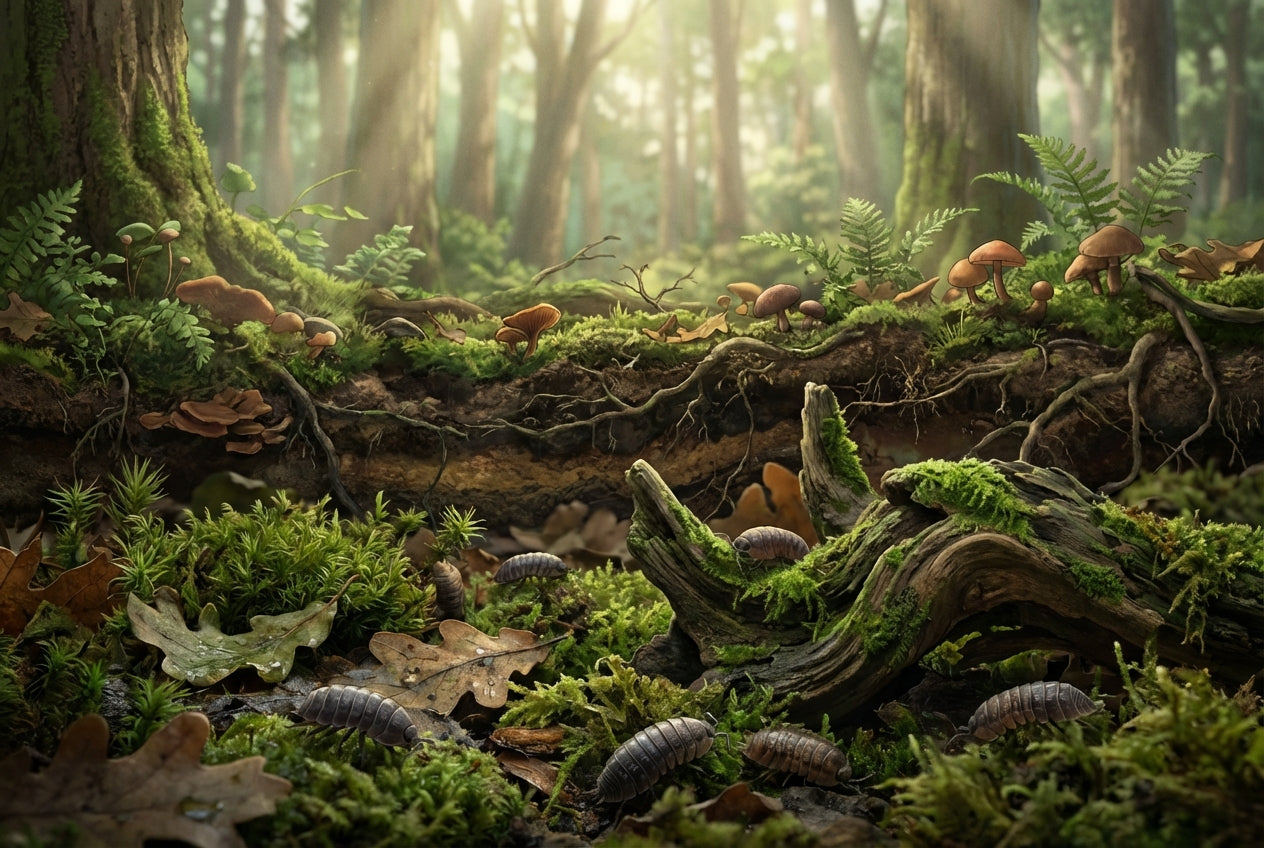
Introduction: Why Understanding Isopod Groups Matters
At first glance, most isopods look similar — small, segmented creatures quietly living under moss, wood, or soil. But beneath that simple appearance lies a huge diversity of species, each adapted to very different environments.
Some thrive in dry, airy setups.
Others require constant humidity and dense moss.
Understanding how isopods are grouped by family, genus, and species helps you make better decisions when building your setup. Instead of guessing, you begin to design with intention.
The key idea is simple:
When you match their natural habitat, isopods thrive. When you don’t, they slowly decline.
Section 1: How Isopods Are Classified (A Simple Breakdown)

Isopods follow a scientific classification system, but for hobbyists, we can simplify it into three useful levels:
- Family → Defines body structure and general behaviour
- Genus → Indicates care style and environment preference
- Species → Determines appearance and variation
For example, Armadillidium vulgare belongs to:
- Family: Armadillidiidae
- Genus: Armadillidium
This tells us it is a rolling species that prefers a balanced, semi-humid environment.
👉 This is why two isopods that look similar may behave very differently in the same tank.
Section 2: Major Isopod Families (What You’ll See in the Hobby)
Most hobbyist species fall into a few key families. Each has its own behaviour and environmental needs.

Armadillidiidae (Pill Bugs / Rollers)
These are the classic “ball-rolling” isopods. When threatened, they curl into a tight sphere — a behaviour known as conglobation.
They are commonly found in temperate regions, living under leaf litter and logs. In captivity, they do well in semi-humid setups with a gentle moisture gradient.
Because of their adaptability, they are one of the best choices for beginners.
Porcellionidae (Fast, Dry-Loving Isopods)
Unlike pill bugs, these isopods cannot roll. Instead, they rely on speed and tend to be much more active.
They originate from more open, drier environments such as grasslands and rocky terrain. As a result, they prefer well-ventilated enclosures with drier substrate.
These are excellent for bioactive setups, especially where airflow is important.
Trichoniscidae (Moisture-Dependent Micro Species)
These are smaller, softer-bodied isopods that live deep within soil and moss layers.
They require consistently high humidity and are rarely seen in dry conditions. In captivity, they thrive in moss-rich terrariums with minimal airflow.
Ideal for closed terrariums and lush, humid ecosystems.
Armadillidae (Tropical Exotic Isopods)
This group includes many popular display species like Cubaris (“Rubber Ducky”).
They originate from tropical regions and prefer stable, warm, and humid environments with deep substrate for burrowing.
These species are slightly more sensitive but highly rewarding when kept correctly.
Ligiidae (Semi-Aquatic Isopods)
These are transitional species that live along coastal areas, often on rocks exposed to waves and moisture.
They require a balance of high humidity, airflow, and mineral-rich conditions, making them less common in the hobby.
Best suited for advanced setups.
Habitat-Based Grouping (The Most Practical Way to Understand Isopods)
While classification is useful, the most practical way to understand isopods is through their natural habitats.

Dry / Arid Species
Species like Porcellio come from dry, open environments.
They prefer:
- Dry substrate
- Cork bark and rocks
- Strong airflow
Too much moisture will stress them over time.
Semi-Humid Forest Species
Species like Armadillidium live on forest floors where moisture varies.
They do best with:
- A mix of dry and moist areas
- Leaf litter
- Moderate airflow
This is the most forgiving setup for beginners.
High Humidity Species
Species like Cubaris and dwarf whites thrive in consistently moist environments.
They require:
- Moss-heavy substrate
- High humidity
- Stable conditions
These are perfect for terrariums and display ecosystems.
Semi-Aquatic Species
Species like Ligia occupy coastal zones where land meets water.
They need:
- Moist surfaces
- Good airflow
- Mineral-rich environments
Not commonly kept, but fascinating to understand.
Why Habitat Matters More Than Species Name

All terrestrial isopods evolved from aquatic ancestors. Over time, different groups adapted to very different environments.
This is why:
- Some species need constant moisture
- Others prefer dry, airy conditions
- Some sit somewhere in between
The most common mistake beginners make is assuming all isopods need high humidity.
In reality, each species reflects its natural environment.
Common Mistakes Hobbyists Make

Many isopod setups fail not because of neglect, but because of incorrect assumptions.
Common issues include:
- Keeping dry species in overly wet environments
- Poor ventilation
- Using the wrong substrate
- Lack of habitat variety
These mistakes don’t cause immediate failure — instead, they lead to slow decline and weak colonies.
A well-designed setup should always include:
- Proper airflow
- Correct moisture levels
- Natural materials like leaf litter and wood
Choosing the Right Isopod for Your Setup
Instead of choosing based on appearance, start with your setup.
If you are building:
- A moss terrarium → choose humid species like Cubaris
- A beginner enclosure → choose adaptable species like Armadillidium
- A dry bioactive tank → choose Porcellio
- A display ecosystem → explore tropical species
When the environment is correct, everything becomes easier — from care to breeding.

Conclusion: Build Around Nature, Not Preference
The most successful isopod keepers don’t just collect species — they recreate ecosystems.
By understanding:
- Family → behaviour
- Habitat → environment
- Setup → design
You move from trial-and-error to intentional building.
And that’s when your isopods don’t just survive — they thrive as part of a living system.


