
How Isopod Colour Morphs Develop: From One Unusual Isopod to a Breeding Line
This guide is created by Green Chapter — Nature Workshop Studio, where we focus on creating living ecosystems through hands-on experience. We share practical insights across terrariums, aquascaping, plants, and natural systems to help you build and care for your own.
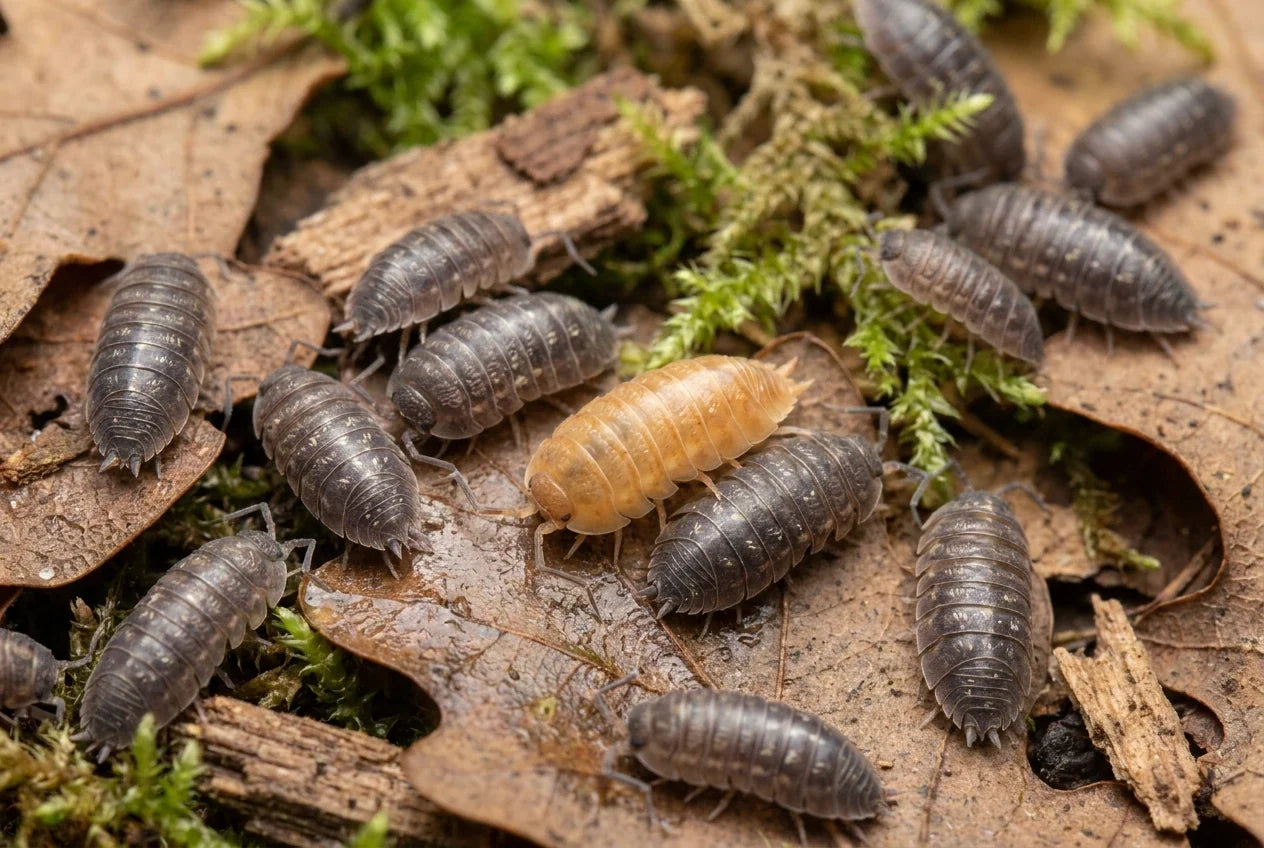
You have been keeping an isopod colony for several months.
The colony is doing well. Babies are appearing regularly.
Then one day, you notice something different.
One isopod is much lighter than the others. Perhaps it has more orange, less pattern, or a colour you have never noticed in the colony before.
Could this become a new colour morph?
Possibly.
But finding a different-looking isopod is only the beginning.
The real question is:
Can you produce that appearance again?
First, What Kind of Breeding Project Is This?
Isopod breeding can mean several different things.
Before going further, it helps to separate them.

What Is a Colour Morph?
A colour morph is a recognisable colour or pattern form within the same species.
Two isopods can look quite different while still belonging to the same species.
But one unusually coloured isopod does not automatically become a new morph.
Think of it as a series of stages.
One unusual isopod
→ interesting observation
The appearance appears again in its descendants
→ it may be inherited
The appearance can be reproduced through later generations
→ a breeding line is developing
The line produces a recognisable and reasonably consistent appearance
→ it may become an established morph or line
Finding the first unusual animal is therefore not the finish.
It is the start of the test.
Why Did This One Look Different?
Offspring inherit genetic information from their parents, but this does not mean every baby will look exactly the same.
Variation already exists within populations.
Occasionally, new genetic changes called mutations can also happen.
If these differences affect colour or pattern, you may eventually notice an individual that looks different from the rest of the colony.
But there is an important point:
Something that looks new to you is not necessarily a brand-new mutation.
The genetic variation may already have existed in the colony without being obvious. A particular combination may simply have made it visible.

Does This Happen Often?
There is no useful rule such as:
“One new colour appears in every 1,000 isopods.”
Some colonies show plenty of visible variation. Others may remain very similar for many generations.
Even when an unusual animal appears, the difference may not be inherited.
And not every different-looking isopod represents a useful genetic colour trait.
Age, moulting, condition and other factors can sometimes affect appearance.
So if you find something unusual, observe it first.
Does the colour remain?
Does the animal still look different after some time?
Is the difference clear enough that you could recognise it again?
If yes, you may have something worth investigating.
You Found One Unusual Isopod. What Now?
This is where the breeding project starts.
You do not need to find another 5 or 10 isopods with exactly the same rare colour before you can begin.
If only one unusual animal exists, that individual can be your starting point.
Your first goal is not to build a large colony.
It is to answer a much simpler question:
Can this difference be passed to its descendants?
Step 1 — Record What You Found
Start immediately.
Take a clear photograph and record:
-
the species
-
which colony it came from
-
the date
-
what looks different
You don't need complicated breeding records yet.
You simply need to know where this animal came from and which future offspring belong to the project.
This becomes increasingly useful once several generations are involved.
Step 2 — Start the First Breeding
Your unusual isopod cannot start a line alone.
It needs a suitable mature breeding partner of the same species.
At the beginning, your project might therefore be as simple as:
1 unusual individual + normal-looking same-species partner
Breed them and wait for offspring.
Their offspring are called the F1 generation.
F1 simply means the first generation produced from your starting parents.

Step 3 — Watch the F1
Don't judge the babies too early.
Young isopods can change as they grow. Give them enough time to develop before deciding whether they show the colour or pattern you are following.
Then compare the F1 with the original unusual parent.
If some F1 show the unusual colour
Good. Keep clear records of those animals.
Healthy F1 showing the desired trait may become breeding animals for your next generation.
If all the F1 look normal
Don't end the project yet.
A trait can sometimes be inherited without being visible in that generation.
The inheritance may also be more complicated than expected.
Your normal-looking F1 are still important because you know they are descendants of the unusual parent.
If the F1 show several different appearances
Record what happened.
Follow the particular characteristic you originally wanted to investigate instead of selecting every animal that looks unusual.

How Long Does This Take?
This is not a project that normally gives answers in a few days.
The parents need to reproduce.
The babies need to grow.
Then the F1 may need to reach maturity before they can produce the next generation.
If you are working with a species that takes around 3–4 months to reach breeding maturity, for example, simply growing the F1 to breeding age may already take several months.
Other species may develop faster or considerably slower.
The important idea is:
Think in generations, not days.

Why F2 Can Be Important
The next generation produced from your F1 line is called F2.
Sometimes the characteristic you are looking for may not be visible in F1 but can appear again in F2.
For example:
Unusual parent × normal-looking parent
↓
F1 offspring all appear normal.
↓
Suitable F1 descendants are bred.
↓
Some F2 offspring show the unusual appearance again.
If that happens, you now know much more than when you found the original animal.
The appearance has appeared again in its descendants.

Now You Have More Than One
This is an important turning point.
At the beginning, you may have had:
50 normal-looking isopods + 1 unusual one
There was no large group of unusual animals to select from.
But after following the project through F1, F2 or later generations, you may eventually have several animals showing the characteristic.
Now you can begin selecting.
Choose healthy animals that clearly show the colour or pattern you want to continue.
Breed them.
Observe their offspring.
Then select again.
This is selective breeding.

What If Several Similar Animals Appear From the Start?
Sometimes you are lucky enough to find more than one.
Perhaps your colony already contains:
-
slightly orange individuals
-
stronger orange individuals
-
very strongly orange individuals
You do not need to begin with the one-animal route.
Instead, you can select several healthy animals showing the same direction of variation and start breeding from them.
If you are trying to develop stronger orange colour, choose the animals showing stronger orange.
Don't simply combine every strange-looking animal.
A pale animal, an orange animal and an unusually patterned animal may represent completely different traits.
Choose the characteristic you want to follow, then select for that characteristic.
Select, Breed, Observe, Repeat
Once you have enough animals showing your desired trait, the process becomes easier to understand.
SELECT
Choose healthy animals clearly showing the characteristic.
↓
BREED
Produce another generation.
↓
OBSERVE
See how the offspring develop.
↓
SELECT AGAIN
Choose suitable offspring that continue the trait.
↓
REPEAT
Over several generations, the appearance may become more recognisable and more consistent.
Or it may not.
Both results tell you something about your breeding project.
When Does It Become a Colour Morph?
There is no magic generation where you can suddenly declare:
“I made a new morph.”
Instead, ask:
Can I reproduce the appearance?
Does it continue appearing in later generations?
Is the characteristic easy to recognise?
Does the line produce reasonably consistent results?
The more reliably you can reproduce the characteristic, the stronger the breeding line becomes.
Giving one unusual animal a new name does not make it an established morph.
Reproducing the trait is what matters.
What If It Doesn't Work?
Not every unusual isopod will become a new colour line.
You might breed it and never see the colour again.
The colour may return but remain inconsistent.
Later generations may also produce something completely different from what you expected.
Don't force the result.
Record what happened and work with what the animals actually produce.
Sometimes the answer to a breeding experiment is simply:
This trait did not develop into a stable line.
That is still a useful result.
Protect a Line You Have Worked On
Once you have spent several generations developing a line and have enough animals, consider keeping a separate backup colony.
Cultures can fail. Containers can dry out. Important breeding animals can die.
Keeping every animal from an important line in one container creates an unnecessary risk.
A backup becomes especially useful once the project has taken many months or longer to develop.
From One Isopod to Your Own Breeding Project
This is the big difference between finding an unusual isopod and developing a colour line.
You may begin with:
50 normal isopods + 1 unusual orange one
After several generations of careful breeding and selection, you may eventually have:
a separate colony where many descendants reliably show that orange appearance.
That is the achievement.
You did not simply find an orange isopod.
You followed the trait, tested whether it could be inherited, selected its descendants and learned whether you could reproduce the appearance.

One Important Note
Isopod species and colour lines do not all inherit their traits in exactly the same way.
Some colour traits may follow relatively simple inheritance patterns. Others can be more complicated, and the genetics behind many hobby morphs have not been fully studied.
The F1 and F2 examples in this guide therefore show possible breeding outcomes, not guaranteed results.
You don't need advanced genetics to begin observing a breeding project.
Start with a simple routine:
Observe → Record → Breed → Select → Repeat
Then let the offspring show you what your line actually does.
Next: What Happens If We Cross Two Existing Morphs?
This article began with an unusual colour appearing within one species.
But what if you already have two established colour morphs of that same species?
What happens when you breed them together?
Can one colour disappear in F1 and return in F2?
Can the offspring carry a trait that you cannot see?
And can two existing morphs eventually produce a different combination?
That is the next breeding project.
Read Part 2: Article 2: Isopod Colour & Breeding Series — Part 2


