
Crossing Isopod Colour Morphs: What Happens When Two Different Colours Breed?
This guide is created by Green Chapter — Nature Workshop Studio, where we focus on creating living ecosystems through hands-on experience. We share practical insights across terrariums, aquascaping, plants, and natural systems to help you build and care for your own.
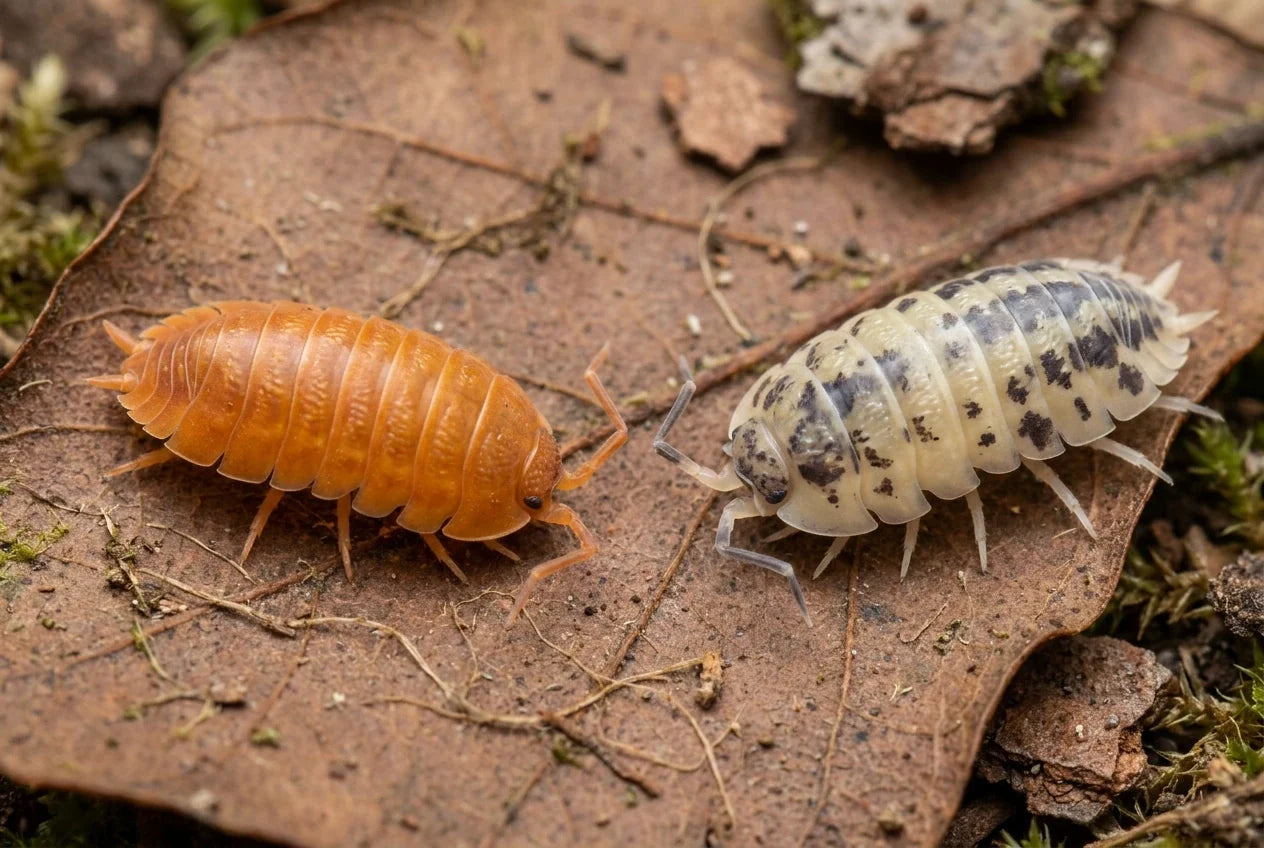
Imagine having two colonies of the same isopod species. One is bright orange, while the other is pale with dark spots.
Both are attractive in their own way. But what would happen if you bred them together?
Would their babies become orange with spots? Would they resemble one parent? Or could something completely unexpected appear?
This is where isopod breeding becomes particularly interesting. The offspring do not always look the way we imagine, and sometimes the most surprising results appear only after another generation.
For this article, we will explore a reported breeding example involving two colour morphs of Porcellio scaber: Spanish Orange and Dalmatian.
Two Different Morphs, but the Same Species
Spanish Orange Porcellio scaber have a recognisable orange body colour. Dalmatian Porcellio scaber have a pale body with irregular darker markings.
Despite their different appearances, both are sold as colour morphs of the same species.
That distinction matters. We are discussing the crossing of two colour morphs within one species, not hybridisation between different species.
In Part 1, we explored how an unusual isopod can become the starting point of a breeding line. This time, the starting point is different: two established morphs already exist, and a breeder wants to find out what their offspring might look like.
The First Surprise: The Babies May Look Ordinary
It is tempting to imagine that breeding an orange isopod with a spotted one will immediately produce orange-and-spotted babies.
But colours and patterns do not combine like paint.
In reported Spanish Orange × Dalmatian breeding experiments, the first generation of offspring appeared much closer to ordinary, dark-coloured Porcellio scaber than either of the colourful parent morphs.
Think about that for a moment.
Two distinctive-looking parents produced offspring that seemed to have lost the very characteristics that made their parents interesting.

The first generation is called F1. If you have read Part 1, you may already recognise this term.
Does this mean the cross failed?
Not necessarily.
An isopod's appearance does not always reveal every inherited characteristic it carries. Some characteristics can remain hidden when other genetic variants affect how the animal looks.
This is one reason breeders do not judge every experiment by its first group of babies.
Then Something More Interesting Appeared
In reported breeding accounts involving these morphs, later generations produced animals showing combinations of orange colour and Dalmatian-style patterning.
One particularly interesting result is the form known in the hobby as Orange Dalmatian.
Instead of looking entirely orange or resembling a typical pale Dalmatian, these isopods can display orange-toned markings against a lighter background.

This is the kind of result that makes selective breeding fascinating.
A breeder may begin with two familiar morphs, only to see a different combination of characteristics appear among their descendants.
However, Orange Dalmatian is already an established name in the hobby. The appearance of a similar animal in an experimental colony does not mean the breeder has discovered or created an entirely new morph.
It also does not mean every Spanish Orange × Dalmatian pairing will produce the same result.
The genetic background of the particular breeding lines matters.
How Can a Colour Disappear and Return?
Here is a simple way to understand it.
An offspring receives inherited information from both parents, but not every characteristic it inherits must be visible.
Imagine that a particular colour characteristic only becomes visible when an animal inherits a suitable combination of genetic variants.
The first generation might carry some of those variants without showing the colour.
When descendants breed, their offspring receive new combinations of inherited information. Under certain inheritance patterns, a characteristic that was not visible in the parents can become visible again.
That is why F2 — the generation produced by breeding suitable F1 descendants — can sometimes reveal something unexpected.
This is only one possible explanation. Colour and pattern inheritance in Porcellio scaber can involve several interacting genetic factors, and not every commercial morph has a fully documented inheritance pattern.
The important lesson is simple:
A characteristic that disappears from view has not necessarily disappeared from the breeding line.
Not Every Brother or Sister Looks the Same
Another interesting part of breeding colour morphs is that descendants may not all share one appearance.
Depending on the genetic background of the parents and how their characteristics are inherited, offspring may show different colours, patterns or combinations.
In breeding projects, this variety is useful because it gives breeders something to observe and compare.

A breeder might find that one animal has a particularly attractive pattern, while another has stronger colour. Some may resemble familiar morphs, and others may be less distinctive.
But an unusual appearance is not automatically a new morph.
The more useful question is whether that appearance can be produced again through further breeding.
One interesting animal is a discovery. Repeatedly producing similar, healthy animals is what begins to establish a breeding line.
Can You Combine Any Two Morphs?
Not necessarily.
Even when two morphs belong to the same species, their visible characteristics may not combine in the way a breeder hopes.
Some traits may be influenced by the same genetic mechanisms. Others may involve several genes, or their inheritance may not yet be well understood.
There is also a difference between combining two existing characteristics and producing a genuinely new appearance.
For example, seeing orange markings and Dalmatian-style patterning together is interesting, but it does not prove that every orange morph can be crossed with every patterned morph to produce a predictable combination.
Breeding is an experiment, not a colour-selection menu.
That uncertainty is part of what makes observing real offspring more rewarding than simply predicting them.
What If You Want to Try a Cross Yourself?
If you already have two established morphs of the same species, you can approach a breeding experiment in a controlled way.
The first thing is to protect the colonies you already have.
Keep the original morphs in their own established colonies, and set up a separate enclosure for the experimental cross.

This way, if the experimental offspring develop unexpected appearances, you still have the original breeding lines.
Choose healthy, mature animals and keep records of which colonies they came from. Where possible, use animals with known breeding histories, since a female that has mated previously may produce offspring whose father is not the male you recently introduced.
Once offspring appear, allow them to develop before judging their adult colours and patterns. Record what you see, and keep track of later generations.
You do not need complicated equipment or genetic calculations. Clear photographs, dates and simple breeding notes can already make the experiment much more useful.
Most importantly, do not mix all your original breeding animals into one colony just to see what happens. Once different lines have been mixed without records, recovering their original characteristics may become difficult.
The Most Interesting Result May Take Several Generations
Imagine starting with an Orange colony and a Dalmatian colony.
Your first offspring look ordinary. You might initially feel disappointed.
But you continue observing the descendants. Later, an animal appears with an interesting combination of orange colour and patterning.
Then another appears.
If you select healthy animals showing that characteristic and continue breeding them, you may eventually produce a group where the desired appearance becomes more common.

That is the exciting part of breeding established morphs.
The achievement is not simply producing one unusual-looking isopod. It is learning what the parents can pass on, recognising promising results and discovering whether those results can be repeated.
There is no guarantee of a particular outcome, and some crosses may never produce the appearance you hoped for.
But even an unexpected result can teach you something about the breeding lines you are working with.
What We Can Learn From This Cross
The Spanish Orange × Dalmatian example illustrates three useful lessons.
First, two colourful parents do not necessarily produce colourful first-generation offspring.
Second, an inherited characteristic may become visible in later generations, even when it was not obvious in the first.
Third, combining existing morphs can produce interesting appearances, but establishing a reliable line requires further observation and selection.
The documented inheritance of pigmentation in Porcellio scaber is more complicated than a single rule that applies to every colour morph. The breeding results discussed here are reported examples, not promises of what every pairing will produce.
If Part 1 was about finding one unusual isopod and following its descendants, Part 2 is about deliberately crossing two existing morphs and discovering what their offspring can reveal.
And that leads to another question.
What happens when the two isopods are not different morphs, but different species altogether?
That is a separate subject involving species compatibility and possible hybridisation, which we will explore in Part 3.
Read Part 1: Article 1: Isopod Colour & Breeding Series — Part 1


