
Why Aquarium Plants Change Form (Melt)
This guide is created by Green Chapter — Nature Workshop Studio, where we focus on creating living ecosystems through hands-on experience. We share practical insights across terrariums, aquascaping, plants, and natural systems to help you build and care for your own.
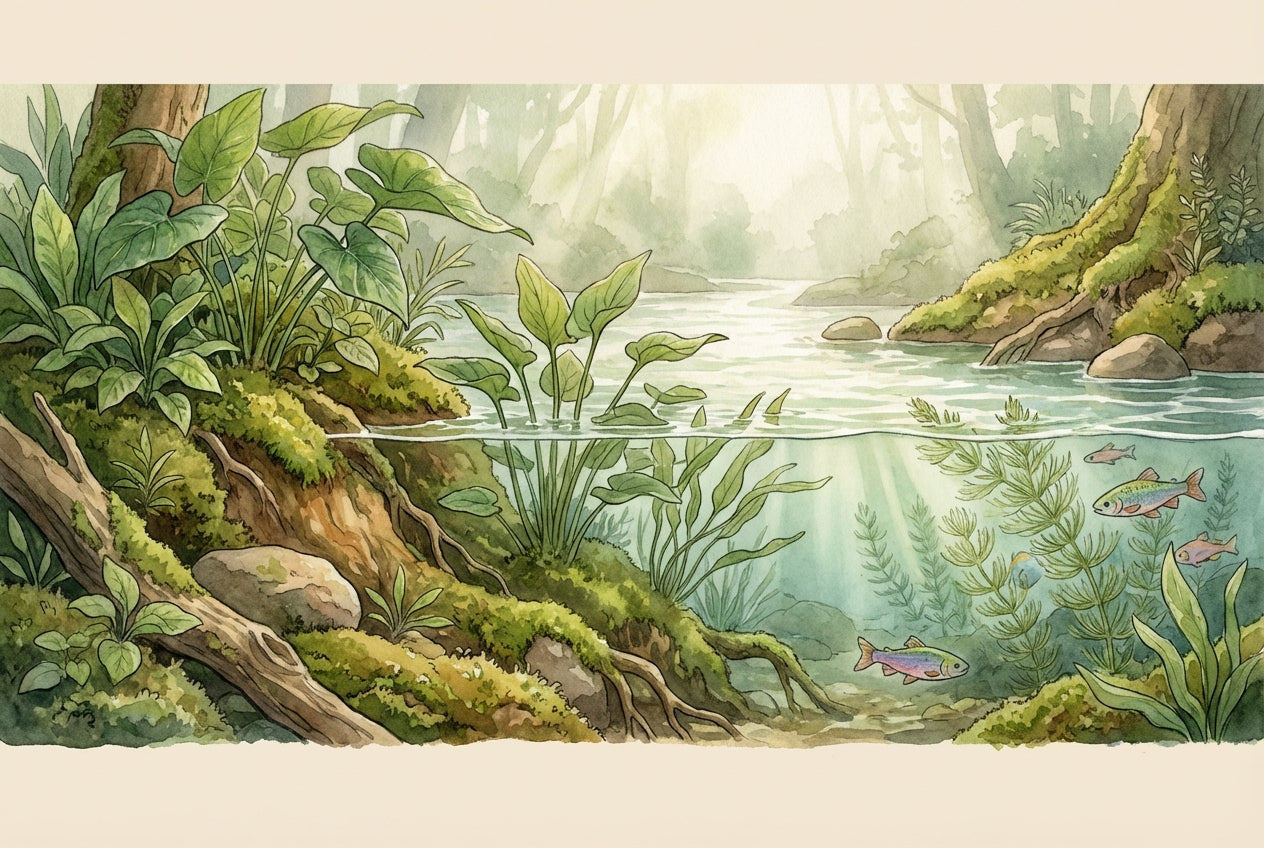
Introduction — The Hidden Transformation
If you’ve ever bought aquarium plants and noticed them melting, changing shape, or looking completely different, you’re not doing anything wrong.
Most aquarium plants are actually grown above water (emersed form) in farms because it is faster, cleaner, and more efficient.
But once placed into your aquarium, these plants must transition into a submerged form to survive underwater.
This process may look dramatic—but it is completely natural.
In the wild, aquatic plants constantly move between land and water environments.
What you are seeing in your tank is simply that same transition happening again.
How Plants Grow in Nature (Bog to River Transition)

In nature, aquatic plants grow along riverbanks, wetlands, and floodplains, where water levels change regularly.
These environments create three main growth zones:
🌱 Emergent Zone (Above Water)
Plants grow in wet soil but extend leaves into the air.
Leaves are thick, sturdy, and designed to reduce water loss.
🌊 Transitional / Floating Zone
As water rises, plants begin adapting.
Leaves may flatten or reposition to interact with the water surface.
💧 Submerged Zone
Plants become fully underwater.
Leaves are thin, soft, and designed to absorb nutrients and gases directly from water.
👉 Because of these changing conditions, plants evolved the ability to change their leaf structure depending on where they grow.
Stem Plants: Complete Leaf Transformation

Stem plants show the most obvious transformation when moved from land to water.
Examples include:
- Rotala rotundifolia
- Ludwigia repens
- Hygrophila difformis
- Ammannia gracilis
🌱 Emersed Form
Leaves are typically rounder, thicker, and more rigid, built for air exposure.
💧 Submerged Form
New leaves grow longer, thinner, or finely divided, allowing better light capture and CO₂ absorption underwater.
👉 Stem plants don’t keep their original leaves—they grow completely new ones suited for life underwater.
Rosette Plants: The “Melt and Regrow” Strategy

Rosette plants follow a different strategy—they reset themselves completely.
Examples include:
- Cryptocoryne wendtii
- Echinodorus bleheri
When placed in your aquarium:
- Existing leaves may turn yellow, soften, and dissolve
- This process is commonly known as “crypt melt”
- The plant redirects energy into its roots
After that:
- New leaves emerge
- These leaves are thinner, softer, and adapted for underwater growth
👉 Rosette plants don’t adapt old leaves—they replace them entirely with new ones.
Rhizome Plants: Naturally Adapted Stability

Rhizome plants are the most stable and beginner-friendly.
Examples include:
- Anubias barteri
- Bolbitis heudelotii
These plants:
- Have thick, waxy leaves
- Show minimal change when submerged
- Grow slowly but are highly resilient
👉 They are naturally adapted to both wet and submerged environments, so they do not need major transformation.
Why Plants “Melt” in Your Aquarium

Seeing your plant melt can be worrying—but it is actually part of the process.
What You See:
- Leaves turning yellow
- Leaves breaking down
- Sudden loss of foliage
What Is Really Happening:
- The plant is discarding leaves that cannot function underwater
- It is adapting to:
- Lower CO₂ availability
- Different lighting conditions
- Submerged nutrient absorption
👉 This is not plant death—it is adaptation in progress.
What Happens in Your Tank (Step-by-Step Transition)

Understanding the timeline helps you stay confident during the process:
Week 1–2
- Initial stress phase
- Some leaf melt occurs
- Roots begin establishing
Week 2–4
- New submerged leaves start appearing
- Growth stabilizes
Week 4+
- Plant is fully adapted
- Healthy and consistent growth resumes
👉 Patience is key—once adapted, plants often grow stronger and more beautifully than before.
Final Takeaway — Understanding Builds Success
Aquarium plants are not failing when they change form—they are doing exactly what nature designed them to do.
Some plants adapt, some restart, and some are already prepared.
By understanding this transition:
- You avoid unnecessary panic
- You make better planting decisions
- You create a more stable and successful aquascape


