
If Aquatic Plants Grow in Nature Without Fertiliser, Why Do We Need Fertiliser in Aquariums?
This guide is created by Green Chapter — Nature Workshop Studio, where we focus on creating living ecosystems through hands-on experience. We share practical insights across terrariums, aquascaping, plants, and natural systems to help you build and care for your own.
Introduction
If you have ever seen aquatic plants growing in rivers or streams, you might wonder:
“Why do aquarium plants need fertiliser when plants in nature don’t?”
The answer lies in one key difference:
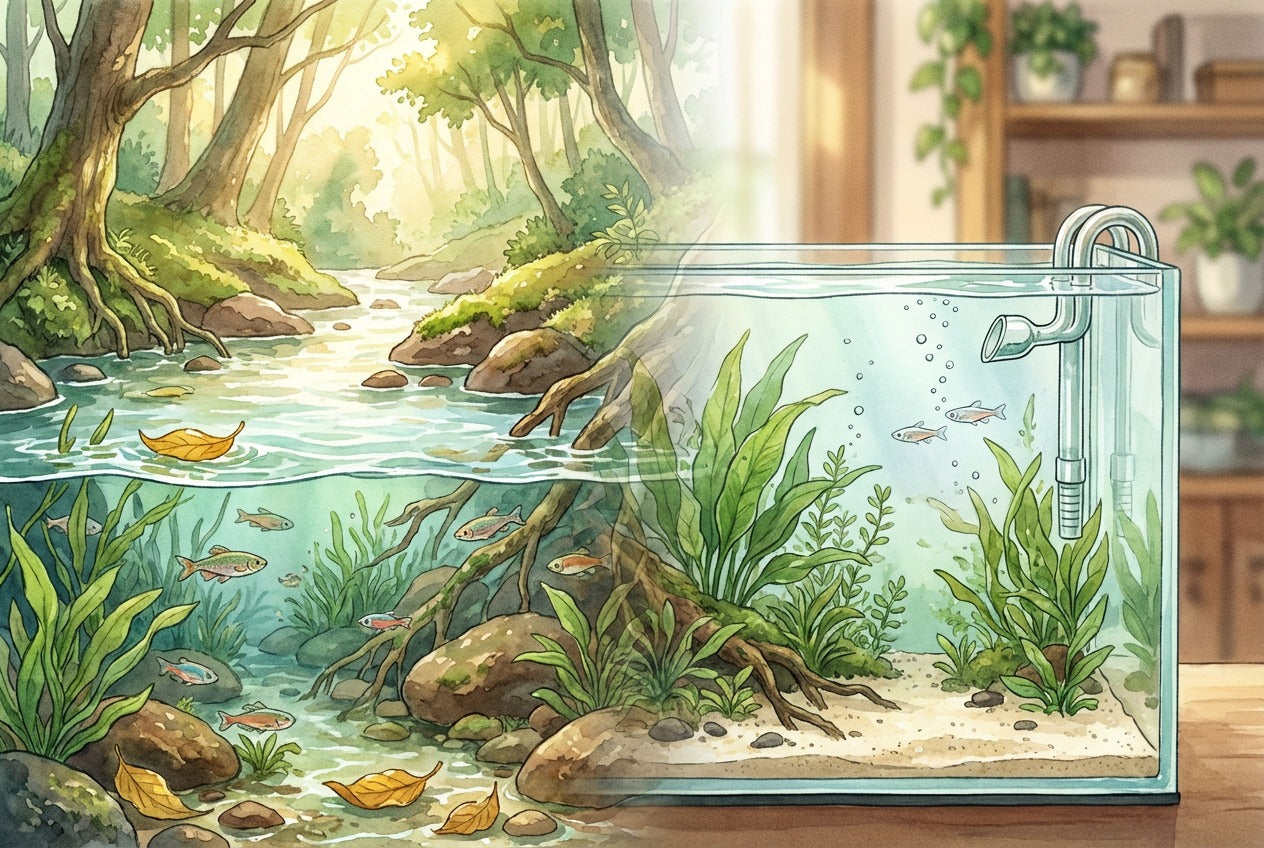
Nature is an open system, while an aquarium is a closed system.
In nature, nutrients are constantly being added and recycled.
In an aquarium, nutrients are limited and get used up over time.
This is why fertilisation becomes important in planted tanks.

Where Do Aquatic Plants Get Nutrients in Nature?
In the wild, aquatic plants grow in environments rich in natural nutrients. These nutrients come from:
- Fallen leaves and wood
- Fish and animal waste
- Decomposing plants
- Mud and sediment
- Minerals from rocks
- Flowing water bringing nutrients downstream
Bacteria break down organic matter into forms that plants can absorb, creating a continuous nutrient cycle.
A natural river functions like a slow, constant fertiliser system.

Why Substrate Matters: Mud vs Sand
In nature, most aquatic plants grow in nutrient-rich mud.
Mud contains:
- Nitrogen (N)
- Phosphorus (P)
- Potassium (K)
- Iron (Fe)
- Organic matter
In aquariums, we often use sand or gravel, which contain almost no nutrients.
This means plants in aquariums rely on:
- Root tabs
- Aquasoil
- Liquid fertilisers
Without nutrients in the substrate, plants will eventually become deficient.

Open System vs Closed System
The biggest difference between nature and aquariums is how nutrients move.
| Nature (River) | Aquarium |
|---|---|
| Open system | Closed system |
| Nutrients constantly added | Nutrients get used up |
| Continuous input from environment | Limited nutrient sources |
| Natural recycling | Nutrient depletion over time |
In an aquarium:
- Filters remove organic waste
- Water changes remove nutrients
- Plants continuously consume nutrients
Over time, this leads to nutrient deficiency unless fertiliser is added.
Non-CO₂ Tank vs CO₂ Injected Tank
Not all planted tanks require the same amount of fertiliser.
The key difference is plant growth speed.
Comparison:
| Feature | Non-CO₂ Tank | CO₂ Injected Tank |
|---|---|---|
| Growth rate | Slow | Fast |
| Nutrient demand | Low | High |
| Fertiliser need | Minimal | Regular dosing |
In a CO₂ injected tank:
- Plants grow much faster
- Nutrients are consumed quickly
- Fertiliser becomes essential
In a non-CO₂ tank:
- Growth is slower
- Fish waste and natural breakdown may be enough
Faster growth = higher nutrient demand.

The Balance of Light, CO₂ and Nutrients
Healthy plant growth depends on balancing three key factors:
- Light
- CO₂
- Nutrients
If one increases, the others must also increase.
| Imbalance | Result |
|---|---|
| High light, low nutrients | Algae |
| High CO₂, low nutrients | Plant deficiencies |
| Balanced system | Healthy growth |
Success in planted tanks is about balance, not just adding more fertiliser.

Conclusion
Aquatic plants in nature thrive without bottled fertiliser because nutrients are constantly supplied through:
- Mud and sediment
- Fish and animal waste
- Decomposing organic matter
- Flowing water
In an aquarium, these natural processes are limited.
As a result:
- Nutrients get used up
- Plants become deficient over time
- Fertiliser is needed to replenish what is missing
Fertiliser is not artificial — it simply replaces what nature would normally provide.
Final Thought
A successful planted aquarium is not about adding more fertiliser.
It is about maintaining the right balance between:
Light, CO₂, and Nutrients.


