
Understanding Aquatic Plants: Growth Forms, Ecological Types & Plant Structure
This guide is created by Green Chapter — Nature Workshop Studio, where we focus on creating living ecosystems through hands-on experience. We share practical insights across terrariums, aquascaping, plants, and natural systems to help you build and care for your own.
Introduction — Why Understanding Aquatic Plants Matters
When starting a planted aquarium, many beginners get confused:
- Why do some plants need root tabs?
- Why do some plants need liquid fertilizer?
- Why do some plants melt after planting?
The answer is simple — not all aquatic plants grow the same way.
To properly understand aquatic plants, we classify them into three key categories:
- Growth Forms — how the plant grows
- Ecological Types — where the plant grows in nature
- Morphological Types — what the plant looks like
Once you understand these, you will know:
- Where to place each plant
- How to fertilize correctly
- How to avoid common beginner mistakes
Growth Forms (How the Plant Grows)

Growth form describes how a plant physically grows in your aquarium.
This is the most practical classification because it directly affects placement, trimming, and fertilization.
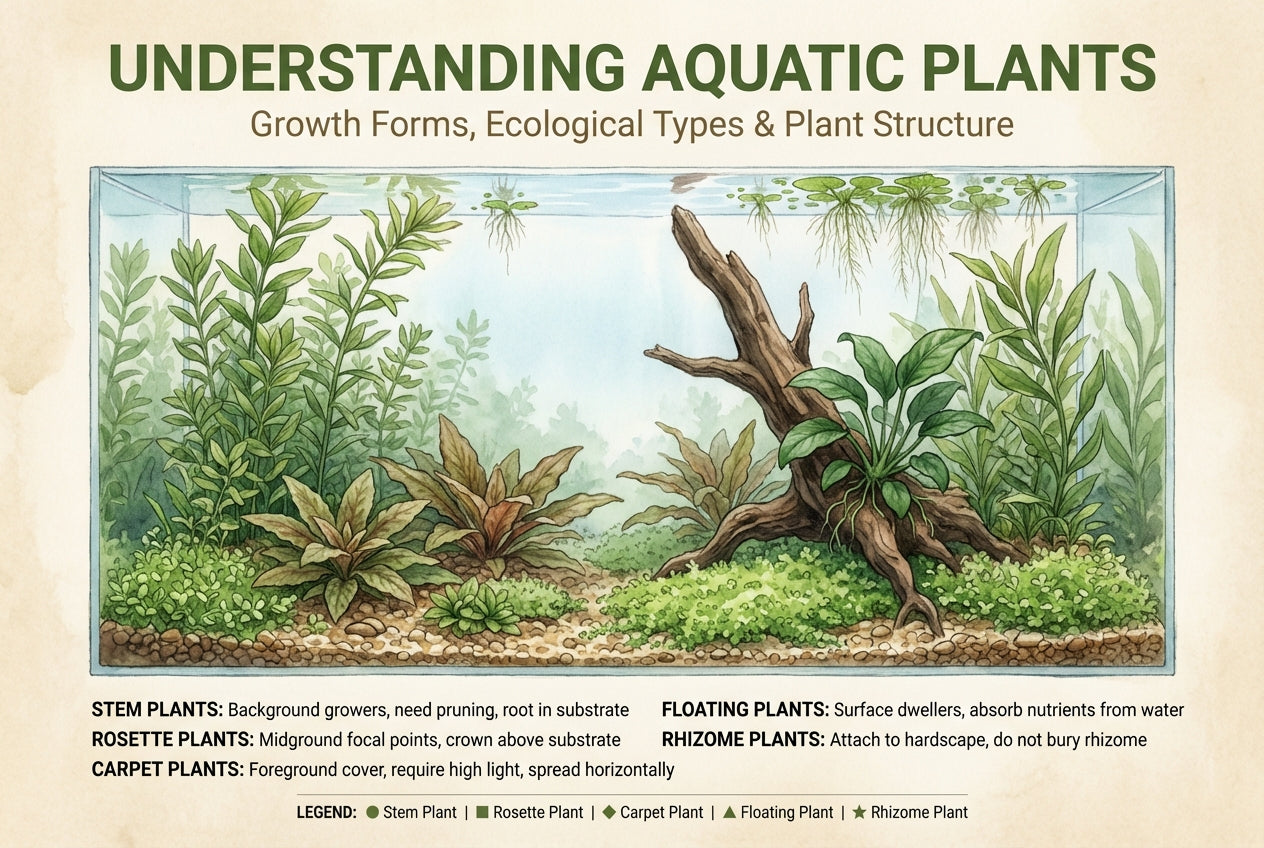
There are five main growth forms:
Stem Plants
Grow vertically and can be trimmed and replanted.
They absorb nutrients mainly from the water column.
Rosette Plants
Grow from a central base with strong roots in the substrate.
They absorb nutrients mainly from the substrate.
Rhizome Plants
Grow from a horizontal rhizome and must be attached to wood or rocks.
They absorb nutrients from the water column.
Carpet Plants
Spread horizontally across the substrate to form a carpet.
They rely heavily on root feeding.
Floating Plants
Float on the surface and grow long roots into the water.
They absorb nutrients directly from the water column.
💡 Simple Beginner Rule
- Stem & floating plants → Liquid fertilizer
- Rosette & carpet plants → Root tabs
- Rhizome plants → Attach to wood, not soil
Ecological Types (Where the Plant Grows)

Ecological classification explains how plants grow in relation to water in nature.
This is important because many aquarium plants are actually amphibious, not fully aquatic.
Submerged Plants
Grow completely underwater.
Emergent Plants
Roots underwater, leaves above water.
Floating Plants
Float freely on the water surface.
Amphibious Plants
Can grow both above and below water.
This includes most aquarium plants.
Marginal Plants
Grow at the edge of water where the soil is moist.
Important Concept — Why Plants “Melt”
Most aquarium plants are grown above water (emersed form) on farms.
When placed underwater, they may lose old leaves and grow new ones adapted to submerged conditions.
This process is normal and is called plant conversion.
Morphological Types (Plant Structure)

Morphological classification focuses on the structure of the plant, especially the leaves.
This helps you understand maintenance, lighting needs, and algae behavior.
Broad Leaf Plants
Large leaves, easy to grow, but prone to algae.
Fine Leaf Plants
Delicate and detailed, but require cleaner water.
Grass-like Plants
Long narrow leaves, often used in carpets or backgrounds.
Moss
No true roots, attaches to surfaces, great for shrimp and terrariums.
Fern-type Plants
Grow from rhizomes and should be attached to hardscape.
Practical Tip
Leaf structure affects:
- Light demand
- Water flow needs
- Maintenance difficulty
How Aquatic Plants Absorb Nutrients

Now that we understand plant types, we can simplify everything into one key idea:
Aquatic plants feed in two main ways:
Root Feeders
Absorb nutrients from the substrate through roots
→ Require root tabs
Water Column Feeders
Absorb nutrients directly from the water through leaves
→ Require liquid fertilizer
Why This Matters
Using the wrong fertilizer is one of the most common beginner mistakes.
- Adding only liquid fertilizer → root plants struggle
- Adding only root tabs → stem plants struggle
A balanced planted tank usually needs both.
Final Takeaway
If you remember one thing from this guide, remember this:
How a plant grows determines how you should care for it.
By understanding:
- Growth form
- Ecological type
- Plant structure
You will be able to:
- Choose the right plants
- Fertilize correctly
- Prevent plant melt
- Build a healthier, more stable aquarium


