
Mapping the World of Aquarium Plants
This guide is created by Green Chapter — Nature Workshop Studio, where we focus on creating living ecosystems through hands-on experience. We share practical insights across terrariums, aquascaping, plants, and natural systems to help you build and care for your own.
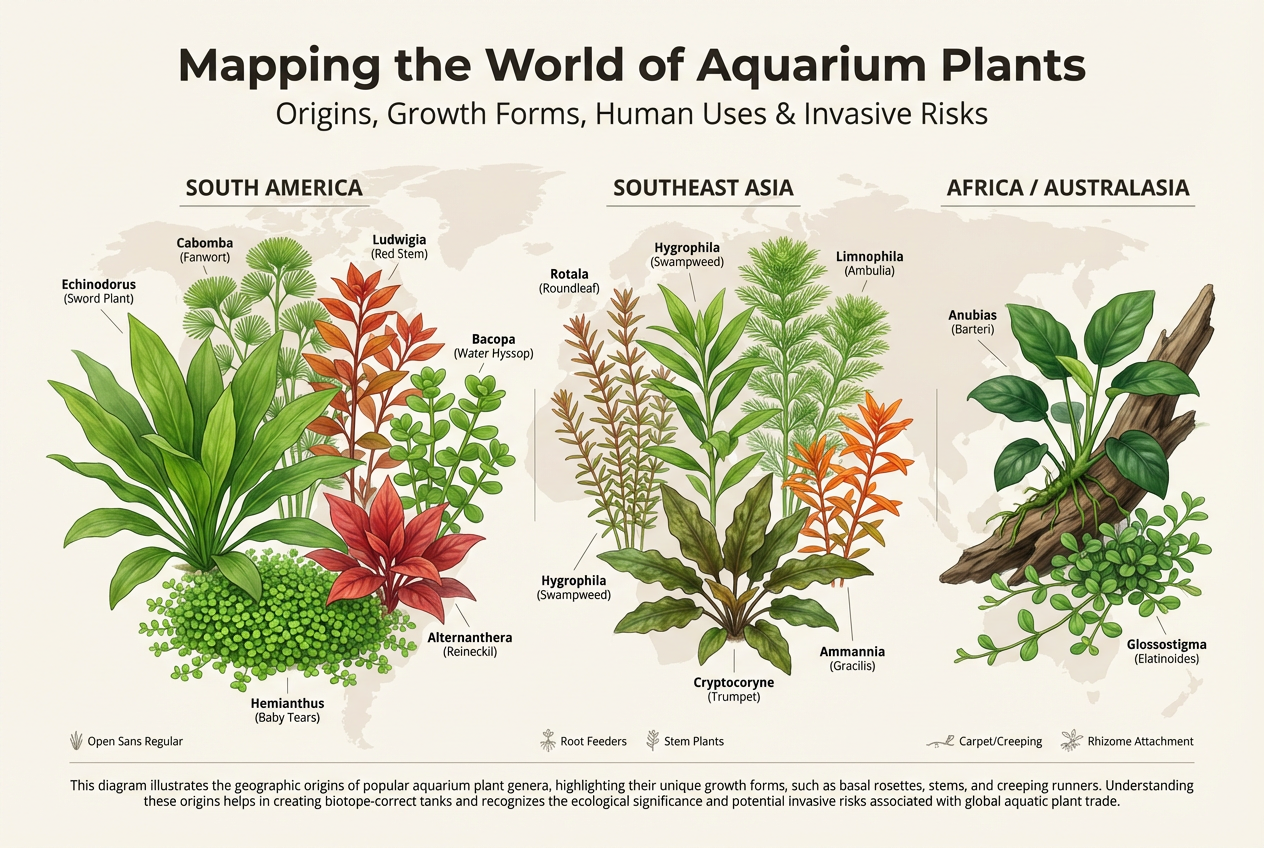
Origins, Growth Forms, Human Uses & Invasive Risks
Introduction
Most aquarium plants are chosen for how they look—lush greens, red accents, or compact carpets. But behind every plant is a deeper story shaped by where it comes from and how it survives in nature.
Some grow fully submerged in rivers. Others live in wetlands that flood and dry with the seasons. A few never truly stay underwater at all, instead clinging to rocks along humid riverbanks.
Understanding this changes how you approach aquascaping.
It explains why plants:
- melt after planting
- grow differently above and below water
- thrive in paludariums
- or become invasive when released
This guide maps aquarium plants across global regions, growth strategies, and real-world uses—so you can design with intention, not guesswork.
1. Global Origins of Aquarium Plants
Aquarium plants may appear similar in stores, but their origins tell very different stories. Their native environments directly influence how they grow in your tank.
🌱 South America — The New World Core
This region is known for bold, structured plants and vibrant colors.
Key genera include Echinodorus, Cabomba, Ludwigia, Bacopa, Alternanthera, and Hemianthus.
These plants typically grow in floodplains and river margins, where water conditions are relatively stable.
- Echinodorus develops strong roots and large sword-like leaves
- Cabomba is a delicate true aquatic with fan-shaped foliage
- Ludwigia and Alternanthera provide warm red tones
- Bacopa features thick, resilient stems
These plants tend to perform best in stable, nutrient-rich environments.
🌿 South & Southeast Asia — The Adaptability Zone
This is the most important region for aquarium hobbyists due to its highly adaptable plants.
Key genera include Rotala, Hygrophila, Limnophila, Cryptocoryne, and Ammannia.
They originate from:
- rice paddies
- seasonal wetlands
- shallow flood zones
Because of this, they are naturally adapted to changing water levels.
- Rotala produces fine, delicate stems
- Hygrophila grows quickly and robustly
- Limnophila shows soft, feathery foliage
- Cryptocoryne forms textured rosettes
These plants are often forgiving and beginner-friendly.
🌳 Tropical Africa — The Specialist Habitat
The standout genus here is Anubias, known for its durability.
- Grows along shaded riverbanks
- Attaches to wood or rock via rhizomes
- Produces thick, slow-growing leaves
👉 Ideal for low-maintenance aquariums and hardscape-focused layouts.
🌾 Australasia — The Carpet Specialist
The key genus here is Glossostigma.
- Low-growing and creeping
- Forms dense carpets under strong light
- Requires stable conditions to stay compact

Quick Takeaway
Each region contributes unique plant types:
- Americas → bold rosettes, reds, true aquatics
- Asia → adaptable, amphibious plants
- Africa → hardy rhizome species
- Australasia → carpeting plants

2. True Aquatic vs Amphibious Plants
One of the most important concepts in planted tanks is understanding that most aquarium plants are not truly aquatic.
🌊 True Aquatic Plants
These plants are specialized for permanent underwater life.
Example: Cabomba
- finely divided leaves
- delicate structure
- does not adapt well to emersed conditions
🌿 Amphibious (Bog-Type) Plants
Most aquarium plants belong here.
They naturally grow in:
- wetlands
- marshes
- river edges
This includes Rotala, Hygrophila, Echinodorus, Limnophila, Ludwigia, Bacopa, Glossostigma, Hemianthus, Anubias, Cryptocoryne, Alternanthera, and Ammannia.
These plants can grow both:
- submerged in aquariums
- emersed in humid environments
👉 This flexibility makes them highly versatile.

Why Plants “Melt” After Planting
Most aquarium plants are grown above water before sale.
When submerged:
- old leaves die off
- new leaves grow adapted to underwater conditions
👉 This is a normal transition process—not a sign of failure.
3. Emersed vs Submerged Growth
Plants don’t just survive underwater—they change their form.
What Changes
- Rotala shifts from compact to fine, delicate stems
- Hygrophila becomes softer and more elongated
- Echinodorus produces longer flowing leaves
- Ludwigia develops stronger red coloration
- Cryptocoryne forms longer, wavy leaves
- Anubias becomes slightly thinner in structure
These changes reflect adaptation to a different environment.

🌿 4. Why Aquarium Plants Work in Paludariums
Because most aquarium plants are actually wetland species, they also thrive in humid environments outside water.
They can be used in:
- paludariums
- wabi-kusa setups
- open-top tanks
- emersed grow systems
Best choices include:
Anubias, Cryptocoryne, Hygrophila, Bacopa, Rotala, Ludwigia, and Alternanthera.
👉 This makes them highly versatile beyond traditional aquascaping.
🍃 5. Aquarium Plants Beyond the Tank
Some aquarium plants are not just ornamental—they are part of real-world food and medicinal systems.
🌿 Key Examples
Limnophila aromatica
A rice paddy herb widely used in Southeast Asian cuisine.
Hygrophila
Associated with traditional herbal uses in wetland regions.
Bacopa monnieri
A well-known medicinal plant.
Alternanthera sessilis
Consumed as a leafy vegetable in tropical regions.
Ammannia
Linked to traditional medicinal uses.

🌍 Why This Matters
These plants are part of:
- local ecosystems
- agricultural systems
- cultural traditions
👉 Your aquarium reflects real-world environments.
⚠️ 6. Invasive Risk — The Hidden Side
Some aquarium plants can become invasive when introduced into natural ecosystems.
🚨 High-Risk Genera
- Cabomba
- Ludwigia
- Hygrophila
- Alternanthera
- Rotala (moderate risk)
Why They Spread
- rapid growth
- fragmentation
- high adaptability
- strong competition

♻️ Responsible Disposal
Never release aquarium plants into:
- drains
- canals
- lakes
- natural waterways
Instead:
- dry them completely
- seal them in a bag
- dispose responsibly
🧠 7. Quick Hobby Guide
Use this as a simple reference when choosing plants.
Best Stem Plants
Rotala, Hygrophila, Limnophila, Ludwigia, Ammannia
Best Paludarium Plants
Anubias, Cryptocoryne, Bacopa, Rotala
Best Rosette Plants
Echinodorus, Cryptocoryne
True Aquatic Example
Cabomba
Edible / Cultural Plants
Limnophila, Bacopa, Alternanthera
Watchlist (Invasive Risk)
Cabomba, Ludwigia, Hygrophila, Alternanthera

❓ FAQ Section
What are the easiest aquarium plants?
Hygrophila, Rotala, and Bacopa are highly adaptable and beginner-friendly.
Why do aquarium plants melt?
They are transitioning from emersed to submerged growth.
Are aquarium plants fully aquatic?
No. Most are amphibious wetland plants.
Which plants grow above water?
Anubias, Cryptocoryne, Hygrophila, Bacopa, Rotala.
Which plants are invasive?
Cabomba, Ludwigia, Hygrophila, Alternanthera.
Are aquarium plants edible?
Some are, including Limnophila and Alternanthera.
🌿 Conclusion
Aquarium plants are more than decorative elements—they are shaped by geography, ecology, and human culture.
Understanding their origins helps you:
- choose plants more effectively
- avoid common mistakes
- design more natural aquascapes
- explore paludariums and hybrid setups
A planted aquarium is not just a display.
👉 It is a living intersection of nature, science, and design.


