
Why Moss Thrives Along Moisture Paths in Paludariums
This guide is created by Green Chapter — Nature Workshop Studio, where we focus on creating living ecosystems through hands-on experience. We share practical insights across terrariums, aquascaping, plants, and natural systems to help you build and care for your own.
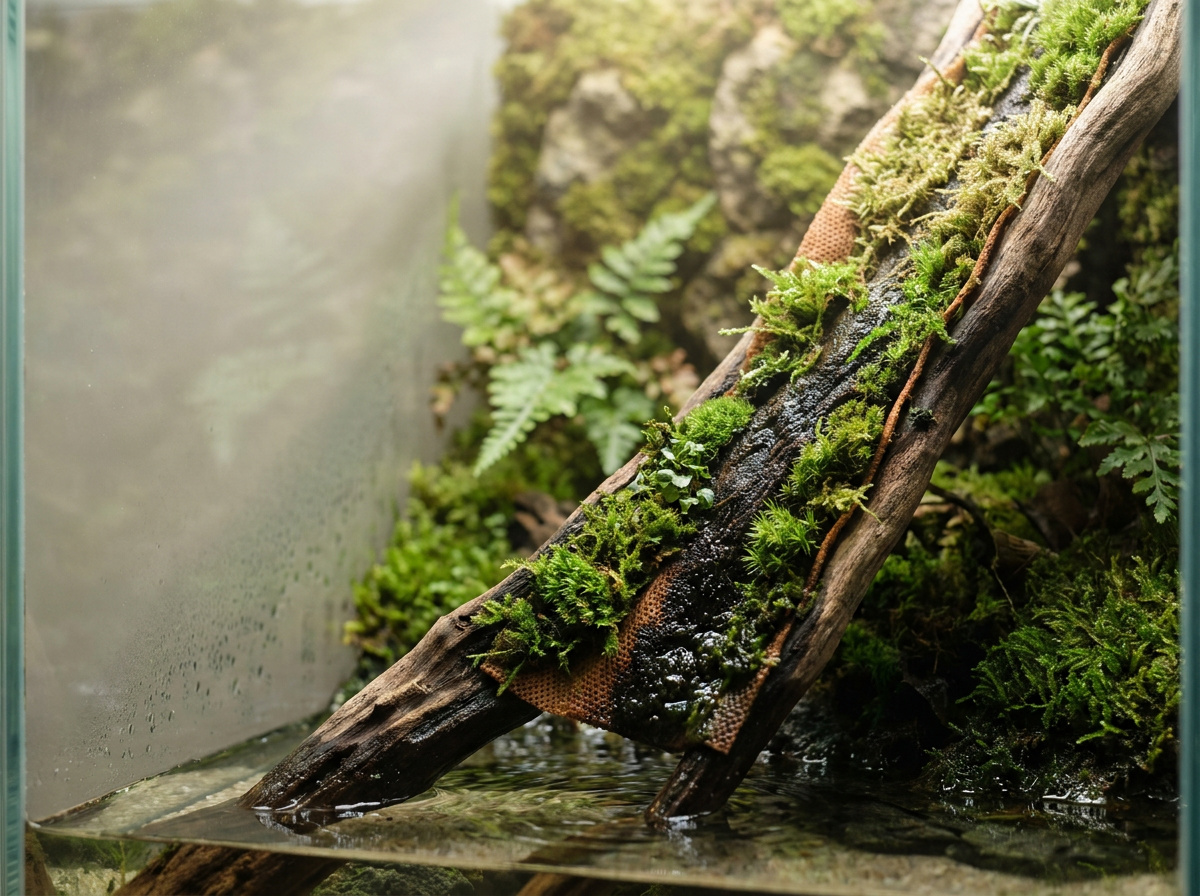
Moss Rarely Grows in Completely Dry Places
When observing moss in nature, it is common to find it growing:
- Along riverbanks
- Beside waterfalls
- On roots near streams
- Across wet cliff faces
- Along humid forest surfaces
- On rocks that remain damp from splashing water
These environments all share one important feature:
Moisture is constantly moving through the surface.
The moss is not surviving because it is underwater.
It survives because the surrounding surface remains consistently damp over long periods of time.
This is one of the most important concepts in paludarium and habitat terrarium design.

Understanding Moisture Transition Zones
A moisture transition zone is the area where water and air meet.
These areas are extremely biologically active because they provide:
- Constant humidity
- Oxygen circulation
- Surface moisture
- Occasional water movement
- Stable hydration without full submersion
This creates ideal conditions for:
- Mosses
- Liverworts
- Small ferns
- Epiphytic plants
- Biofilm and microorganisms
In nature, many moss species actually prefer these transition zones rather than fully submerged environments.
This explains why moss often thrives:
- just above water,
- beside dripping surfaces,
- or across damp hardscape that never fully dries out.
Important Note
Moisture-wicking surfaces do not replace overall humidity systems inside a paludarium.
Healthy moss growth still depends on:
- stable humidity,
- proper airflow,
- suitable lighting,
- and consistent moisture within the environment.
Foggers, misting systems, damp substrates, peat-based backgrounds, clay-based walls, and humid hardscape design still play important supporting roles.
Moisture-wicking materials simply help guide and distribute water across surfaces more consistently, especially across branches, rocks, walls, and transition zones that would otherwise dry too quickly.
Why Moss Often Fails in Artificial Setups
Many beginners assume moss only needs occasional misting.
However, moss attached to hardscape above water often dries out because:
- wood loses moisture quickly,
- rock surfaces dry rapidly,
- airflow removes humidity,
- misting only provides temporary moisture,
- upper hardscape becomes disconnected from water sources.
The result is usually:
- crispy moss,
- browning tips,
- patchy growth,
- detached moss,
- or stagnant unhealthy surfaces.
The issue is not always humidity alone.
Very often:
the surface itself is no longer connected to a stable moisture source.

How Water Can Travel Across Surfaces
One of the most fascinating parts of paludarium design is that water does not need to stay in one location.
Using moisture-wicking materials, water can:
- travel upward,
- travel downward,
- spread sideways,
- cross dry hardscape,
- and create biologically active growing surfaces.
This process is known as passive moisture transfer.
Instead of spraying water repeatedly, the surface itself slowly carries and distributes moisture over time.
This allows:
- moss to remain hydrated,
- roots to stay damp,
- epiphytes to establish,
- and hardscape surfaces to become living ecosystems.
Water Moving Upward
One common method involves allowing a moisture-wicking surface to touch shallow water below.
As water slowly rises through the material:
- the lower portion remains saturated,
- the middle section stays damp,
- and the upper area supports moss growth above the waterline.
This creates a natural moisture gradient similar to stream-edge environments.
Over time:
- moss colonizes the surface,
- roots attach naturally,
- and the material visually disappears into the ecosystem.

Water Moving Downward
Moisture pathways do not only move upward.
In many paludariums, water slowly trickles downward from:
- waterfalls,
- drip systems,
- return outlets,
- seepage walls,
- or overhead humid zones.
Without a moisture-distributing surface, water usually flows too quickly and leaves surrounding areas dry.
Moisture-wicking surfaces help slow and spread the water:
- guiding it across hardscape,
- distributing hydration more evenly,
- and creating larger humid growing zones.
This is why moss often appears naturally along waterfall edges and damp cliff faces in rainforest environments.

Water Moving Across Hard Surfaces
This is often the biggest realization for hobbyists.
Normally:
- vertical rocks stay dry,
- branches dry unevenly,
- and hardscape surfaces remain biologically inactive.
However, moisture-wicking surfaces can spread water laterally across the environment.
This creates:
- moss corridors,
- living branch systems,
- hydrated root pathways,
- active cliff faces,
- and connected ecosystems.
Instead of isolated wet spots, the entire hardscape becomes part of the moisture system.
This creates a much more natural and stable environment over time.

Different Moisture-Wicking Approaches
There are multiple ways hobbyists create living moisture surfaces inside paludariums.
Some systems focus on:
- precision moisture routing,
- while others prioritize broad surface coverage.
For smaller and more controlled applications, narrow moisture-wicking wraps are commonly used around:
- branches,
- roots,
- transition edges,
- and small hardscape zones.
These are useful for:
- nano paludariums,
- emersed moss growth,
- and targeted hydration paths.
For larger setups, broader moisture-distributing sheets are often used behind:
- moss walls,
- vertical backgrounds,
- humid cliff systems,
- and large-scale planted surfaces.
These larger systems:
- distribute water over wider areas,
- support larger moss colonies,
- and create more continuous living walls.
Each approach serves slightly different habitat-building goals depending on the size and complexity of the setup.

Materials Commonly Used for Living Moisture Surfaces
Different hobbyists use different moisture-wicking materials depending on the type of environment they are building.
For smaller and more controlled applications, narrow moisture-guiding wraps are commonly used around:
- branches,
- roots,
- transition edges,
- and small hardscape zones where moss or epiphytes need stable surface moisture.
These are especially useful in nano paludariums and detailed branch systems where water needs to travel precisely across narrow surfaces.
For larger environments such as:
- moss walls,
- humid cliff systems,
- vertical planted backgrounds,
- and broad living surfaces,
larger moisture-distributing sheets are often used instead. These spread water across wider areas and create more continuous humid growing zones over hardscape.
Both approaches follow the same principle:
creating stable moisture pathways that allow living surfaces to remain biologically active over time.

For hobbyists exploring these systems:
- narrow moisture-guiding wraps are often used for precision branch and root work,
- while larger moisture-distributing sheets are commonly used for moss walls and broader humid surfaces.
You can explore both approaches here:
- Moisture-Guiding Wrap Materials (DOOA Terra Tape) →
- Moss Wall & Moisture Surface Materials (Hygrolon) →
Creating Living Surfaces Instead of Decorative Surfaces
One of the major differences between advanced paludariums and decorative terrariums is that the surfaces themselves become biologically active.
Over time:
- moss spreads naturally,
- roots attach deeper,
- humidity stabilizes,
- biofilm develops,
- microorganisms establish,
- and the environment becomes more self-sustaining.
Instead of simply decorating hardscape with moss, the goal becomes:
creating stable living moisture zones that continuously support growth.
This is what gives mature paludariums their soft, aged, rainforest appearance.
Final Thoughts
Understanding how moisture moves across surfaces completely changes the way many hobbyists approach moss growth and paludarium design.
Rather than relying purely on misting or spraying, successful systems usually focus on:
- stable moisture pathways,
- passive hydration,
- humid transition zones,
- and surfaces that continuously support plant life.
Whether using narrow moisture routes for branch systems or larger humid walls for vertical landscapes, the core principle remains the same:
Water movement creates living surfaces.
And once those surfaces remain consistently active, moss and epiphytic plants naturally begin to follow.


