
Growing Above Water: Volcanic Pots, Wabi-Kusa & Rock Planting
This guide is created by Green Chapter — Nature Workshop Studio, where we focus on creating living ecosystems through hands-on experience. We share practical insights across terrariums, aquascaping, plants, and natural systems to help you build and care for your own.
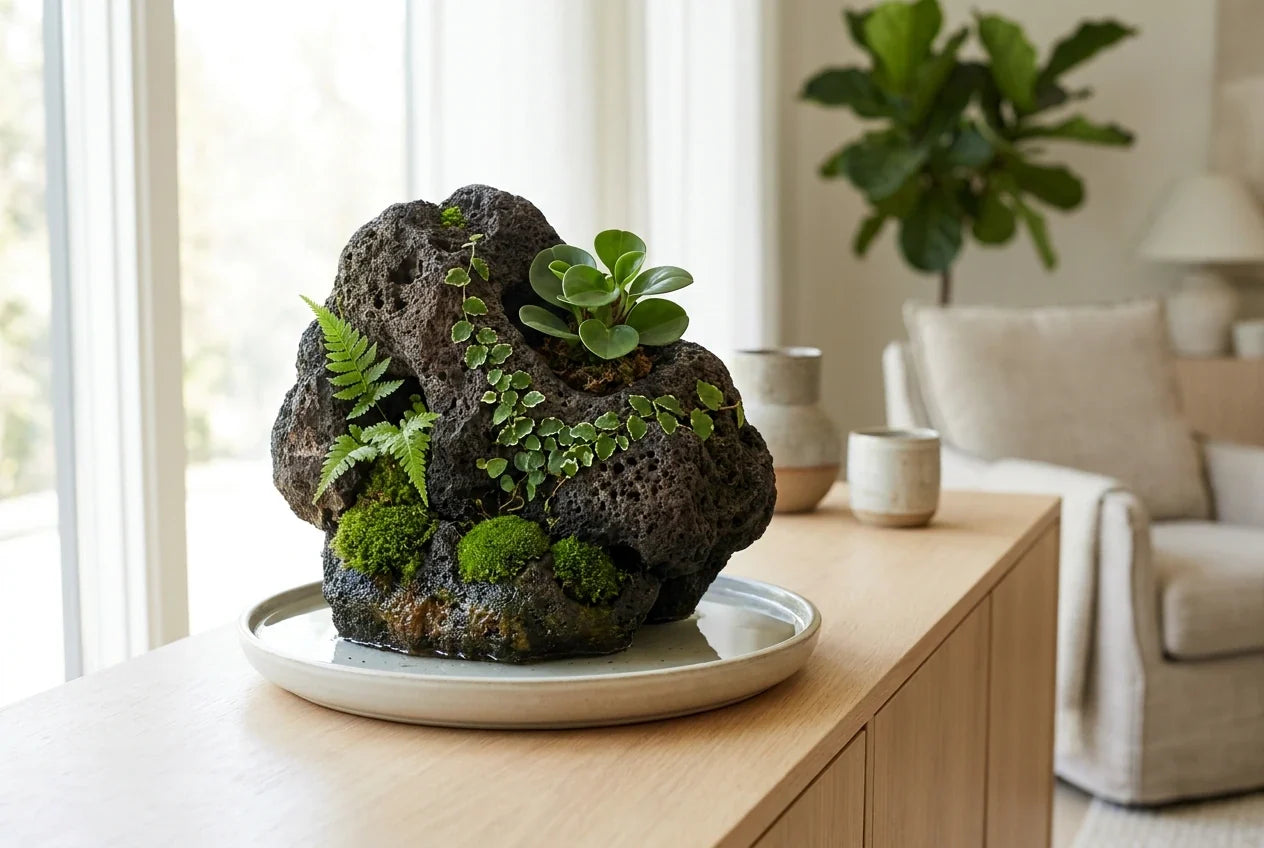
Growing Above Water: Wet Roots, Leaves in Air
Plants do not always need to grow from a conventional flowerpot.
A shallow tray of water, a planted volcanic pot, a Wabi-Kusa arrangement or even a piece of porous rock can become a small living feature for a shelf, desk or plant corner at home.
These displays can look very different, but they share one simple idea:
Water below. Roots stay moist. Leaves grow in air.
The trick is not to keep every plant as wet as possible. It is to give the roots the amount of moisture they need while the leaves grow normally above water.
Here are three ways to try it.

Three Ways to Grow Above Water
| Volcanic Pot | Wabi-Kusa | Rock Planting | |
|---|---|---|---|
| The idea | Plant inside a porous pot sitting in shallow water | Grow suitable aquarium plants with wet roots and leaves above water | Establish plants and moss directly on moist rock |
| Good for | Compact tabletop displays | Lush emersed aquatic planting | Natural, sculptural planted hardscape |
| Water | Shallow reservoir beneath the pot | Planting base stays consistently wet | Moisture reaches selected areas of the rock |
| Start with | Pot + tray + plant | Planting base + aquatic plants | Volcanic rock + moss/plants |
They use the same broad principle, but they are not the same growing method.
1. Volcanic Pot
A volcanic pot is one of the simplest ways to try growing above water.
Instead of placing the pot on a dry saucer, the lower portion sits in a shallow reservoir of water. The planting material inside stays in contact with moisture while the foliage remains completely above water.
The porous structure of some volcanic pots can also help distribute moisture around the planting area. However, volcanic rock varies considerably in pore size and structure, so do not assume every pot will move water in exactly the same way.
What You Need
- Volcanic pot
- Shallow tray or dish
- Suitable planting material
- Plant
- Moss, if desired
- Suitable light
Choosing a Plant
Think about how wet the planting pocket will remain.
Mosses and plants that naturally appreciate consistently moist conditions are easier starting points. Depending on the particular setup, suitable Begonia, small ferns, creeping Ficus, certain Solanum, butterworts and other moisture-loving plants can all create very different styles.
The important point is not the name on a plant list.
Choose the plant for the moisture conditions your pot actually creates.
A plant that enjoys a moist, aerated root zone may not tolerate having its crown or entire root system permanently underwater.
Setting It Up
Add the planting material and establish the plant as you would in a small container, keeping the crown or growing point at an appropriate level.
Place the pot into its tray and add a small amount of water.
Start with the water relatively low. Allow the bottom of the pot or planting material to maintain contact with the reservoir and observe how moist the root zone becomes.
If it remains too dry, increase the water level gradually.
If the planting material becomes completely saturated or the plant begins to deteriorate, reduce it.
The correct waterline depends on the pot, planting material and plant — not on a fixed measurement.

2. Wabi-Kusa
Wabi-Kusa takes the idea in a different direction.
Instead of starting with a terrestrial houseplant, it uses aquatic and marginal plants that are capable of growing above water.
Their roots remain in a consistently wet planting base while their leaves develop in air.
What You Need
- Shallow container or tray
- Wabi-Kusa or suitable planting base
- Suitable aquarium plants
- Light
- Water
Many plants familiar to planted-aquarium hobbyists are not restricted to life underwater.
In nature, some occur around streams, wetlands and seasonally flooded areas where water levels change. Depending on the species and conditions, they may grow submerged at one time and above water at another.
That makes them useful for creating lush miniature plant displays without keeping the entire arrangement underwater.
Expect the Leaves to Change
A plant moved from an aquarium into an emersed display may not immediately look perfect.
Leaves that developed underwater are adapted to submerged conditions. Once the plant begins growing in air, it may produce new leaves with a different size, thickness, texture or shape.
Some older submerged leaves may decline during the transition.
This does not automatically mean the plant is dying.
Look for healthy new shoots and leaves adapted to growing above water.
Help Aquarium Plants Make the Transition
Do not move delicate submerged plants straight from an aquarium into a hot, dry position.
Keep the planting base consistently wet and initially provide relatively humid conditions around the foliage. As new emersed growth develops, the plants can gradually become accustomed to greater airflow.
Good light helps, but excessive light combined with dry air can dehydrate transitioning plants quickly.

3. Planting Directly on Volcanic Rock
For a more natural appearance, the rock itself can become the planting structure.
Moss can spread across damp surfaces while suitable plants establish roots in cracks, cavities or small pockets of growing material.
This produces a very different effect from using a volcanic pot.
Instead of seeing a container with a plant inside it, the objective is for the plant and rock to gradually become one composition.
What You Need
- Porous volcanic rock
- Moss and/or suitable plants
- Small amount of appropriate growing material where required
- Plant attachment material where required
- Reliable moisture source
- Light
Look for Natural Planting Pockets
A useful rock is not simply the one with the most holes.
Look at its shape.
Crevices can hold roots and planting material. Depressions may remain wetter. Vertical faces may suit creeping growth or moss. Higher exposed areas may remain considerably drier than the bottom of the same rock.
Use these differences rather than trying to make the entire rock equally wet.
Moss may be established directly against a suitably damp surface, while larger rooted plants can be positioned into cavities containing a small amount of appropriate growing material.
Small ferns, Begonia, creeping Ficus and other moisture-loving or lithophytic plants can create very different effects depending on the moisture available.
Let the Plant Follow the Rock
Do not try to fill every opening immediately.
Start with a few deliberate planting points and allow creeping plants, moss and roots to gradually occupy the structure.
Over time, this usually produces a more natural result than covering the entire rock on the first day.

Want to understand the science?
Our Knowledge Hub article Why Plants Can Grow on Wet Rock Without Soil explores porous structure, root aeration, moisture movement and how plants establish on rock in greater detail.
How Does the Water Reach the Roots?
You do not need a pump for every above-water display.
In a simple setup, the shallow water below acts as a moisture reservoir.
When planting material or porous rock remains in contact with that water, moisture can move through sufficiently connected small spaces by capillary action.
But this has limits.
The amount and distance that water moves depends on the material, pore structure, planting medium and how well they contact the reservoir.
Volcanic rock does not magically pump water upward, and two pieces of volcanic rock may behave quite differently.
This is why observation is more useful than following a universal water depth.
Check the actual planting area.
If it stays appropriately moist, the reservoir is doing its job.
Choosing Plants: Think in Moisture Zones
Instead of asking only:
"Can this plant grow on volcanic rock?"
ask:
"How wet does this plant want its roots to be?"
A simple way to think about your choices is:
Very Wet
Suitable bog and wet-margin plants can tolerate conditions that would be excessive for many ordinary terrestrial plants.
Some butterworts and other bog-associated plants can work here, provided their particular water and substrate requirements are respected.
Continuously Moist
This is useful territory for many mosses, suitable ferns, Begonia and other plants associated with humid, moist environments.
Moist but Well Aerated
Some creeping Ficus, suitable Solanum and many other terrestrial plants may appreciate regular moisture while still requiring good oxygen around their roots.
Emersed Aquatic
Wabi-Kusa uses a different group: aquatic and marginal plants capable of maintaining wet roots while producing foliage above water.
These are starting points rather than strict categories. Even closely related plants can have different requirements.

Light Still Matters
Growing above water does not mean the plant can be placed anywhere in the room.
Most displays still need good plant-growing light.
A bright position or suitable plant light is generally more reliable than a dark shelf. However, strong direct sun can heat a small container quickly and increase evaporation.
This is particularly important for Wabi-Kusa and very small reservoirs.
Watch the plants rather than simply increasing light.
Pale, stretched growth can indicate insufficient light, while bleaching, scorching or very rapid drying may indicate that conditions are too intense.
Keep the Water Simple
Once the display is established, one of the main jobs is simply keeping the reservoir from drying out.
Small shallow trays lose water quickly.
Top up as required, but do not automatically keep raising the waterline. The objective is to restore the reservoir to the level that works for that particular planting.
Also remove fallen leaves and decomposing material rather than allowing them to accumulate in the water or wet planting pockets.
Continuously moist is useful.
Stagnant, decomposing and completely saturated are not the same thing.
Simple Long-Term Care
These displays change as they mature.
Moss thickens. Creeping plants spread. Roots move farther into cracks. Wabi-Kusa plants can become surprisingly dense once established above water.
Maintenance is mostly about keeping that growth in proportion.
Top up
Maintain the working water level.
Trim
Cut back plants that begin overwhelming the composition.
Clean
Remove dead leaves and accumulated organic material.
Observe
Look at new growth and the actual root zone, not just the water in the tray.
Adjust
If one plant continually struggles while the others thrive, it may simply be unsuitable for that particular moisture zone.
If Something Isn't Working
The plant wilts even though there is water below
The root zone may not actually be receiving enough moisture. Check the contact between the water, rock and planting material.
The base of the plant starts rotting
The water may be too high, the planting pocket too saturated, or the plant may simply require a more aerated root zone.
Moss keeps drying out
The rock surface may not remain sufficiently moist, or the surrounding air may be too dry for that moss.
Aquarium leaves deteriorate after moving above water
Look for new growth. The plant may be replacing submerged foliage with leaves better adapted to air.
The water smells or becomes dirty
Remove decaying organic matter and clean or refresh the reservoir. Check whether too much planting material is remaining permanently submerged.
One plant thrives and another doesn't
They may have different moisture requirements. Move the struggling plant to a wetter or drier position rather than changing the whole display immediately.
Build Your Own Growing-Above-Water Display
You do not need a complicated system to begin.
Volcanic Pot
Start with:
Volcanic pot + shallow tray + suitable plant
Add planting material and moss according to the plant you choose.
Good starting point for:
A compact planted feature for a desk, shelf or tabletop.
Wabi-Kusa
Start with:
Planting base + shallow container + suitable aquatic plants + light
Keep the base wet while the plants establish their above-water growth.
Good starting point for:
Aquarium plant lovers who want to explore plants outside the aquarium.
Rock Planting
Start with:
Volcanic rock + moss + suitable plants
Add planting or attachment material only where it is needed and use the natural cracks and moisture zones of the rock.
Good starting point for:
A more natural, sculptural living display or as inspiration for larger paludarium and riparium planting.

A Different Way to Bring Plants Home
A houseplant does not always have to mean a plastic nursery pot inside a decorative planter.
Plants can emerge from a piece of volcanic rock, spread across a damp stone surface, or transform from submerged aquarium growth into a miniature landscape above water.
The important part is understanding the relationship between the plant and its root zone.
Water below. Roots stay moist. Leaves grow in air.
Start with the form you like, choose plants that suit the moisture it provides, and let the display develop from there.


