
How to Care for Venus Flytraps in Singapore — And Why There Are So Many Different Types
This guide is created by Green Chapter — Nature Workshop Studio, where we focus on creating living ecosystems through hands-on experience. We share practical insights across terrariums, aquascaping, plants, and natural systems to help you build and care for your own.
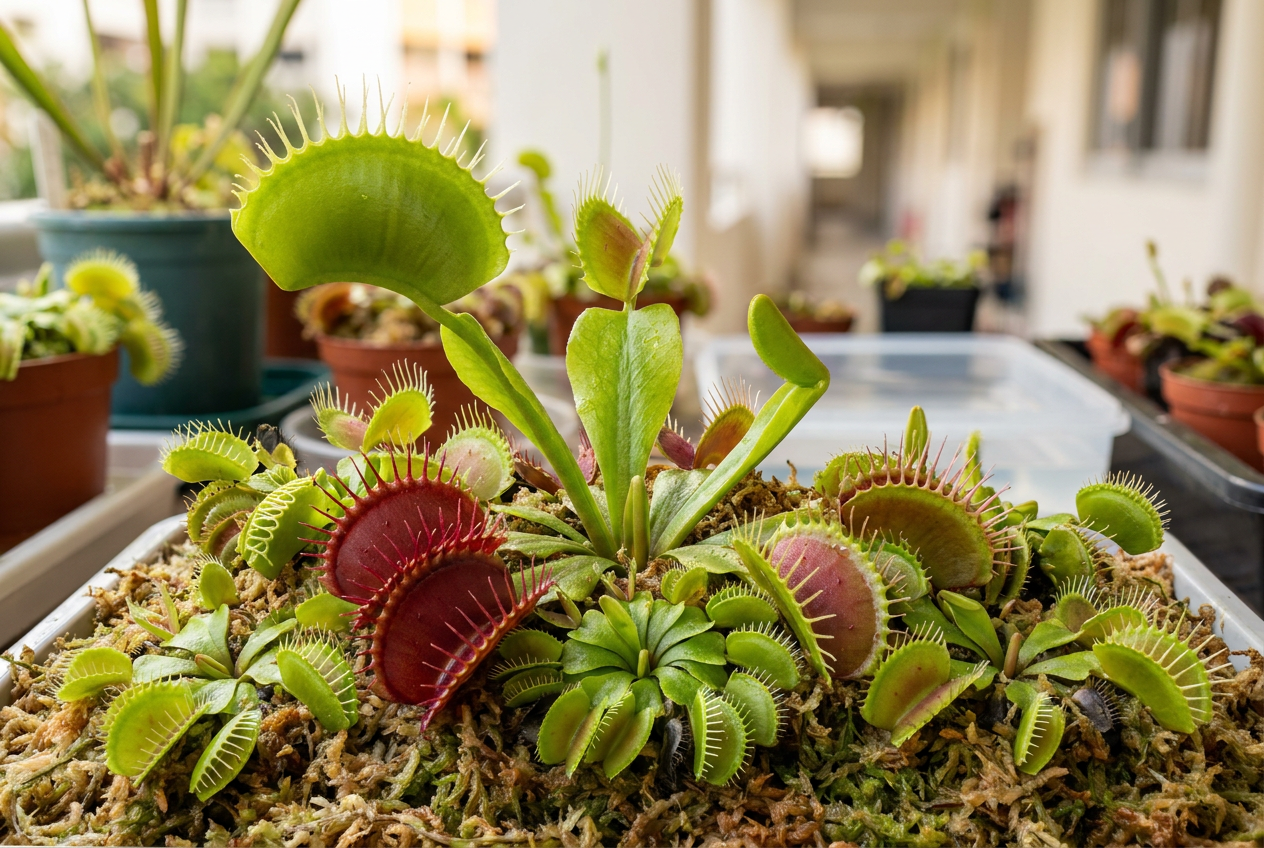
The Venus Flytrap is one of the most iconic carnivorous plants in the world.
Its moving traps, strange feeding mechanism, and alien-like appearance make it fascinating even to people who have never grown plants before.
But once you start exploring the world of Venus flytraps, you quickly realize something surprising:
there are hundreds of different-looking Venus flytraps available.
Some have giant traps.
Some are deep blood red.
Some have twisted mutant traps that barely look functional at all.
At the same time, many beginners in Singapore struggle to keep even a normal Venus flytrap alive for more than a few months.
So why are there so many Venus flytrap varieties?
And how do you actually grow them successfully in Singapore’s tropical climate?
This guide covers both.
There Is Actually Only One Venus Flytrap Species
Many beginners assume giant Venus flytraps, red Venus flytraps, and mutant Venus flytraps are different species.
They are not.
There is only one true species:
Venus Flytrap
Everything else you see are cultivars.
A cultivar means:
a cultivated plant variety selected and reproduced for specific traits.
This is similar to how there are many varieties of roses, orchids, or bettas despite belonging to the same species group.
Why Are There So Many Venus Flytrap Varieties?
Venus flytraps naturally produce strange mutations quite easily.
Over decades, growers and collectors selectively bred these unusual traits into stable cultivars.
This created an enormous collector market.
Giant Venus Flytraps
Some breeders selectively breed for larger and more powerful traps.
These cultivars can produce dramatically oversized traps compared to normal Venus flytraps.
Popular giant cultivars include:
- B-52
- DCXL
- Ginormous
- King Henry
These giant forms are especially popular because they exaggerate the iconic “mouth-like” appearance of the plant.

Red Venus Flytraps
Some cultivars are selectively bred for intense coloration.
Under strong lighting, these plants can become:
- dark crimson
- wine red
- deep purple-red
Popular red cultivars include:
- Royal Red
- Red Dragon
- Red Piranha
Many collectors love red cultivars because they look far more dramatic than standard green flytraps.
However, strong sunlight is usually required to maintain these colors.
Without enough light, many red varieties slowly turn greener.

Mutant and “Freak” Venus Flytraps
One of the biggest reasons Venus flytraps became collector plants is because of bizarre natural mutations.
Some mutations produce:
- fused teeth
- saw-like teeth
- distorted traps
- permanently open traps
- twisted growth
- cup-shaped traps
These are often called:
- mutant cultivars
- freak cultivars
Popular examples include:
- Alien
- Wacky Traps
- Fused Tooth
- Cupped Trap
Ironically, some of these mutant traps are actually worse at catching insects than normal Venus flytraps.
Collectors grow them mainly because they look so unusual.

Tissue Culture Changed the Venus Flytrap Hobby
Many rare Venus flytraps are reproduced using tissue culture.
This allows growers to clone a plant perfectly while preserving the exact mutation or color trait.
Without cloning:
- giant traps may disappear in seedlings
- mutant traits may not reproduce consistently
- red coloration may become unstable
Tissue culture helped make rare cultivars more widely available around the world.
Why Venus Flytraps Often Struggle in Singapore
Venus flytraps naturally come from temperate wetlands in North and South Carolina in the United States.
Singapore’s climate is completely different:
- constant tropical heat
- no winter
- intense afternoon sun
- warm nights year-round
This means growers in Singapore need to adapt their care methods carefully.
Sunlight Is the Most Important Factor
This is the number one reason Venus flytraps fail locally.
Venus flytraps are not indoor decorative houseplants.
They are outdoor bog plants that evolved under intense sunlight.
Best Growing Locations in Singapore
- HDB corridor with morning sun
- bright balcony
- rooftop garden
- outdoor windowsill with airflow
Aim for:
- 4–6 hours of direct morning sunlight daily
- bright indirect light for the rest of the day
Without enough light:
- traps become smaller
- leaves stretch and become floppy
- red coloration disappears
- growth weakens dramatically

Protect Them From Singapore’s Harsh Afternoon Heat
Although Venus flytraps love sunlight, Singapore’s afternoon heat can overheat small pots very quickly.
The roots dislike extreme heat buildup.
If your growing area receives harsh west sun:
- use 50% shade netting
- improve airflow
- avoid black pots
- keep tray water cooler
Morning sun is usually safest.
The Tray Watering Method
Venus flytraps naturally grow in permanently damp bog conditions.
Their soil should never fully dry out.
Correct Watering Setup
Place the pot inside a shallow tray containing:
- around 2–4 cm of water
This allows moisture to wick upward naturally.
The tray method:
- stabilizes moisture
- cools roots
- mimics natural bog environments

Water Quality Matters More Than Most Beginners Realize
Venus flytraps are extremely sensitive to minerals.
Best Water Types
Use:
- distilled water
- reverse osmosis (RO) water
- rainwater
Singapore tap water is relatively clean, but minerals still accumulate slowly over time.
Mineral buildup can eventually cause:
- black roots
- deformed traps
- slow decline
- weak growth
If you must use tap water:
- occasionally flush the pot thoroughly from above
- avoid long-term mineral accumulation
Never Use Normal Potting Soil
This is one of the fastest ways to kill a Venus flytrap.
Their roots evolved for nutrient-poor bog environments.
Correct Soil Mix
Use:
- 50% peat moss or sphagnum moss
- 50% perlite
Avoid:
- compost
- garden soil
- fertilizer-rich mixes
- decorative potting soil

Never Fertilize Venus Flytraps
Unlike most plants, Venus flytraps absorb nutrients mainly through captured insects rather than roots.
Chemical fertilizers can:
- burn roots
- deform traps
- destabilize the plant
Healthy outdoor Venus flytraps in Singapore usually catch enough insects naturally.
Feeding Venus Flytraps in Singapore
If grown outdoors:
- ants
- gnats
- spiders
- flies
…will naturally feed the plant.
Indoor plants under grow lights may occasionally need feeding.
Indoor Feeding Rules
- feed only once every 1–2 weeks
- feed only one trap at a time
- use insects smaller than half the trap size
Never feed:
- meat
- rice
- fish food
- oversized insects

Stop Triggering the Traps for Fun
Every trap closure costs the plant energy.
Repeatedly triggering traps weakens the plant significantly.
A trap can only close a limited number of times before dying naturally.
If traps close without catching food:
- energy is wasted
- growth slows
- traps blacken faster
This is one of the most common mistakes among beginners and children.
The Biggest Singapore Challenge — Dormancy
In nature, Venus flytraps experience cold winter dormancy for around 2–3 months yearly.
Singapore has no winter season.
Without dormancy, many imported Venus flytraps eventually weaken after prolonged growth in constant tropical warmth.
Two Common Dormancy Solutions in Singapore
1. Refrigerator Dormancy Method
Some hobbyists simulate winter manually.
Around November:
- reduce watering slightly
- keep media damp
- place the potted plant inside a plastic bag
- store in refrigerator vegetable compartment
Dormancy usually lasts:
- around 2–3 months
Check weekly for:
- fungus
- rot
- dryness
After dormancy:
- gradually reintroduce sunlight
2. Tropicalised Local Cultivars
Some Singapore growers and tissue culture labs have acclimatised Venus flytraps over multiple generations.
These locally adapted plants are often:
- more heat tolerant
- more stable in tropical humidity
- less dependent on strict dormancy cycles
These are usually easier for beginners locally.

Final Thoughts
Venus flytraps are far more than simple “bug-eating novelty plants.”
Behind their traps lies an entire world of:
- selective breeding
- tissue culture
- collector cultivars
- bizarre mutations
- specialized tropical care
Even though there is only one true species, growers have created hundreds of unique forms through decades of cultivation and cloning.
In Singapore, success comes down to understanding one important truth:
Venus flytraps are not ordinary indoor houseplants.
Give them:
- strong sunlight
- pure water
- nutrient-poor soil
- constant moisture
- careful heat management
…and they can become one of the most rewarding carnivorous plants to grow locally.


