
How to Pot Succulents in Singapore (Soil, Watering & Root Health Guide)
This guide is created by Green Chapter — Nature Workshop Studio, where we focus on creating living ecosystems through hands-on experience. We share practical insights across terrariums, aquascaping, plants, and natural systems to help you build and care for your own.
Succulents are often described as easy plants, yet many beginners in Singapore struggle to keep them alive. Plants that look healthy at first slowly decline, even when watering seems controlled.
The issue is not effort — it is environment. In Singapore’s humidity, soil dries much more slowly than expected, and what works in dry climates often fails here.
Succulents rarely die from lack of water. They fail because they cannot dry out fast enough.
The System Behind Healthy Roots
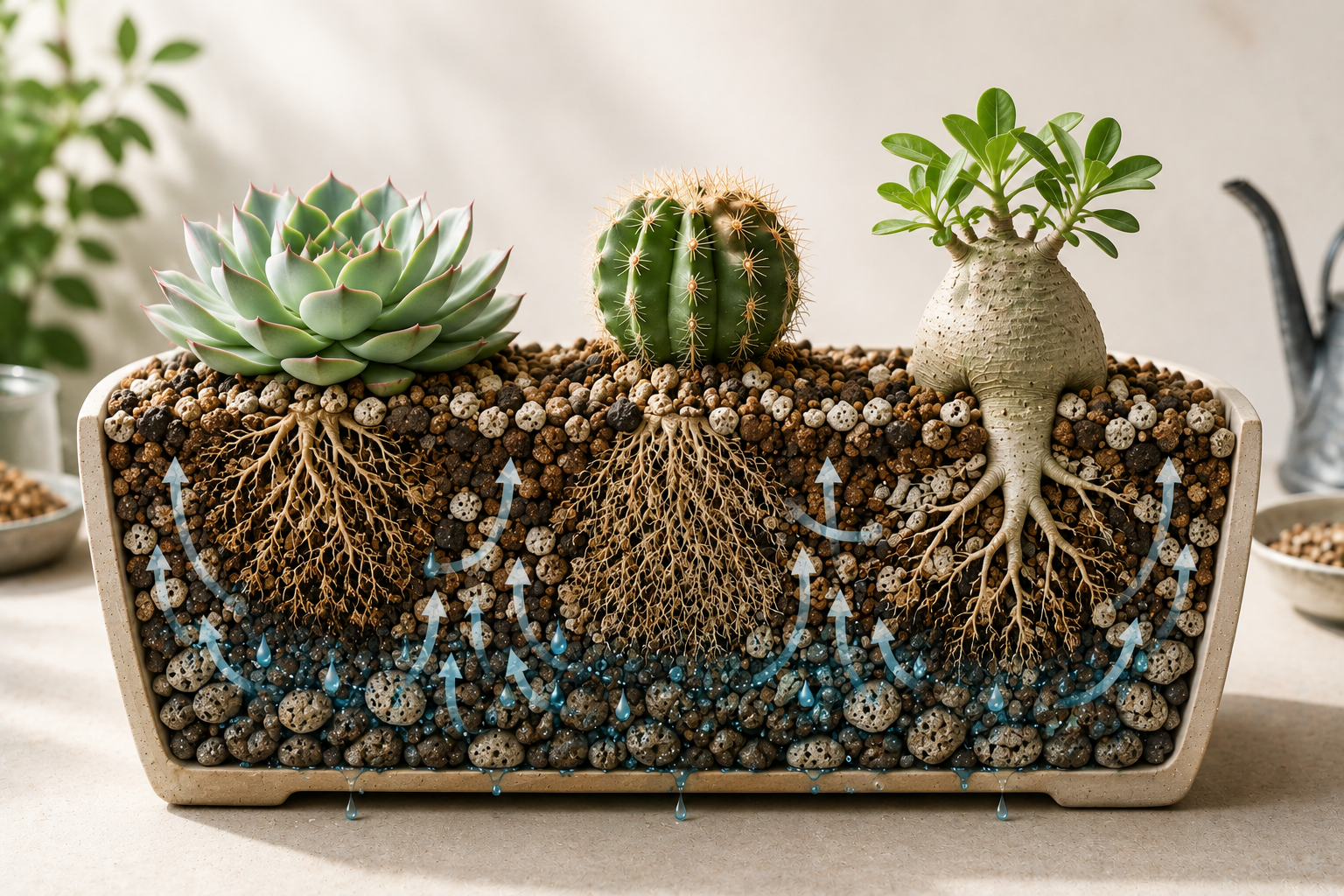
Instead of thinking about soil, pots, and watering as separate steps, it helps to see them as one system.
Roots need both water and oxygen. Water allows them to function, but oxygen keeps them alive. When soil stays wet for too long, air spaces disappear and roots begin to suffocate.
Everything you choose — from substrate to pot size — affects one outcome:
How quickly the root zone dries.

Understanding the Plant Types
Succulents, cactus, and caudex plants are often grouped together, but they store water differently and respond differently to moisture.

Succulents store water in their leaves and can tolerate short dry periods, but they are sensitive to poor airflow and damp soil.
Cactus store water in their stems and are adapted to much drier conditions. They use water slowly and require faster drying cycles.
Caudex plants store water in a swollen base. Many grow in cycles, so their watering needs change depending on whether they are actively growing or resting.
These differences do not require completely different care, but they do change how quickly each plant should dry.
Soil Mix — Focus on Behavior, Not Recipe
There is no perfect succulent soil mix. What matters is how the soil behaves in your environment.
A good mix holds some moisture while still allowing air to move through it. In Singapore, this usually means using a more open, fast-draining structure.
Fine materials tend to compact and hold too much water, while overly coarse mixes can dry too quickly. A balanced, small particle structure helps maintain both airflow and stability.

Substrate Materials (Singapore Context)
Instead of fixed recipes, it is more useful to understand what each material does.
Materials like pumice, perlite, mini LECA, and coarse volcanic sand form the structure of the mix. They keep the soil open and allow excess water to drain easily.
A smaller portion can include moisture-retaining components such as peat moss, compost, or akadama. These hold enough water for roots without slowing drying too much.
In humid conditions, it is safer to reduce the organic portion and rely more on structure.
Your mix is not about ingredients — it is about how fast it dries in your setup.

Choosing the Right Pot
The pot does not directly improve plant health, but it changes how the soil dries.
Terracotta allows moisture to evaporate through its walls, helping soil dry faster. This makes it a safer option for beginners in Singapore. Plastic and glazed pots retain moisture longer, which can work but requires more control.

Pot Size — A Common Hidden Problem
Pot size has a strong effect on how long soil stays wet.
A pot that is too large holds more soil than the plant can use, and that unused soil stays wet longer, creating a damp zone that increases the risk of rot.
Choosing a pot only slightly larger than the root system keeps drying more balanced and predictable.

Practical Setup Guide (By Plant Type)
Once the basics are clear, setup becomes easier to manage.
Succulents
A pot slightly wider than the root ball works well. The plant should sit at the same level it was previously growing, with leaves kept above the soil to avoid trapping moisture.
Cactus
Cactus generally prefer tighter pots with less excess soil. Many have shallow roots, so depth is less important than keeping the base exposed.
Burying the stem often leads to rot, especially in humid conditions.

Caudex Plants
Caudex plants require a slightly different approach. The roots should sit in the substrate, while the swollen base remains partially above the soil.
A good starting point is to expose around one-third to half of the caudex. This reduces moisture contact and improves airflow around the most sensitive part of the plant.


Good soil and watering cannot compensate for incorrect planting depth.
Do You Need a Drainage Layer?
Adding stones at the bottom of a pot does not improve drainage in the way many expect.
Water tends to sit above the layer rather than passing through it, which can create a wetter zone near the roots. A well-structured substrate is far more effective.
How to Pot Succulents
Potting is straightforward when the setup is correct.
Start with a suitable pot and fill it with your mix. Position the plant so the roots spread naturally, then fill around them without compacting the soil too tightly. Small air spaces help maintain airflow.

How to Water (Methods)
Watering becomes much easier when tied back to the root system.
The most reliable method is to water thoroughly from the top until water flows out of the drainage hole. This ensures the entire root zone is evenly hydrated. After that, allow the soil to dry fully before watering again.

Bottom watering can help when soil becomes too dry and repels water, but it works best as a supporting method rather than the main approach.

For newly repotted or rootless plants, lighter watering may be needed. The goal is to introduce slight moisture without fully saturating the soil.
Succulents respond best to clear wet and dry cycles, not constant moisture.
Knowing When to Water
Deciding when to water is more important than following a schedule.
Lifting the pot is one of the simplest methods. As the soil dries, the pot becomes noticeably lighter. Checking below the surface also helps, as the top layer can dry faster than deeper soil.

Over time, you will begin to recognise how long your setup takes to dry under your conditions.
Special Situations
After repotting, roots may be stressed, and heavy watering too soon can increase the risk of rot. Allowing some recovery time or watering lightly is often safer.
For rootless plants, some moisture is needed to trigger new growth, but too much can cause decay. Keeping the substrate slightly moist usually works best.
Indoor environments in Singapore tend to dry more slowly, so adjustments in soil mix or watering frequency are often needed.
Light and Airflow
Light affects more than just growth — it also influences how quickly soil dries.
Stronger light increases evaporation and encourages active growth, while weaker light slows both growth and drying. Airflow helps remove excess moisture and keeps conditions from becoming stagnant.

When light and airflow are limited, everything in the system dries more slowly.
Common Mistakes
Many beginner problems come from similar patterns. Overwatering, dense soil, oversized pots, and poor airflow all lead to slow drying conditions.
Focusing on how your setup behaves, rather than following fixed rules, makes it easier to avoid these issues.
Bringing It All Together
Succulent care becomes much simpler once you understand the system behind it.
Soil controls how water moves and how much air remains. Pot size determines how much moisture is held. Light and airflow influence how quickly everything dries.
When these factors are balanced, watering becomes easier to judge and plants become more stable over time.
Success is not about watering more or less — it is about creating a setup that dries at the right pace.


