
How Do You Feed Sundews (Drosera)?
This guide is created by Green Chapter — Nature Workshop Studio, where we focus on creating living ecosystems through hands-on experience. We share practical insights across terrariums, aquascaping, plants, and natural systems to help you build and care for your own.
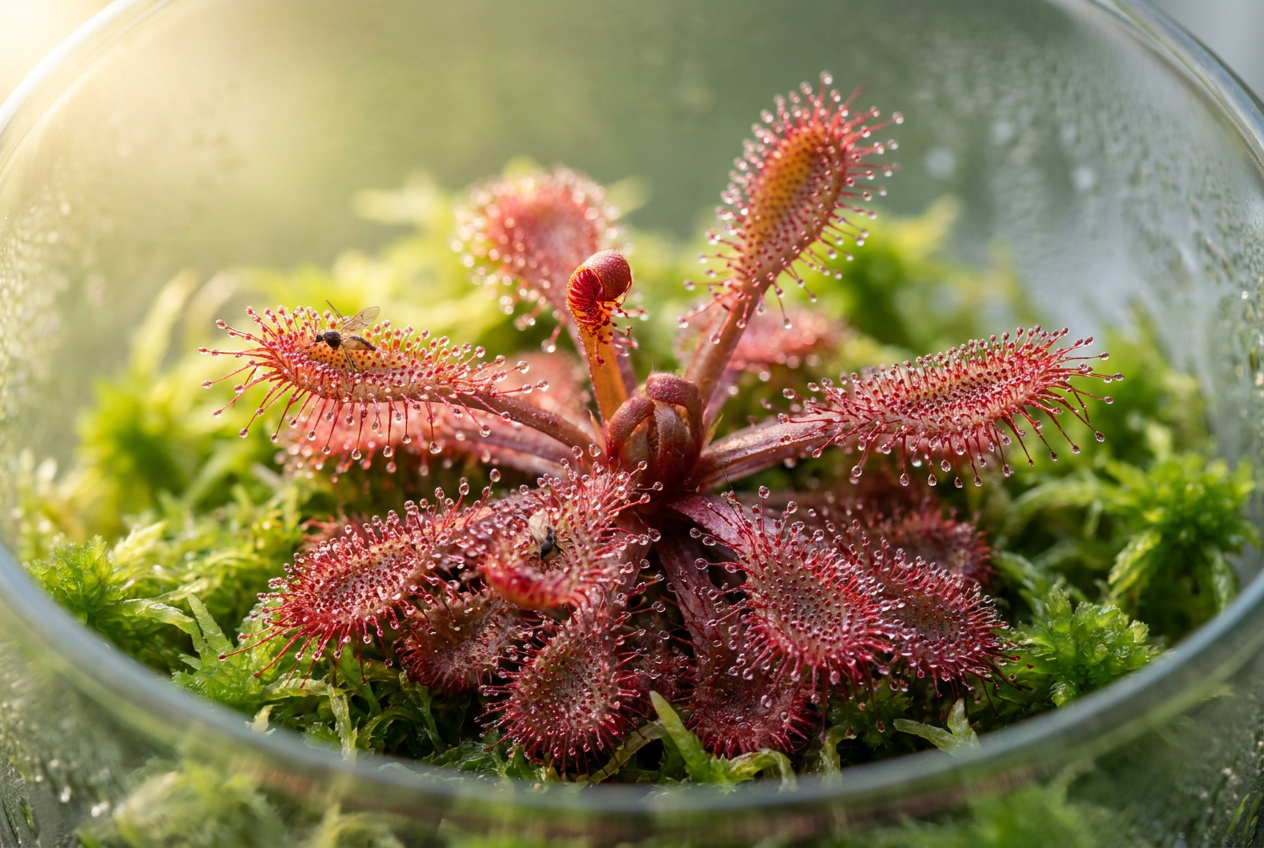
How Do You Feed Sundews (Drosera)?
Sundews, or Drosera, are often the plant that surprises people the most when they first enter the world of carnivorous plants.
At first glance, they look soft and delicate. Under good lighting, their leaves sparkle with tiny droplets that resemble morning dew. But those shimmering droplets are actually sticky traps designed to capture insects.
Unlike most plants, sundews do not rely only on their roots for nutrients. In the wild, they grow in nutrient-poor bogs and wetlands where the soil contains very little nitrogen. To survive, they evolved a completely different strategy — catching food directly with their leaves.
For beginners keeping sundews indoors or inside terrariums, feeding is usually one of the first questions that comes up.
Do they really need insects?
Can you feed them fish food?
How often should you feed them?
What happens if the plant has no dew?
The good news is that feeding sundews is actually quite simple once the plant is healthy.
How Sundews Catch Food Naturally
The leaves of a sundew are covered with tiny tentacles that produce a sticky substance called mucilage. This is the “dew” that gives the plant its name.
The droplets help attract insects by reflecting light and sometimes even producing a sweet scent. When a small insect lands on the leaf, it becomes trapped in the glue-like surface.
As the insect struggles, the sundew begins reacting. Nearby tentacles slowly bend toward the prey, increasing contact with the digestive glands. Some species can even curl the entire leaf around the insect.
The plant then releases digestive enzymes that break down the insect into nutrients the sundew can absorb directly through its leaves.
This is how sundews obtain important nutrients such as nitrogen and phosphorus in environments where normal plants would struggle to survive.

Do Sundews Need Feeding Indoors?
If your sundew is kept outdoors or near open windows, it may catch enough insects naturally.
Indoor terrariums and enclosed setups are different. Because there are fewer insects available, many indoor sundews benefit from occasional feeding.
Feeding can help encourage:
- Faster growth
- Stronger dew production
- Better coloration
- More frequent flowering
That said, feeding is not the most important factor.
A healthy sundew under strong lighting will usually do much better than a poorly lit sundew that is fed regularly.
Think of feeding as a supplement, not the foundation of care.
What Can You Feed a Sundew?
One of the reasons sundews are beginner-friendly is that they are not very picky about food.
Dried Bloodworms
This is one of the easiest feeding methods for indoor growers.
Simply soften a tiny piece of dried bloodworm with a drop of water and place it gently onto the sticky tentacles using tweezers or a toothpick.
Only use a very small amount. Sundews do not need large meals.
Crushed Fish Food
High-protein fish flakes or pellets can also work well.
Crush the food into tiny particles before applying it to the leaf surface. Using too much can lead to mold, especially in enclosed terrariums.
Live Insects
If you prefer a more natural approach, small live prey works extremely well.
Common options include:
- Flightless fruit flies
- Fungus gnats
- Springtails
Many terrarium keepers already culture springtails, so sundews often catch them naturally over time.
Diluted Foliar Fertilizer
Some experienced growers use highly diluted foliar fertilizers such as MaxSea.
This method should be used carefully and only in very small amounts directly on the leaves. Overdoing fertilizer can damage the plant.
For beginners, natural food sources are usually safer and simpler.

How Often Should You Feed a Sundew?
Beginners often assume carnivorous plants need frequent feeding, but sundews actually consume very little.
For most indoor setups:
- Feed only 2–3 leaves
- Once every 2–4 weeks
That is usually enough to support healthy growth.
Avoid feeding every leaf at once. Overfeeding can stress the plant and may encourage mold or rot in humid terrarium conditions.
A single small insect is often enough for an entire leaf.
Never Feed a Sundew Without Dew
This is one of the most important beginner rules.
If your sundew has little or no sticky dew, the plant is usually stressed.
Common causes include:
- Weak lighting
- Poor water quality
- Low humidity
- Heat stress
- Sudden environmental changes
- Recent repotting
Without dew, the plant cannot properly digest food. Adding food at this stage often causes the material to rot on the leaf instead.
Before feeding again, focus on improving the plant’s environment and allowing the dew to return naturally.

Light Is More Important Than Food
Many beginners focus heavily on feeding when the real issue is usually lighting.
Sundews are surprisingly light-hungry plants because producing sticky mucilage requires a lot of energy. Without enough light, the plant often loses its dew, becomes pale green, and grows weak over time.
Strong lighting helps with:
- Dew production
- Vibrant red coloration
- Compact healthy growth
- Faster recovery after feeding
- Better trapping response
Most indoor sundews do best with:
- Bright grow lights
- 12–16 hours of lighting daily
One of the easiest ways to judge sundew health is simply by observing the dew.
A healthy, well-lit sundew should look sticky, shiny, and active.
<!-- IMAGE INSERT — VIBRANT RED SUNDEW UNDER STRONG GROW LIGHTING INSIDE A CLEAN TERRARIUM SETUP -->
Sundews Are Surprisingly Easy Once Their Basics Are Right
Despite looking exotic, sundews are actually quite forgiving once you understand what they need.
Clean water, strong lighting, airflow, and occasional feeding are usually enough to keep them healthy for years.
In many cases, beginners run into problems not because they are underfeeding the plant, but because the lighting is too weak. Once the light improves, the dew returns — and the sundew starts behaving exactly the way it should.
And honestly, watching a sundew slowly curl around its prey is part of what makes keeping carnivorous plants so addictive in the first place.


