
Common Houseplant Pests: How to Identify, Prevent, Control, and Eliminate Them
This guide is created by Green Chapter — Nature Workshop Studio, where we focus on creating living ecosystems through hands-on experience. We share practical insights across terrariums, aquascaping, plants, and natural systems to help you build and care for your own.
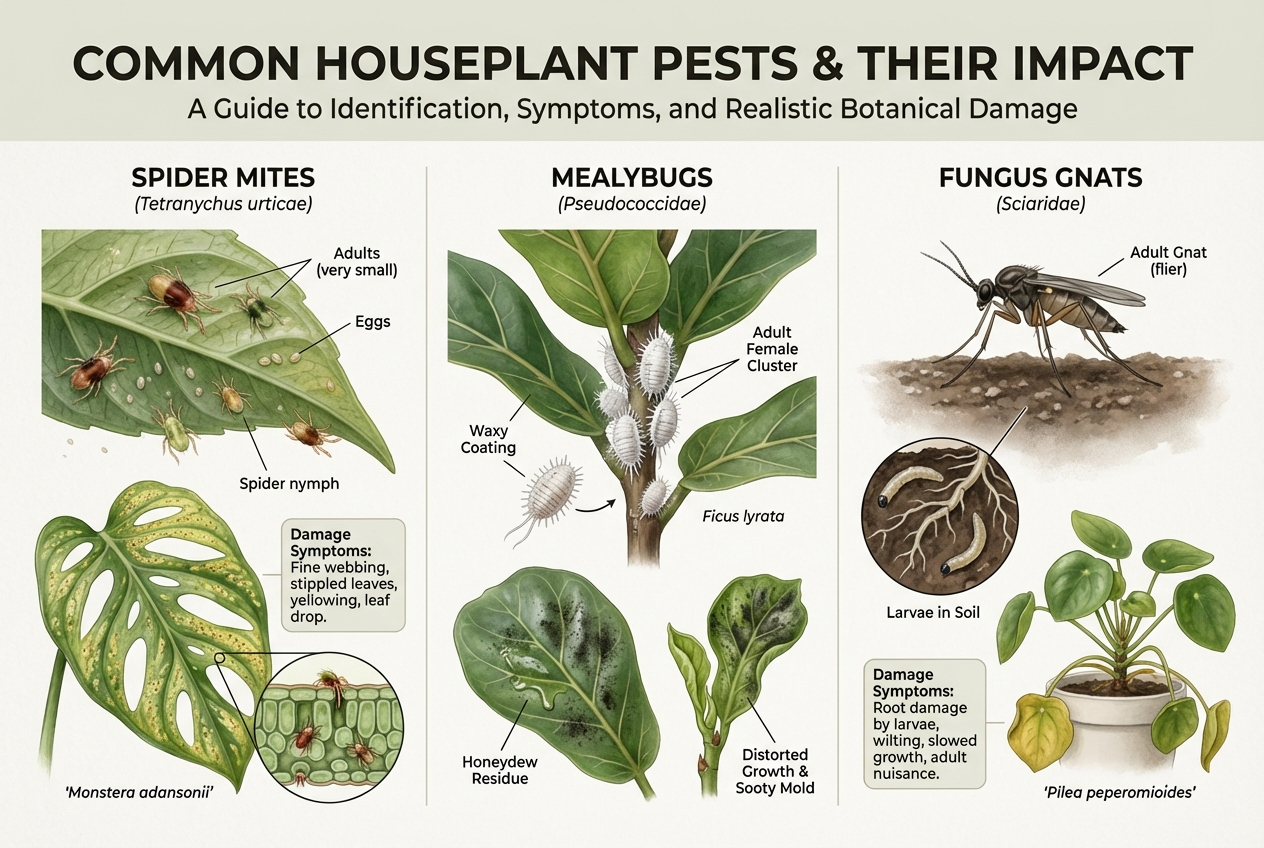
Houseplant pests often go unnoticed until the plant already looks weak, discolored, sticky, or dusty. Many indoor growers first assume the issue is watering, light, or fertilizer, but a closer inspection often reveals that insects or mites are the real cause. The good news is that most pest problems can be managed successfully when they are identified early and treated consistently.
This guide focuses on five of the most common indoor plant pests: fungus gnats, mealybugs, spider mites, aphids, and scale insects. Each one behaves differently. Some live in the potting media, some hide in stem joints, some target new growth, and some are so well camouflaged that they look like part of the plant itself. That is why correct identification is the first and most important step.

Fungus Gnats
Fungus gnats are one of the most common indoor plant complaints because the adults are easy to notice. They look like tiny dark flies or miniature mosquitoes and are often seen fluttering around pots, windows, or nearby lights. Their presence usually points to a persistently moist potting mix rather than a problem on the leaves themselves. University extension guidance consistently associates fungus gnats with overwatered houseplants and damp organic media.
The adult gnats are mostly a nuisance, but the larval stage is what matters for plant health. Fungus gnat larvae live in the growing medium. They are small, pale, worm-like, and usually hard to see unless the infestation is more advanced. In light infestations they often feed on fungi and decaying organic matter, but in larger numbers they may feed on root hairs and fine roots. This can weaken young plants, slow growth, and make already stressed plants decline further.
Fungus gnats usually appear when the soil stays wet for too long, especially in mixes rich in organic matter. Pots without enough drying time between waterings, low airflow, and cool damp conditions make the problem worse. The best control strategy is to target both adults and larvae at the same time. Yellow sticky traps help reduce the adult population, while allowing the top layer of potting media to dry more appropriately interrupts larval survival. BTI-based products and other targeted larval controls can also be useful for persistent infestations.

Quick take
If you see tiny black flies around the pot, the real problem is usually in the soil moisture cycle, not on the foliage.
Mealybugs
Mealybugs are among the most recognizable houseplant pests because they appear as white, cottony clusters on the plant. They are commonly found in leaf axils, along stems, under leaves, and sometimes near the crown or root zone. Their white waxy covering protects them and makes infestations look deceptively soft or harmless, even though they can spread and weaken the plant significantly.
These pests are sap-feeders. They insert their mouthparts into plant tissue and draw out plant fluids over time. Affected plants may show yellowing, reduced vigor, stunting, leaf drop, or overall decline. Mealybugs also produce honeydew, a sticky sugary residue that can coat leaves and nearby surfaces. Honeydew often leads to the growth of sooty mold, which darkens plant surfaces and reduces the plant’s clean appearance.
Mealybugs often enter the home on newly purchased plants or by spreading from one infested plant to another. Because they hide in crevices and sheltered areas, many growers remove the obvious cottony clusters but miss insects tucked deeper in the plant. Early infestations can sometimes be managed by wiping or dabbing insects with alcohol and repeating contact sprays such as insecticidal soap or certain labeled oils. More severe infestations may require repeated treatment, pruning of badly infested sections, or escalation to a systemic control if appropriate for the plant and product label.

Quick take
Mealybugs are not just “white fluff.” They are hidden sap-feeders that often return if you only treat what is easy to see.
Spider Mites
Spider mites are one of the easiest pests to miss in the early stage and one of the most damaging when ignored. They are tiny and often not noticed until the plant begins to show symptoms such as fine pale speckling, a dull grayish cast, bronzing, or delicate webbing. Heavier infestations can lead to leaf drop and severe plant stress. Extension guidance notes that spider mite feeding produces flecking, bronzing, scorching, and sometimes webbing, with plant decline increasing as populations build.
Unlike fungus gnats, spider mites are not mainly about wet soil. They are strongly associated with dry conditions, stressed foliage, and indoor environments that lack humidity. This makes them especially common in air-conditioned rooms, on dry shelves, and on plants that already have dust buildup or environmental stress. Because the mites are often on leaf undersides, the upper surface may simply look faded, stippled, or unhealthy at first.
Control works best when done repeatedly and thoroughly. Rinsing the plant can help reduce populations, especially on leaf undersides, but a single wash is rarely enough. Repeated contact treatments are usually needed because eggs and surviving mites remain. Improving humidity balance and reducing plant stress also helps make the environment less favorable. For persistent or severe infestations, a miticide may be more effective than general insect sprays, because mites are not insects and do not always respond the same way.

Quick take
Spider mites often masquerade as a general plant health problem until the webbing and bronzing become obvious.
Aphids
Aphids are soft-bodied sap-feeding insects that usually gather in clusters on the most tender parts of the plant. They are often found on fresh shoots, flower buds, young stems, and the undersides of new leaves. They may be green, black, yellow, or other colors depending on species and plant host. Their habit of clustering on new growth makes them especially damaging to the parts of the plant that are actively developing.
Because aphids feed by drawing sap from growing tissues, the affected growth may become curled, twisted, puckered, or stunted. Like mealybugs and soft scale, aphids also produce honeydew, which leaves foliage sticky and may encourage sooty mold on leaf surfaces and surrounding objects. If sticky residue is present, it is worth checking the youngest growth carefully for aphid colonies.
Aphids can be introduced on new plants or move in from nearby outdoor plant material. Early infestations are often manageable by washing the insects off and following up with repeated contact sprays such as insecticidal soap or other labeled products. The main challenge with aphids is not that they are difficult to kill individually, but that they reproduce quickly and target fresh growth repeatedly. This means new growth should always be checked again after treatment.

Quick take
If the newest leaves are sticky, distorted, or crowded with tiny soft insects, aphids are one of the first pests to suspect.
Section 6 — Scale Insects
Scale insects are easy to overlook because they often resemble natural bumps on the plant. They typically appear as small brown, tan, or shell-like raised structures attached to stems, petioles, or leaf veins. Once settled, many scales do not move much, which is why growers often fail to notice them until the plant is already sticky, yellowing, or declining.
Scale insects feed by drawing sap from plant tissues. Over time this can lead to yellowing, reduced vigor, stunting, dieback, and general decline. Soft scales are often associated with honeydew, which makes leaves and nearby surfaces sticky and may contribute to sooty mold growth. Because scales tend to stay attached in place, they are often found only after the grower notices the residue or plant decline they leave behind.
Control usually starts with physical removal. Visible scales can often be scraped or wiped away, and badly infested stems may need pruning. Contact treatments work best against the more exposed or vulnerable life stages, so repeat applications are usually necessary. Severe infestations may need stronger escalation, especially if scales are spread across stems and hard-to-reach plant surfaces. Inspection must focus on stems, branch junctions, and leaf veins, not just the flat leaf blade.

Quick take
Scale insects are dangerous because they can look like part of the plant for a long time before the infestation is obvious.
Section 7 — Why Houseplant Pest Infestations Happen

Indoor pest outbreaks rarely happen for just one reason. More often, they result from an environment that favors the pest and a delay in spotting the problem early. For fungus gnats, the most common trigger is overly moist potting media. For spider mites, dry air and plant stress are major factors. For mealybugs, aphids, and scale, the problem often begins with an infested plant being brought indoors and not quarantined before joining the collection.
Poor airflow and crowded plant spacing can make any infestation harder to catch and easier to spread. Plants placed too close together also create more protected hiding zones where pests remain undisturbed. On top of that, indoor growers often focus on visible leaf surfaces while missing the actual hotspots: leaf undersides, nodes, stem joints, crowns, and the potting mix itself.
This is why pest prevention is not only about spraying products. It is about creating a care routine that makes the environment less favorable to pests and makes early detection easier.
How These Pests Damage Plants Differently
Not all pests damage plants in the same way, and understanding the pattern helps with diagnosis. Fungus gnats are mainly a root-zone issue, because the larvae live in the growing medium and can damage fine roots in heavy infestations. Spider mites are primarily a leaf-surface and cell-content issue, causing stippling, bronzing, and webbing. Mealybugs, aphids, and scale are mainly sap-feeders, which means they gradually drain the plant’s energy and often leave sticky honeydew behind.
This difference matters because it changes where you inspect and how you respond. A plant with flies near the soil should push you to examine the substrate and watering pattern. A plant with dusty-looking stippling and faint webbing needs a close leaf inspection. A sticky plant with yellowing stems or distorted new growth should immediately raise suspicion for aphids, mealybugs, or soft scale.

How to Control and Eliminate Houseplant Pests
The most effective pest control system is a sequence, not a single action.
Step 1 — Isolate the plant
Move the affected plant away from the rest of your collection as soon as you suspect a pest problem. This slows spread and gives you a controlled inspection space.
Step 2 — Identify the pest correctly
Look at the exact symptom and location. Flying insects around wet soil suggest fungus gnats. Cottony clusters suggest mealybugs. Fine speckling and webbing suggest spider mites. Sticky new growth suggests aphids. Brown shell-like bumps suggest scale.
Step 3 — Reduce the pest load physically
This may mean washing foliage, wiping stems, removing obvious clusters, scraping scale, pruning badly infested parts, or replacing the worst top layer of overly wet media depending on the pest. Extension guidance broadly supports hand removal, water sprays for smaller populations, and repeat contact approaches for indoor pests.
Step 4 — Apply a targeted treatment
Use the method that fits the pest:
- fungus gnats: drying cycle correction, sticky traps, larval controls
- mealybugs: alcohol spot treatment, repeated contact sprays
- spider mites: rinsing plus repeated mite-focused treatment
- aphids: washing plus repeated contact sprays
- scale: wipe/scrape plus repeat treatment on vulnerable stages
Step 5 — Repeat treatment on schedule
Most indoor pest controls are not one-and-done. Repeated applications are commonly necessary for oils, soaps, and other contact treatments because eggs, hidden insects, or newly emerged pests can survive the first round.
Step 6 — Monitor recovery
Check the newest leaves, the undersides of foliage, stems, and potting mix over the next one to two weeks. Healthy new growth and absence of new pest signs are better indicators of success than the appearance of old damaged leaves.

How to Prevent Pests from Coming Back
Prevention begins with quarantine. Any new plant should be kept separate from the main collection for a period of observation before it joins the shelf or plant area. During this time, check leaf undersides, stems, nodes, and the soil surface regularly. This is one of the simplest ways to prevent mealybugs, scale, aphids, and other hitchhiking pests from entering the collection.
Watering habits also matter. Potting mixes that remain wet for too long encourage fungus gnats and can generally make plant health weaker. Meanwhile, very dry air and stressed foliage make spider mite outbreaks more likely. Adjusting watering, spacing plants more sensibly, and maintaining better airflow all help shift conditions away from those preferred by pests.
Finally, build a simple inspection routine. Once a week, look at the undersides of leaves, stem joints, new growth, and the potting media surface. Wipe dust from leaves when appropriate, remove dead plant debris, and respond early to anything unusual. Healthy indoor plant care is not just about watering and feeding. It is also about regular observation.

Conclusion
Most houseplant pests can be controlled successfully when you know what to look for and act early. The key is to stop treating every plant problem as a generic care issue. Tiny flies near wet soil, white cottony clusters, sticky leaves, fine webbing, and shell-like bumps all point toward very different pests and very different solutions. Once you identify the pest correctly, control becomes much more effective.
A strong pest routine comes down to four habits: inspect carefully, isolate early, treat consistently, and prevent recurrence through better plant hygiene and environmental balance.


