
The Living Blueprint #05: The Pocket
This article is part of Chronicles of the Glass Cage, a collection of explorations into nature, imagination, ecosystems, and the worlds we carry in our minds. Each chapter begins with a question, an observation, a memory, or a possibility, then follows where that path leads.
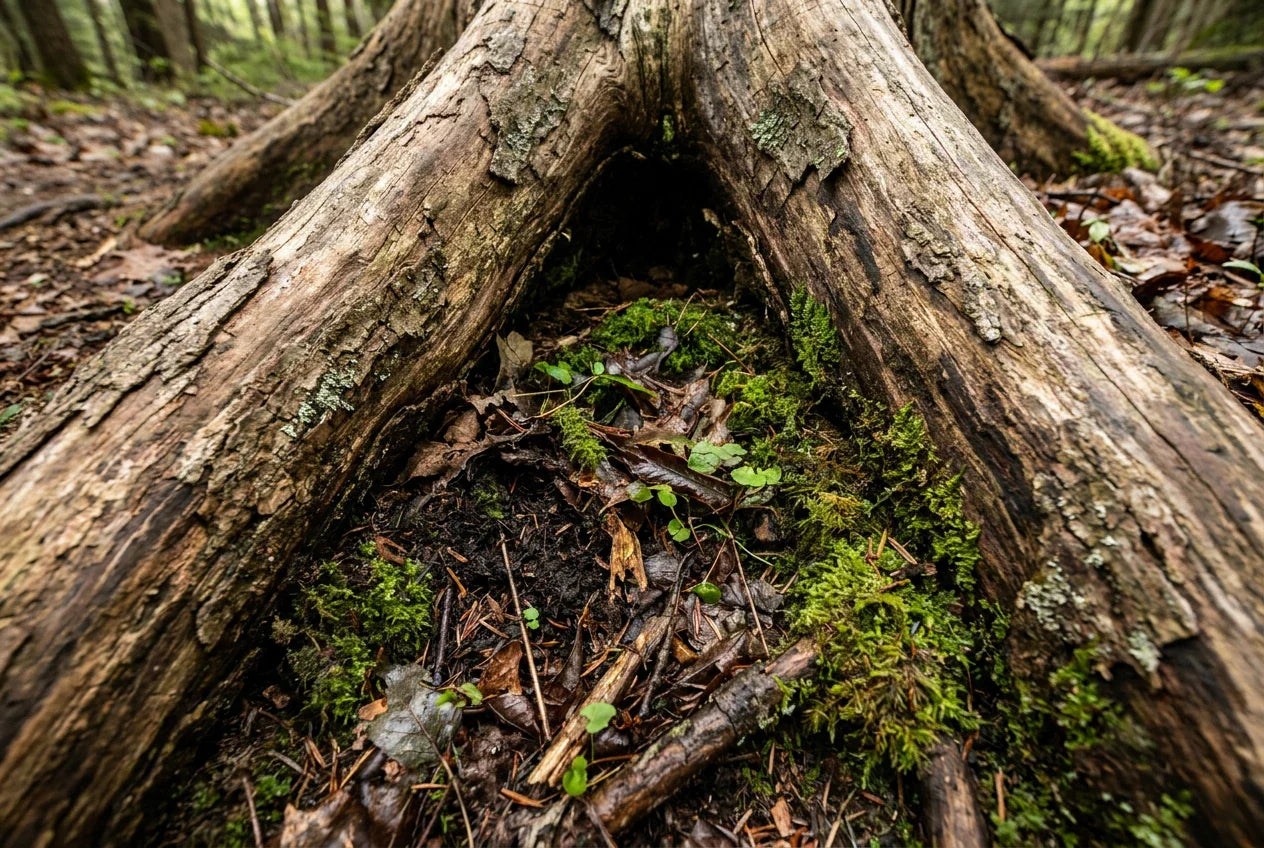
The Pocket
Designing Selection Instead of Coverage

Prelude: Where The Forest Begins
Walk through a forest after a storm and look at where the leaves ended up.
The strange thing is not where they landed. It is where they didn't.
A fallen log may stretch across the ground for several metres without collecting much of anything. Large sections of the forest floor remain almost untouched. Broad rock surfaces stay exposed. Then, without warning, everything gathers in one place.
A root junction fills with leaves. A tree fork becomes a mound of soil. A narrow seam in a cliff face erupts with mosses and ferns.
The difference can be surprisingly abrupt. One area remains almost empty while another, only a short distance away, seems to be collecting half the forest.

Once you start noticing this pattern, it becomes difficult to stop seeing it. The same thing appears in roadside drains, staircase corners, retaining walls, and cracks between paving stones. Some locations gather far more than their fair share of the landscape while others remain almost untouched.
At first it is tempting to focus on what has accumulated there: the leaves, the moss, the ferns, the seedlings. But those are usually the final chapter of the story.
The more interesting question is why that location became different in the first place.
Why did the tree fork become a miniature garden while the surrounding branches remained bare? Why did one seam in the cliff turn green while the rest of the rock face stayed exposed? Why does one corner of a drain overflow with debris while the surrounding pavement remains clean?
Nature rarely distributes its attention evenly. Some places become richer, busier, and more important long before everything around them changes.
The Place That Keeps Things
A tree fork is a good example. Most people see a branch splitting into two directions. The landscape sees a place where leaves can be trapped, moisture can linger, and organic matter can slowly accumulate.
The transformation happens gradually. A few leaves become many. Dust settles. Small fragments of bark collect after every storm. Material that would normally continue travelling is retained instead.
Years pass.
Eventually the fork begins carrying something unexpected.
Not leaves. Not debris.
Soil.
An actual layer of soil suspended several metres above the ground.
The tree begins carrying a fragment of the forest floor within its own canopy.
Nobody built it. Nobody planted it.
The landscape assembled it one storm at a time.

The same process can be found throughout the forest. A root junction traps debris after every rainfall. A seam running through a cliff captures enough material to support moss and ferns. A fallen log pins leaves against damp ground until the first signs of decay begin to appear.
Different structures behave in the same way. Some places keep things. Other places let them pass. The locations that keep things gradually become different from the landscape around them. They gather resources, support new growth, and begin changing first.
In other words, they become important.
Why Important Places Matter
That importance is what many builders accidentally miss.
When we build, we often assume every surface deserves attention. A bare branch feels unfinished. An exposed stone feels wasted. An empty corner feels neglected. We respond by adding something. Then we add something else. Eventually every branch carries moss, every corner contains planting, and every surface begins competing for attention.
The result is rarely ugly. It is simply difficult to remember.
A moss-filled tree fork only feels remarkable because the surrounding branches are bare. A fern growing from a cliff seam only feels dramatic because most of the cliff remains empty. The landscape has quietly decided where to invest its resources, and that decision creates contrast.

Nature does not reward every location equally. Most of a tree remains ordinary so that one fork can become extraordinary. Most of a cliff remains empty so that one seam can become significant. Most of a forest floor remains unchanged so that a handful of places can become the starting points for something larger.
The pocket is one of the mechanisms that makes this possible.
A pocket is not defined by wood, stone, bark, roots, soil, concrete, or brick. The material changes, but the behaviour remains the same.
A pocket is a place where the landscape begins keeping things.
Everything else follows from that decision.
The moss does not create the pocket. The fern does not create the pocket. The seedling does not create the pocket.
Life arrives later.
Life inherits what the landscape has already assembled.
The Coverage Trap
Look at your current enclosure. How many branches have moss? How many stones have planting? How many surfaces have been given something interesting to do?
Now ask a different question.
Which places are allowed to remain ordinary?
If the answer is none, your layout may have a coverage problem rather than a planting problem.
A landscape becomes memorable when a few locations matter more than the rest.

The Hotspot Rule
Choose three places.
Not thirty.
Three.
Give those locations most of the future growth potential in your layout. Allow the surrounding areas to remain quieter.
The goal is not equal coverage. The goal is meaningful concentration.
The next time you build a terrarium, resist the urge to improve every surface. Leave some branches bare. Leave some stone exposed. Leave some corners untouched.
The landscape needs ordinary places if a few locations are ever going to feel important.

The Gravity Test
Before planting, take a handful of dry leaf litter and drop it over your hardscape.
Do not move anything afterwards.
Watch where the material catches and accumulates. Those locations are revealing the pockets. More importantly, they are revealing where the landscape wants to begin.
Master Class Check
Look at your enclosure.
If every surface carries the same amount of moss, planting, and visual weight, what has your landscape chosen to make important?
If the answer is everything, the answer may actually be nothing.
The next time you walk through a park, look for the places the landscape has selected: the loaded tree fork, the debris-filled root junction, the seam between two stones, the crowded corner of a drain.
Find the pocket.
Then ask what it has been keeping.


