
Where Do the Fish in Your Aquarium Come From?
This guide is created by Green Chapter — Nature Workshop Studio, where we focus on creating living ecosystems through hands-on experience. We share practical insights across terrariums, aquascaping, plants, and natural systems to help you build and care for your own.
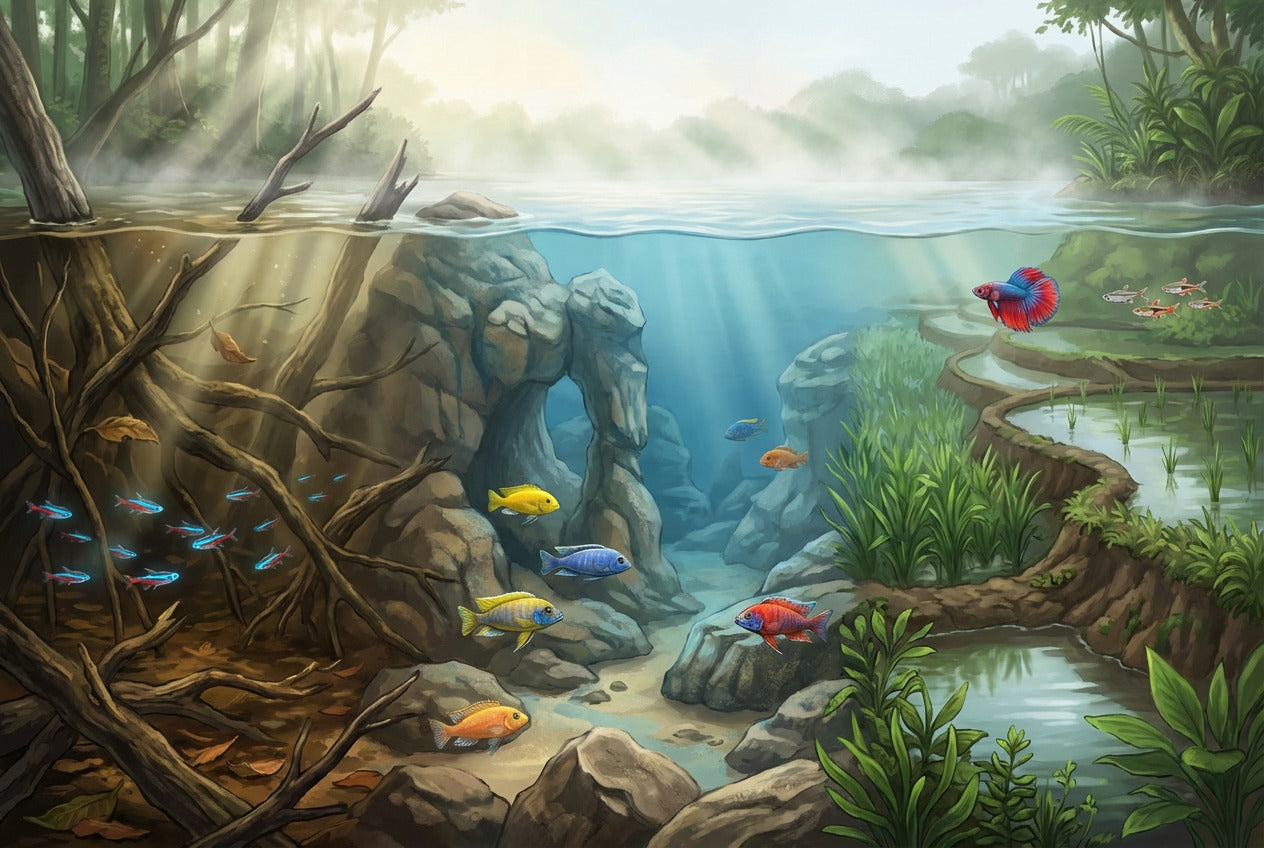
The Ultimate Guide to Tropical Fish Origins, Habitats & Aquarium Setup
Introduction — Understanding Your Aquarium at a Deeper Level
Every aquarium is a reflection of nature.
The fish you keep originate from ecosystems across the world—Amazon rivers, African lakes, and Southeast Asian wetlands. Each environment shapes how fish behave, what they need, and how they should be kept.
Yet, most hobbyists unknowingly mix species from completely different environments. This often leads to:
- Stress and poor fish health
- Unnatural behaviour
- Unstable tank conditions
This guide answers one essential question:
Where do the fish in your aquarium come from—and how should that influence your setup?
Global Overview — The 3 Major Origins of Aquarium Fish
Most freshwater tropical fish in the hobby can be traced back to three key regions:
South America (Amazon Basin)
- Tetras (Neon, Cardinal)
- Corydoras
- Plecos
- Dwarf cichlids
Africa (Rift Lakes & Rivers)
- African cichlids
- Congo tetras
- Synodontis catfish
Southeast Asia (Jungle & Wetlands)
- Rasboras
- Barbs
- Betta
- Arowana
These regions define not just fish—but entire aquarium styles (biotopes).

South America Aquarium Fish
Amazon Biotope Explained
South America is the most popular region for planted aquariums.
The Amazon Basin is dominated by blackwater environments, where decomposing leaves release tannins into the water, creating a soft, slightly acidic system.
🌿 Natural Habitat
- Soft, acidic water (low pH)
- Driftwood and leaf litter
- Dim lighting
- Slow-moving water
🧬 Key Fish Types
Characins (Tetras)
Schooling fish that rely on numbers and colour visibility in dark water.
Corydoras Catfish
Bottom scavengers that thrive on sand and require group living.
Plecos
Algae grazers adapted to wood and surfaces.
South American Cichlids
More peaceful, adapted to softer water conditions.
🎯 Aquarium Setup Guide (South America)

- Use driftwood and botanicals
- Choose soft substrate (sand)
- Keep water soft and slightly acidic
- Add plants and shaded areas
👉 This setup supports natural schooling and calm behaviour.
African Aquarium Fish
Rift Lake Ecosystem Explained
Africa’s aquarium fish are largely shaped by Rift Lake systems, which are very different from Amazon rivers.
These lakes are rich in minerals, resulting in hard, alkaline water with high clarity.
🌿 Natural Habitat
- Hard, alkaline water
- Rocky terrain
- Clear visibility
- High competition
🧬 Key Fish Types
African Cichlids
Highly territorial, brightly coloured, and behaviourally complex.
Congo Tetra
A larger, more metallic relative of South American tetras.
Synodontis Catfish
Adapted to both rivers and lakes.
🎯 Aquarium Setup Guide (Africa)

- Use rocks and caves
- Avoid heavy planting
- Maintain alkaline water
- Create territories
👉 This reduces aggression and supports natural social structures.
Southeast Asia Aquarium Fish
Jungle Stream & Rice Paddy Ecosystem
Southeast Asia produces some of the most adaptable fish in the hobby.
Many habitats here are shallow, slow-moving, and low in oxygen—leading to unique evolutionary traits.
🌿 Natural Habitat
- Still or slow-moving water
- Dense vegetation
- Warm, low oxygen
- Peat swamp environments
🧬 Key Fish Types
Rasboras
Peaceful schooling fish suited for planted tanks.
Barbs
Active and hardy species.
Betta Fish
Air-breathing fish adapted to stagnant water.
Asian Arowana
Surface predators in slow rivers.
Aquarium Setup Guide (Asia)

- Use dense plants
- Keep flow minimal
- Create calm zones
- Use darker substrates
👉 Ideal for relaxing, nature-style aquascapes.
Why Fish From the Same Family Behave Differently
Not all fish in the same family are alike.

Example: Cichlids
- African → aggressive, bright, hard water
- South American → calmer, softer tones
Example: Characins
- Africa → larger, metallic
- South America → smaller, neon
👉 This happens because of:
- Water chemistry differences
- Habitat structure
- Predator pressure
- Geographic isolation
Habitat Types — The Real Key to Fishkeeping
Beyond geography, fish are shaped by habitat type.

Major Habitat Types in the Hobby
- Blackwater rivers
- Flooded forests
- Fast-flow streams
- Still ponds
- Peat swamps
- Rocky lakes
Each habitat influences:
- Oxygen levels
- Water chemistry
- Fish behaviour
👉 Matching habitat is often more important than matching species.
How to Choose the Right Fish for Your Aquarium
Instead of mixing fish randomly, choose a clear direction:
Option 1 — South America Biotope
- Peaceful, planted tank
- Tetras + Corydoras
Option 2 — African Cichlid Tank
- Bold, active setup
- Rock-based layout
Option 3 — Southeast Asia Style
- Calm, plant-heavy
- Betta + Rasbora
👉 A focused setup is easier to maintain and looks more natural.
Final Takeaway — Build Ecosystems, Not Just Tanks
Every fish has evolved for a specific environment.
When you understand:
- Where your fish comes from
- What habitat it evolved in
👉 You unlock the ability to create a truly thriving aquarium.
The goal is not just to keep fish alive—but to let them live naturally.


