
Keeping and Breeding Vampire Crabs
This guide is created by Green Chapter — Nature Workshop Studio, where we focus on creating living ecosystems through hands-on experience. We share practical insights across terrariums, aquascaping, plants, and natural systems to help you build and care for your own.
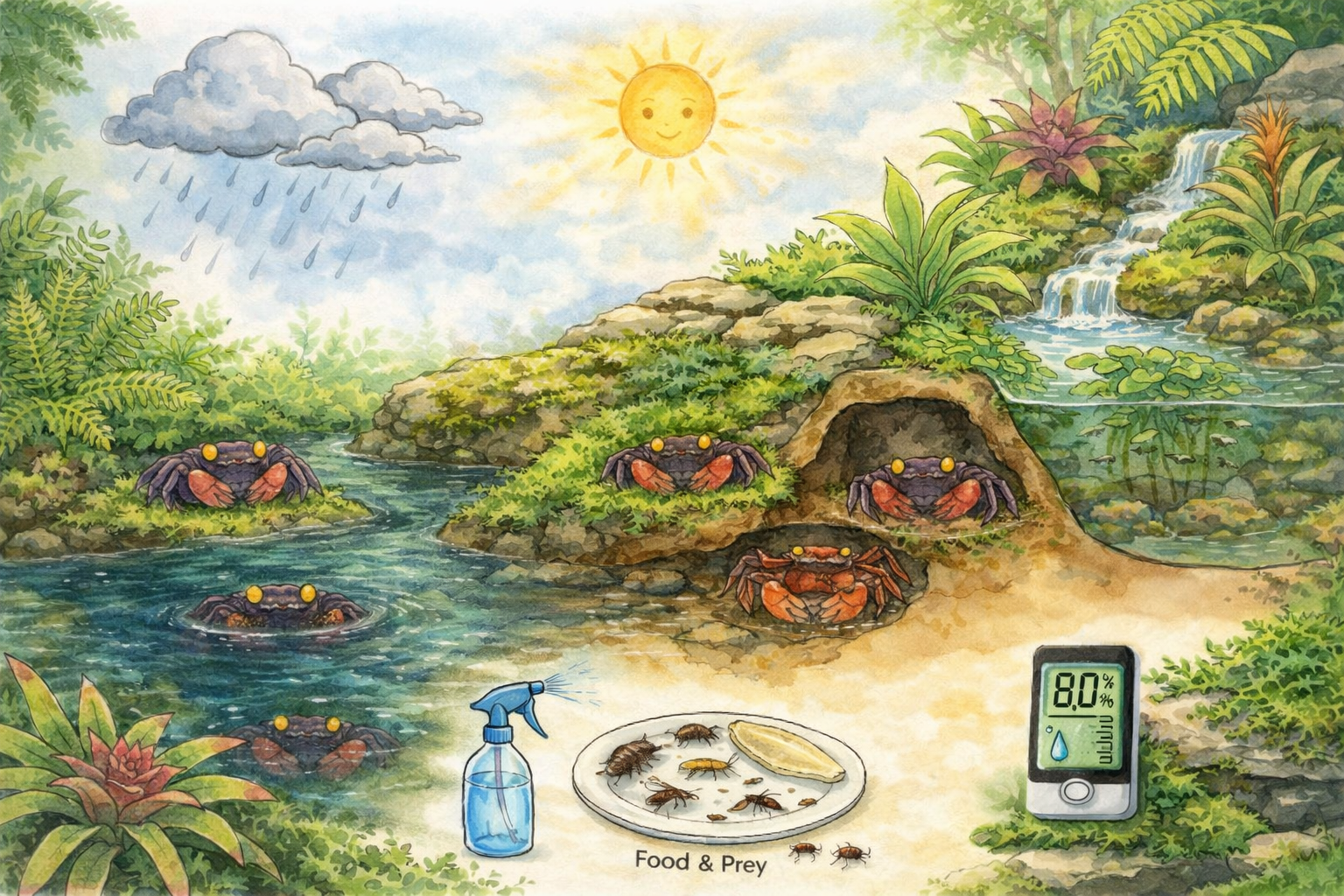
How to Trigger Vampire Crab Breeding
The “Monsoon Method” Explained
Most people try to breed vampire crabs by keeping everything stable — same water level, same humidity, same routine every day.
And that’s exactly why many colonies never breed.
In the wild, vampire crabs don’t reproduce because conditions are stable. They breed because conditions change — specifically, when the rainy season arrives. The rising water, cooler air, and sudden abundance of food signal that it’s the safest time to raise babies.
If you want to breed them consistently, you need to simulate a seasonal change, not just maintain a nice tank.
This is what I call the Monsoon Method.
Why Rainy Season Triggers Breeding
In nature, vampire crabs live near forest streams that swell during monsoon season. When water levels rise, two important things happen:
New shallow water areas appear where baby crabs can hide
Food becomes abundant due to insects and nutrients washed in by rain
This tells the crabs that it’s a safe time to reproduce and raise young.
A tank with a constant water level often signals the opposite — a dry season — which makes females delay breeding.
So the key idea is simple:
If nothing changes in your tank, nothing changes in your colony.
Important Mistake: Daily Tides
Some keepers try to simulate tides by raising and lowering water every day.
This sounds logical — but it’s actually harmful.
Vampire crabs are not tidal crabs. They are rainforest crabs. Their environmental change is seasonal, not daily. Flooding their burrows too often can stress them or even cause them to abandon their eggs, since the incubation period lasts around 45–60 days.
Slow seasonal change works.
Fast daily change does not.
The 4-Phase Monsoon Method
Instead of daily changes, think in seasons. The entire process takes about 6–8 weeks.
Phase 1 — The Rain Begins (1 week)

Mist more often (twice a day)
Slowly raise water level every few days
Only small changes — about 1 cm at a time
This tells the crabs: rainy season is starting.
Phase 2 — The Flood Season (4–6 weeks)

Keep water level high
Flood the lower areas of the tank
Maintain very high humidity (around 80–90%)
Feed more protein and calcium
This is the main breeding window.
Phase 3 — The Water Recedes (1 week)

Stop extra misting
Slowly lower water level back to normal
This simulates the end of the rainy season.
Phase 4 — Dry Season (2–3 months)

Normal tank conditions
Lower water level
Standard humidity
This rest period is important for colony health before the next breeding cycle.
Tank Design Matters More Than You Think
If you plan to raise and lower water levels, your tank must be built correctly.
A good breeding tank should have three zones:
Zone Description
Deep Water Always underwater
Intertidal Shelf Gets flooded during monsoon phase
Land Area Never flooded (burrow area)
The biggest mistake is flooding soil for weeks — it turns anaerobic, smells like rotten eggs, and kills beneficial microfauna.
Use lava rock, slate, or gravel for the flood zone instead of soil.
The Silent Sign a Female Is Pregnant

Here’s something many beginners miss:
If a female vampire crab disappears and hides for weeks, she is probably carrying eggs.
Do not dig her up. Do not check. Do not disturb.
Just leave the tank stable.
The Biggest Danger: Cannibalism

The number one killer of baby vampire crabs is adult vampire crabs.
Once babies appear, you must either:
Remove the adults, or
Move the babies to a nursery area
Otherwise, survival rates drop dramatically.
Final Thoughts
Breeding vampire crabs isn’t about perfect water parameters.
It’s about simulating a season.
If you remember only one thing, remember this:
Stable tanks keep crabs alive.
Changing seasons make crabs reproduce.
Control the seasons, and you control the breeding.
Quick Summary
Vampire crabs breed during rainy season conditions
Slowly raise water and humidity over several weeks
Keep water high for about a month
Slowly lower water again
Provide a flood-safe intertidal zone
Remove adults once babies appear
Follow this cycle, and breeding becomes predictable instead of random.
Some Other useful articles:
https://www.indoorecosystem.net/guides/vampire-crab-care-guide


