
Understanding the Many “Riums” — From Aquariums to Living Ecosystems
This guide is created by Green Chapter — Nature Workshop Studio, where we focus on creating living ecosystems through hands-on experience. We share practical insights across terrariums, aquascaping, plants, and natural systems to help you build and care for your own.
At Green Chapter, one of the most common questions we hear is:
“There are so many ‘riums’ — aquarium, terrarium, paludarium… what’s the difference?”
In this guide, we’ll walk through most of the commonly used “rium” systems, explaining what they are and how they are used.
But instead of starting with a long list of unfamiliar terms, we’ll begin with something more practical — the systems we actually build and display in our showroom.
These are real, working ecosystems you can observe up close, and they form the foundation for understanding everything else.
Once you’re familiar with these core systems, we’ll expand into the wider range of “riums”, grouping them clearly so you can see how they all fit together.
What Does “-arium” Actually Mean?
The term “-arium” simply refers to:
A place designed to house and sustain a specific type of life or environment
The difference between each “rium” comes down to:
- Water vs land
- Plants vs animals
- Humidity, airflow, and environmental control
The Systems We Build & Teach (Start Here First)
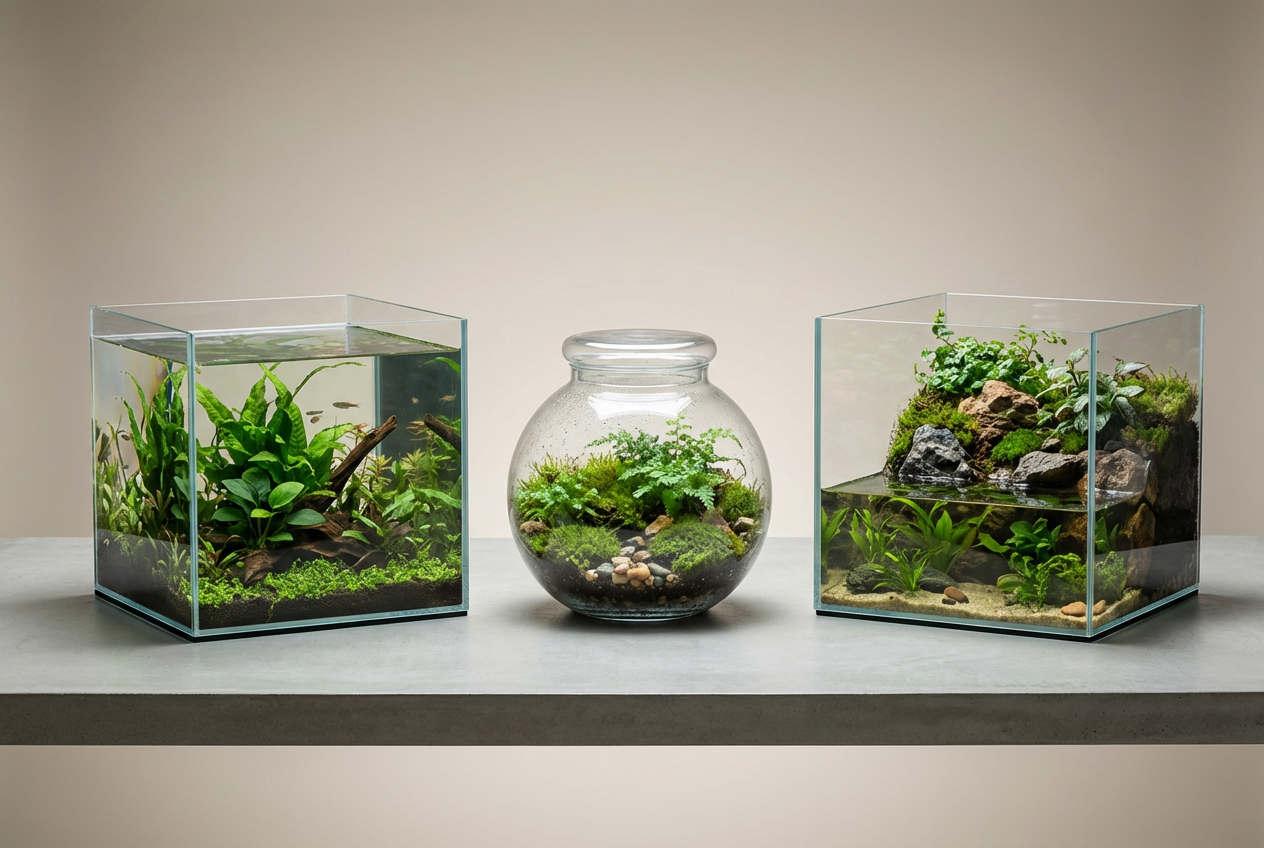
Aquarium — Fully Aquatic System

An Aquarium is built entirely around water.
Fish, shrimp, and aquatic plants live in a fully submerged environment, supported by filtration, lighting, and water movement. These systems are dynamic and constantly evolving.
Closed Terrarium — Self-Sustaining Plant System

A Closed Terrarium is a sealed plant-based system that creates its own internal climate.
Moisture cycles within the container through condensation, making it a stable, low-maintenance environment ideal for moss and humidity-loving plants.
Habitat Terrarium — Balanced Plant + Animal System

A Habitat Terrarium is designed for both plants and animals.
Unlike closed terrariums, these systems are ventilated and carefully balanced to support living creatures such as frogs, geckos, or invertebrates, alongside a functioning planted environment.
Paludarium — Land and Water in One System

A Paludarium combines aquatic and terrestrial environments in a single system.
These setups often include water features such as streams or waterfalls, alongside planted land sections, creating a rich and layered ecosystem.
Streamarium — A Flow-Based Aquatic Landscape

At Green Chapter, we also work with a system we refer to as a Streamarium.
This describes a type of aquarium designed to replicate the structure and movement of a natural stream.
Instead of a still body of water, the layout guides water through a rocky path, using elevation and directional flow to shape the environment. Planted banks on both sides complete the landscape, making the system feel like a miniature stream rather than a static tank.
Closed vs Habitat Terrarium — What’s the Difference?

Although both systems use plants and soil, they serve very different purposes.
A Closed Terrarium is designed to be a self-contained environment, while a Habitat Terrarium is built to support animals that require airflow, oxygen exchange, and environmental stability.
| Feature | Closed Terrarium | Habitat Terrarium |
|---|---|---|
| Purpose | Plant ecosystem | Animal habitat |
| Airflow | Sealed | Ventilated |
| Humidity | Self-cycling | Controlled |
| Maintenance | Low | Moderate |
The Full “Rium” Landscape — Categorised
| Category | Examples | Environment |
|---|---|---|
| Water Systems | Aquarium, Jarrarium, Riparium, Riverine Aquarium | Aquatic / flowing |
| Plant Systems | Closed Terrarium, Florarium, Mossarium | Humid / enclosed |
| Mixed Systems | Paludarium, Aquaterrarium, Crabarium | Land + water |
| Animal Systems | Habitat Terrarium, Aridarium, Formicarium, Insectarium | Species-specific |
Beyond the Basics — Other “Riums” Explained
Riparium

A Riparium recreates riverbank conditions where plants grow above water while their roots remain submerged.
Jarrarium

A Jarrarium is a simplified aquatic system, often small and self-balanced.
Aquaterrarium

An Aquaterrarium supports animals that require both water and dry areas.
Aridarium

An Aridarium is designed for desert environments with low humidity.
Riverine Aquarium (Riverarium)

A Riverine Aquarium focuses on strong water movement to support species adapted to fast-flowing environments.
Formicarium & Insectarium

- Formicarium — for ants
- Insectarium — for insects
Florarium & Mossarium

- Florarium — aesthetic plant display
- Mossarium — moss-focused environments
How to Make Sense of It All

Instead of memorising names, think in systems:
- Water → Aquarium
- Land (plants) → Closed Terrarium
- Land (animals) → Habitat Terrarium
- Mixed → Paludarium
- Flow-based → Streamarium / River systems
Bring It All Together
All these “riums” are simply different ways of doing one thing:
Recreating nature in a controlled environment
At Green Chapter, the focus is always on building systems that are practical, stable, and meaningful to interact with.
What You’ll Understand
- The meaning behind different “rium” systems
- How they are grouped and used
- Which type fits your interest
Continue Exploring
- Closed Terrarium Mini Hub
- Habitat Terrarium Mini Hub
- Paludarium Guide
- Aquascaping Basics
Experience It Hands-On
The best way to understand these systems is to build one.
👉 Join a workshop and create your own ecosystem.


