
How Water Really Moves Inside Your Terrarium
This guide is created by Green Chapter — Nature Workshop Studio, where we focus on creating living ecosystems through hands-on experience. We share practical insights across terrariums, aquascaping, plants, and natural systems to help you build and care for your own.
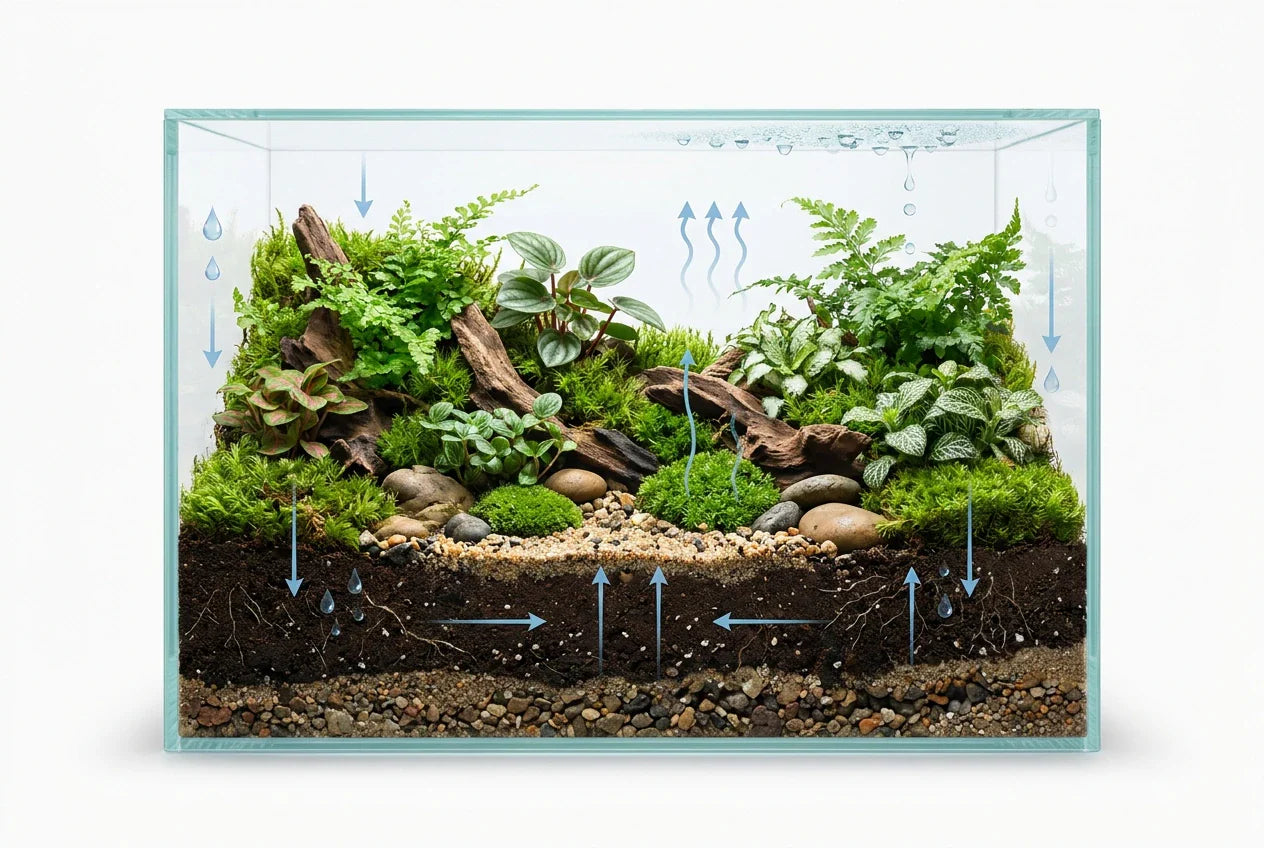
You Watered Your Terrarium. What Happens Next?
Imagine you've just finished building a terrarium.
The plants are in place.
The rocks are arranged.
Everything looks perfect.
You pour in some water and watch it disappear into the substrate.
Most people think they know what happens next.
The water goes down.
The soil gets wet.
The plants absorb the water.
End of story.
But if that were true, every part of your terrarium would stay equally moist.
It doesn't.
After a few days, one corner might still be damp while another already feels dry.
The moss beside a rock stays green, but another patch begins to dry out.
One plant grows quickly while another struggles, even though they're only a few centimetres apart.
Why?
Because water doesn't move through your substrate the way most people imagine.
It doesn't spread out evenly like pouring syrup onto a pancake.
Instead, every drop is constantly searching for the easiest path to travel.
Once you understand that, many things inside a terrarium suddenly start making sense.

Water Doesn't Move Through the Soil
Pick up a handful of terrarium substrate.
It looks like a solid pile of small pieces.
But it isn't solid at all.
Between every grain are tiny empty spaces.
Some are large enough for water to flow through easily.
Others are so small you can barely imagine them.
These tiny gaps are called pore spaces.
They're one of the most important parts of any substrate.
Here's the surprising part.
Water doesn't travel through the substrate particles themselves.
It travels through the spaces between them.
Think of a city.
The buildings don't move cars around.
The roads do.
Your substrate works the same way.
The particles are the buildings.
The pore spaces are the roads.
When you water your terrarium, every drop begins travelling through this underground road network.
Some roads are wide.
Some are narrow.
Some lead straight down.
Others twist around roots and rocks.
The path that water takes depends entirely on the size and shape of those tiny spaces.
That's why two substrates can behave very differently even if they look almost the same.
One might stay damp for days.
Another might dry much more quickly.
The difference isn't the material itself.
It's the hidden spaces inside it.

Big Gaps and Small Gaps
Not every pore space does the same job.
Some are big.
Some are tiny.
You need both.
Imagine two kitchen sponges.
One has large holes.
The other has very fine holes.
If you pour water onto both, which one drains faster?
The sponge with bigger holes.
The finer sponge holds onto water much longer.
Your substrate behaves in exactly the same way.
Large pore spaces let water move through quickly.
Once the water drains away, those spaces fill with fresh air.
This is important because plant roots don't just need water.
They also need oxygen.
Without enough air, healthy roots can slowly weaken or rot.
Small pore spaces do something different.
Instead of letting water pass straight through, they hold onto it.
The water sticks to the tiny surfaces inside the substrate.
It stays there much longer, ready for plant roots to use later.
This is why a good substrate isn't made from only one material.
If everything is coarse, the terrarium dries out too quickly.
If everything is too fine, the substrate stays wet for too long and there isn't enough fresh air for the roots.
The best substrate is a mixture.
Some spaces store water.
Some spaces carry air.
Together, they create a healthier environment for both plants and beneficial microorganisms.
When people ask,
"What's the best terrarium substrate?"
there isn't a single answer.
The better question is,
"Does this substrate have a good balance of large and small pore spaces?"
Because that's what really controls how water behaves underground.

Water Doesn't Always Move Downwards
Most of us think gravity controls everything.
Pour water into a terrarium and gravity pulls it down.
That's true.
But gravity isn't the only force at work.
Try this simple experiment.
Take a piece of tissue paper.
Dip only the bottom corner into a glass of water.
Leave it there for a few minutes.
You'll notice something interesting.
The water slowly climbs upwards.
Nobody is pumping it.
Gravity isn't pulling it up.
Yet the water keeps moving.
This happens because water likes to stick to surfaces.
As it clings to the tiny fibres inside the tissue, it slowly pulls more water along with it.
Scientists call this **capillary action**.
The name sounds complicated, but the idea is simple.
Water can climb through very small spaces.
Exactly the same thing happens inside your substrate.
The tiny pore spaces between the particles act like thousands of tiny tubes.
Instead of flowing straight down, some of the water slowly moves upwards and sideways.
This movement is much slower than gravity.
You won't notice it in a few minutes.
But over hours and days, it makes a huge difference.
It helps spread moisture through the substrate.
It keeps some areas damp for longer.
It also explains why the surface of your terrarium can look dry while the roots underneath are still receiving moisture.
Water is still moving even after you've finished watering.
Why Moss Doesn't Always Dry Out
Have you ever wondered why moss sometimes stays healthy even though the top of the substrate looks dry?
Many beginners think they need to water again.
Sometimes they do.
Sometimes they don't.
The surface only tells part of the story.
Just below it, there may still be plenty of moisture.
Capillary action slowly brings some of that moisture back towards the surface.
It isn't fast.
It isn't enough to soak everything.
But it can provide just enough water to keep moss and small plants alive.
This is one reason why overwatering is such a common mistake.
People see a dry surface and assume the whole terrarium is dry.
Often, the lower layers are still holding plenty of water.
That's why it's important to understand what's happening below the surface instead of judging your terrarium by appearance alone.

Why One Side Stays Wetter
Imagine pouring rain onto a hill.
Does every drop travel exactly the same way?
Of course not.
Some water follows small dips.
Some flows around rocks.
Some reaches the bottom much faster than the rest.
Your substrate behaves in a very similar way.
Although it looks even from above, the spaces underground are never perfectly identical.
One area might have slightly larger gaps.
Another might contain more roots.
A rock may block one path while opening another.
As soon as water finds an easier route, more water tends to follow it.
Over time, these routes become the favourite paths for future watering.
This is why one side of a terrarium often stays wetter than another.
It doesn't mean you watered incorrectly.
It simply means the underground pathways are different.
Professional growers see this all the time.
Instead of expecting perfectly even moisture, they understand that every substrate develops wetter and drier areas.
Good planting takes advantage of this.
Plants that enjoy wetter conditions can be placed where moisture naturally collects.
Plants that prefer better drainage can be positioned where the substrate dries a little faster.
Instead of fighting nature, you're working with it.
What This Means When You Build
Understanding how water moves changes the way you build a terrarium.
Instead of asking,
"How much water can this substrate hold?"
start asking,
"How will water move through it?"
A good substrate doesn't simply store water.
It stores water, drains excess water and still leaves enough air for healthy roots.
That's why most terrarium mixes contain different materials.
Each one creates different-sized pore spaces.
Together, they produce a balance that one material alone usually cannot.
The same idea applies when watering.
Watering isn't about making every part of the substrate equally wet.
That's almost impossible.
Instead, you're adding enough water for the entire system to keep working.
Over the next few days, gravity, capillary action and evaporation will continue moving that water around for you.
In other words, the watering can only starts the journey.
The substrate does the rest.

Your Terrarium Is Recycling Water All the Time
Water doesn't stop moving after it reaches the bottom of the substrate.
In a closed terrarium, the journey keeps going.
As the terrarium warms up during the day, some of the water inside the substrate slowly evaporates.
Plants release even more water through their leaves.
The water vapour rises until it touches the cooler glass.
Tiny droplets begin to form.
Soon, those droplets become heavy enough to run back down the glass and return to the substrate.
The cycle starts all over again.
This is why a healthy closed terrarium can go for weeks or even months without watering.
The water isn't disappearing.
It's being recycled.
Every day, the same water is travelling through your terrarium again and again.
It drains.
It evaporates.
It condenses.
It returns.
A stable terrarium isn't just a container of plants.
It's a miniature water cycle.
Common Mistakes Beginners Make
Once you understand how water moves, many common mistakes become easier to avoid.
Mistake 1: Using only one type of substrate
A substrate made from only one material usually has pore spaces that are all very similar.
That makes it harder to balance water and air.
Mixing different materials creates different-sized pore spaces, giving roots both moisture and oxygen.
Mistake 2: Watering because the surface looks dry
The top of the substrate dries first.
That doesn't mean the whole terrarium is dry.
Always remember that water below the surface may still be moving upwards through capillary action.
A dry-looking surface doesn't always mean it's time to water again.
Mistake 3: Trying to keep everything equally wet
Many beginners expect every corner of the terrarium to have the same moisture level.
That rarely happens.
Water naturally follows different paths.
Some areas will always be wetter than others.
That's completely normal.
Mistake 4: Forgetting that roots need air
More water isn't always better.
Healthy roots need oxygen too.
If the substrate stays completely soaked for long periods, the roots can struggle even though there's plenty of water available.
A good substrate always leaves room for both water and air.
The Next Time You Build a Terrarium...
The next time you pour water into a terrarium, imagine what's happening beneath the surface.
Picture thousands of tiny tunnels carrying water through the substrate.
Some drops rush down through larger spaces.
Some become trapped in tiny spaces like a sponge.
Some slowly climb back upwards.
Some evaporate into the air before returning as droplets on the glass.
Almost everything that keeps a terrarium alive depends on these invisible movements.
The plants you choose.
The substrate you mix.
The way you water.
Even where you place a rock can change how water travels.
Once you understand how water moves, you stop seeing substrate as just "dirt."
You begin seeing it as the hidden plumbing of your miniature ecosystem.
Final Thoughts
Most of the important work inside a terrarium happens where you can't see it.
Under the surface, water is always moving.
It drains through large spaces.
It stays inside small spaces.
It moves sideways.
It climbs upwards.
It evaporates into the air.
Then it returns again.
Understanding these hidden movements won't just teach you a little science.
It will help you build better terrariums.
The next time someone asks what makes a healthy substrate, you'll know the answer.
It's not the material by itself.
It's how that material allows water and air to move together.
Because in the end, a good terrarium isn't built by adding more water.
It's built by helping water move in the right way.


