
UNIVERSAL CENTURY MOBILE SUIT EVOLUTION
This guide is created by Green Chapter — Nature Workshop Studio, where we focus on creating living ecosystems through hands-on experience. We share practical insights across terrariums, aquascaping, plants, and natural systems to help you build and care for your own.
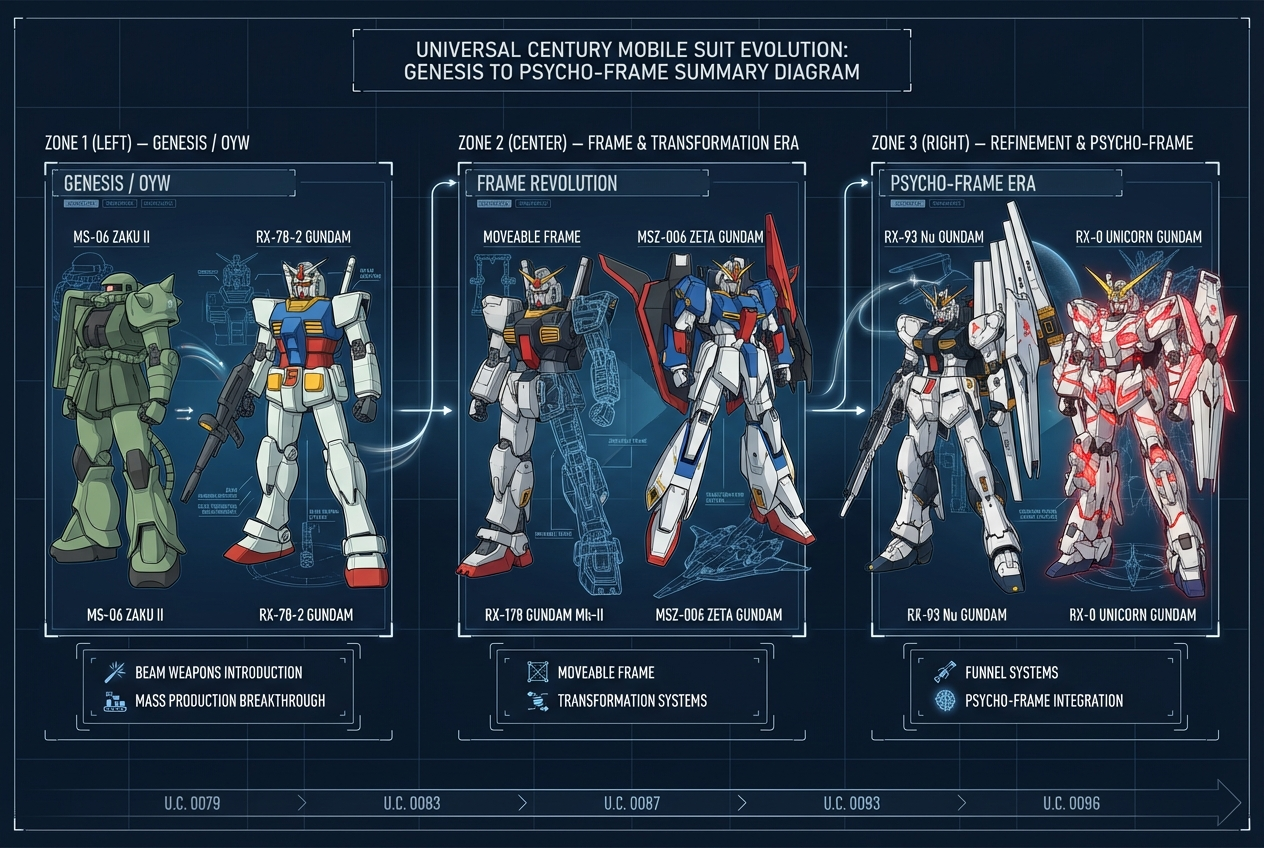
Engineering Lineage from U.C. 0074–0096
The Engineering Arms Race Behind Every Mobile Suit
The evolution of Mobile Suits in the Universal Century was never just about building stronger machines. Each generation was shaped by real engineering constraints—reactor limits, material strength, pilot control systems, and the harsh realities of Minovsky particle warfare.
As one limitation was solved, another emerged. What followed was a continuous cycle of innovation, refinement, excess, and correction.
In this guide, we break down that evolution into clear phases—so you can understand not just what changed, but why it changed.
GENESIS OF MOBILE SUITS (U.C. 0074–0079)
From Experimental Machines to Battlefield Dominance
The first Mobile Suits were not designed to be elegant—they were designed to work.
Early Zeon prototypes like the Zaku I proved that humanoid machines could function in combat, but they were still limited in mobility and adaptability. The breakthrough came with the Zaku II, which balanced performance, reliability, and mass production. For the first time, Mobile Suits became a practical war-winning system.
The Earth Federation responded with Project V, taking a very different approach. Instead of scaling production immediately, they focused on technological superiority. The RX-78-2 Gundam introduced beam rifle weaponry, Gundarium armor, and modular cockpit systems—pushing performance far beyond anything Zeon fielded at the time.
This phase established the two core design philosophies that would define the entire Universal Century:
- Zeon → practical, scalable war machines
- Federation → high-performance prototype systems
POST-WAR REFINEMENT & GP ERA (U.C. 0080–0083)
Refining Performance Instead of Reinventing It
After the One Year War, engineers were no longer trying to prove that Mobile Suits worked—they were trying to make them better.
The Gundam Development Project became the testing ground for this next phase. Instead of one “perfect” machine, multiple prototypes explored different directions. The GP01-Fb focused on high-speed space mobility, while the GP02A pushed the limits of heavy weapon integration. The GP03 went even further, merging Mobile Suit and Mobile Armor concepts into a single platform.
What became clear during this period was that increasing size and power alone was not a sustainable path forward. Performance had to come from efficiency—better thrusters, better tuning, and smarter system integration.
This era quietly laid the foundation for the next major breakthrough.

THE MOVEABLE FRAME REVOLUTION (U.C. 0084–0087)
When Structure Became the Key to Performance
The Moveable Frame was one of the most important engineering breakthroughs in Mobile Suit history.
Previously, armor and structure were tightly integrated, making suits heavier and harder to maintain. The Moveable Frame changed this by separating the internal skeleton from external armor. This reduced weight, improved articulation, and allowed for far more efficient movement.
The Gundam Mk-II demonstrated how effective this approach could be. It wasn’t overwhelmingly armored or heavily armed—but it moved better, responded faster, and performed more efficiently than older designs.
This structural shift also enabled something previously impossible at scale: transformation.
The Zeta Gundam took full advantage of this new architecture, introducing a multi-mode system that could operate as both a Mobile Suit and a high-speed flight form. It marked the beginning of a new era focused on versatility and adaptability.

THE HEAVY ERA (U.C. 0088)
When More Power Became Too Much Power
As conflicts intensified, Mobile Suit design entered a phase of escalation.
Machines like the ZZ Gundam and Queen Mansa were built around a simple idea: overwhelm the enemy with sheer firepower. Larger frames allowed for bigger generators, heavier armor, and massive beam weapons capable of devastating output.
For a time, this worked. These machines were incredibly powerful in direct engagements.
But the trade-offs quickly became clear. Larger suits were harder to maintain, more expensive to deploy, and increasingly impractical in prolonged warfare. Energy consumption skyrocketed, and pilot control became more demanding.
This era proved a critical lesson: beyond a certain point, adding more power creates more problems than it solves.

THE PSYCHO-FRAME ERA (U.C. 0093–0096)
When the Pilot Became Part of the Machine
The Psycho-Frame changed the relationship between pilot and Mobile Suit.
Instead of relying purely on mechanical controls, these systems allowed the machine to respond directly to the pilot’s intentions. Reaction times improved dramatically, and control became more intuitive and precise.
The Unicorn Gundam represents the peak of this technology. With its NT-D system, it could push performance far beyond normal limits—reacting faster than conventional systems could handle.
However, this advancement came with a cost. Machines became increasingly dependent on specific pilots and unstable conditions, making them difficult to standardize for widespread use.
This marked both the highest point of Mobile Suit evolution—and a natural stopping point for this path of development.

The Pattern Behind Every Technological Leap
Looking across the entire Universal Century, a clear pattern emerges.
Each generation of Mobile Suit followed the same cycle:
- solve a limitation
- push performance further
- go too far
- correct back toward efficiency
The most successful designs were never simply the strongest. They were the ones that balanced power, control, and practicality within the constraints of their time.
From the Zaku II to the Unicorn Gundam, the evolution of Mobile Suits tells a deeper story—not just about war machines, but about engineering itself.
Progress is not linear. It is iterative.
And in the Universal Century, every breakthrough came with a lesson.


