
White Spot (Ich) in Tropical Fish — A Complete Guide to Understanding, Treatment & Prevention
This guide is created by Green Chapter — Nature Workshop Studio, where we focus on creating living ecosystems through hands-on experience. We share practical insights across terrariums, aquascaping, plants, and natural systems to help you build and care for your own.
Introduction — A Calm Tank Can Still Hide a Problem
At first glance, your aquarium may look perfectly calm — fish swimming gently, plants swaying, everything in balance. But sometimes, beneath that peaceful surface, a problem is already unfolding.
White Spot Disease, commonly known as Ich, is caused by the parasite Ichthyophthirius multifiliis. It appears as tiny white dots on your fish, but those dots are not harmless — they are parasites living within the fish’s skin.
What makes Ich particularly tricky is that by the time you notice it, the parasite has already begun spreading through your entire system.
This guide will help you understand not just how to treat Ich, but how to see it differently — as a process happening within your aquarium, not just a surface-level issue.
What Causes Ich to Appear?
Ich does not appear randomly. It must enter your aquarium from an external source.
Most commonly, it comes in with new fish. But it can also be introduced through plants, decor, shared tools, or even water transferred between tanks.
However, introduction alone does not always lead to infection. Healthy fish can sometimes resist parasites — until stress lowers their defenses.
This is when Ich takes hold.
Common stress triggers include sudden temperature changes, poor water conditions, overcrowding, or the stress of transport.
👉 Think of Ich as a combination of two factors:
a parasite entering the system, and fish losing the ability to resist it.
Understanding the Ich Life Cycle
To treat Ich effectively, you need to understand how it lives.
The parasite does not stay in one form. It moves through a cycle — and only one stage in that cycle can actually be eliminated.
First, it lives on the fish, forming the visible white spots. At this stage, it is protected and cannot be killed.
Then it drops off and settles onto surfaces like gravel or glass, forming a cyst where it multiplies.
Finally, it releases free-swimming parasites into the water — and this is the only moment when treatment works.
👉 This is why Ich often seems to “come back” — because the cycle was never fully broken.

Recognizing the Signs Early
Ich rarely starts dramatically. In most cases, the first signs are subtle.
You may notice a few white dots on the fins, or fish lightly rubbing against surfaces. At this stage, the fish may still behave quite normally.
As the infection progresses, changes become clearer — breathing becomes faster, activity drops, and the fish may linger near the surface.
The most important thing is not how severe it looks, but how early you notice it.
👉 Early awareness often makes the difference between easy recovery and serious stress on the fish.

Treating Ich — A Process, Not a Quick Fix
Treating Ich is not about removing the spots you see — it is about interrupting the life cycle happening in the tank.
Start by increasing aeration. Fish with Ich often struggle to breathe, especially if the gills are affected.
If your species allows it, gently raise the temperature. This speeds up the parasite’s life cycle, helping treatment reach the vulnerable stage faster.
Next, apply a proven treatment — whether medication or salt, depending on your setup. Follow instructions carefully and avoid rushing the process.
Most importantly, continue treatment even after the white spots disappear. At that point, the parasite is still present in the tank — just no longer visible.
👉 Consistency is what makes treatment successful.

Prevention — The Quiet Habit That Saves Everything
The easiest Ich outbreak to handle is the one that never happens.
Quarantine is the single most effective preventive step. Keeping new fish separate before introducing them to your main tank protects your entire system.
Beyond that, small habits matter:
- Avoid sharing tools between tanks
- Do not transfer water from external sources
- Keep your environment stable
Prevention is not complicated — it is simply consistent.
How Ich Spreads Without You Realizing
One of the most overlooked aspects of Ich is how easily it spreads.
A net moved between tanks, a pair of tweezers, or even your hand carrying a few drops of water can transfer the parasite.
Because Ich exists in microscopic stages, you will not see it move — but it moves anyway.
👉 This is why many outbreaks seem to “appear suddenly” in multiple tanks.

Myth vs Fact — Seeing Ich Clearly
Misunderstanding Ich often leads to ineffective treatment.
Some believe it is caused by cold water. Others think it is a fungus. Some assume that once the spots disappear, the problem is gone.
In reality, Ich follows a biological cycle, not a simple cause-and-effect rule.
Understanding the difference between myth and fact helps you respond calmly and correctly — instead of reacting too late or stopping treatment too early.

Why Ich Becomes Dangerous Over Time
Ich itself damages the fish, but the deeper issue comes afterward.
As the parasite feeds and exits the fish’s body, it leaves behind tiny injuries. These weaken the fish’s natural defenses and make it easier for bacteria, such as Aeromonas hydrophila, to enter.
This is why some fish continue to decline even after the white spots are gone.
👉 Ich is not just a surface problem — it affects the entire health system of the fish.

Can Fish Recover from Ich?
Yes — and very often, they do.
With early detection, proper treatment, and stable conditions, many fish recover fully and return to normal behavior.
The key factors are simple:
- Acting early
- Following through with treatment
- Maintaining a calm, stable environment
Even when the situation looks serious, recovery is still possible if the process is handled correctly.
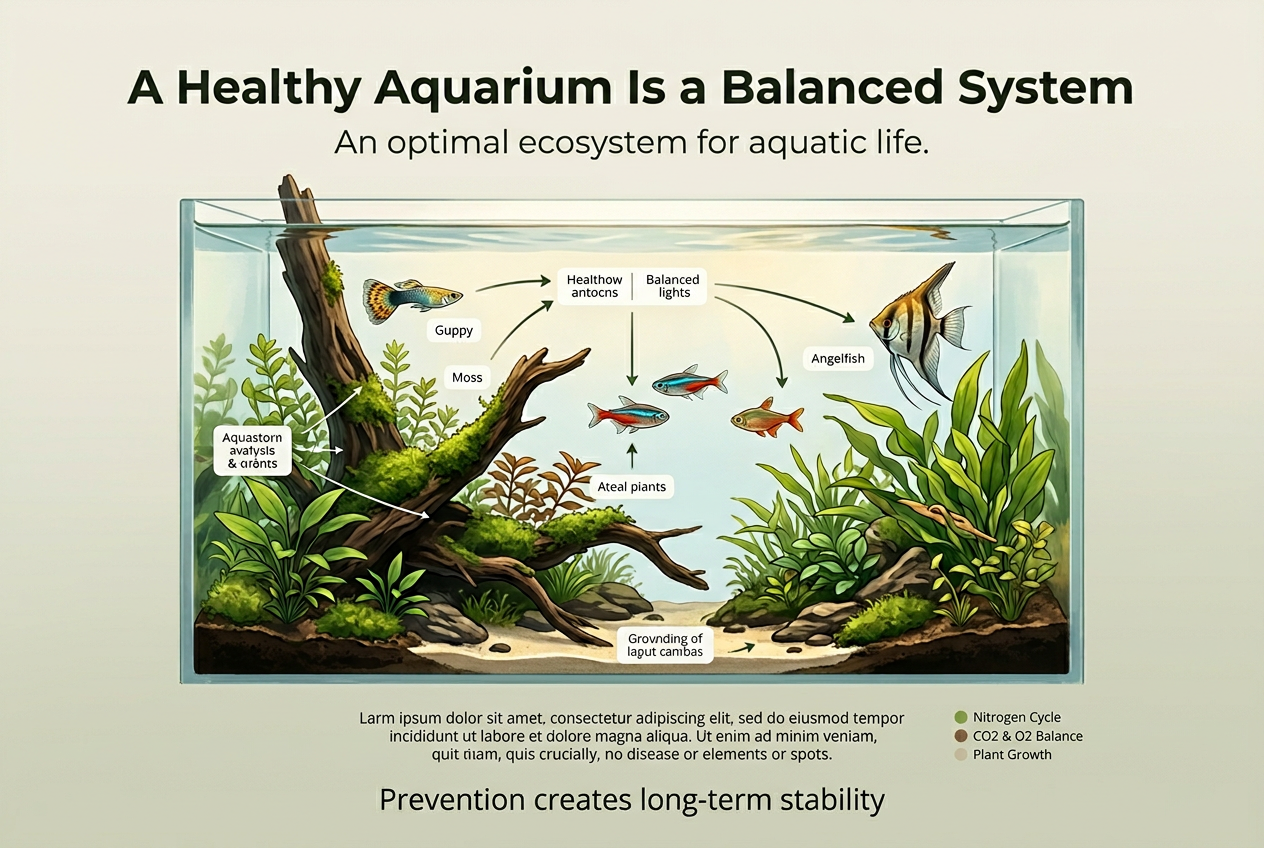
Final Takeaway — A Balanced System Is the Best Protection
An aquarium is not just a container of water — it is a living system.
Ich becomes a problem when that system is disrupted. But when the system is stable, balanced, and carefully managed, outbreaks become far less likely.
Understanding how Ich works allows you to move from reacting to problems…
to quietly preventing them.


