
The Worlds Remembered #06: What Decay Leaves Behind
This article is part of Chronicles of the Glass Cage, a collection of explorations into nature, imagination, ecosystems, and the worlds we carry in our minds. Each chapter begins with a question, an observation, a memory, or a possibility, then follows where that path leads.
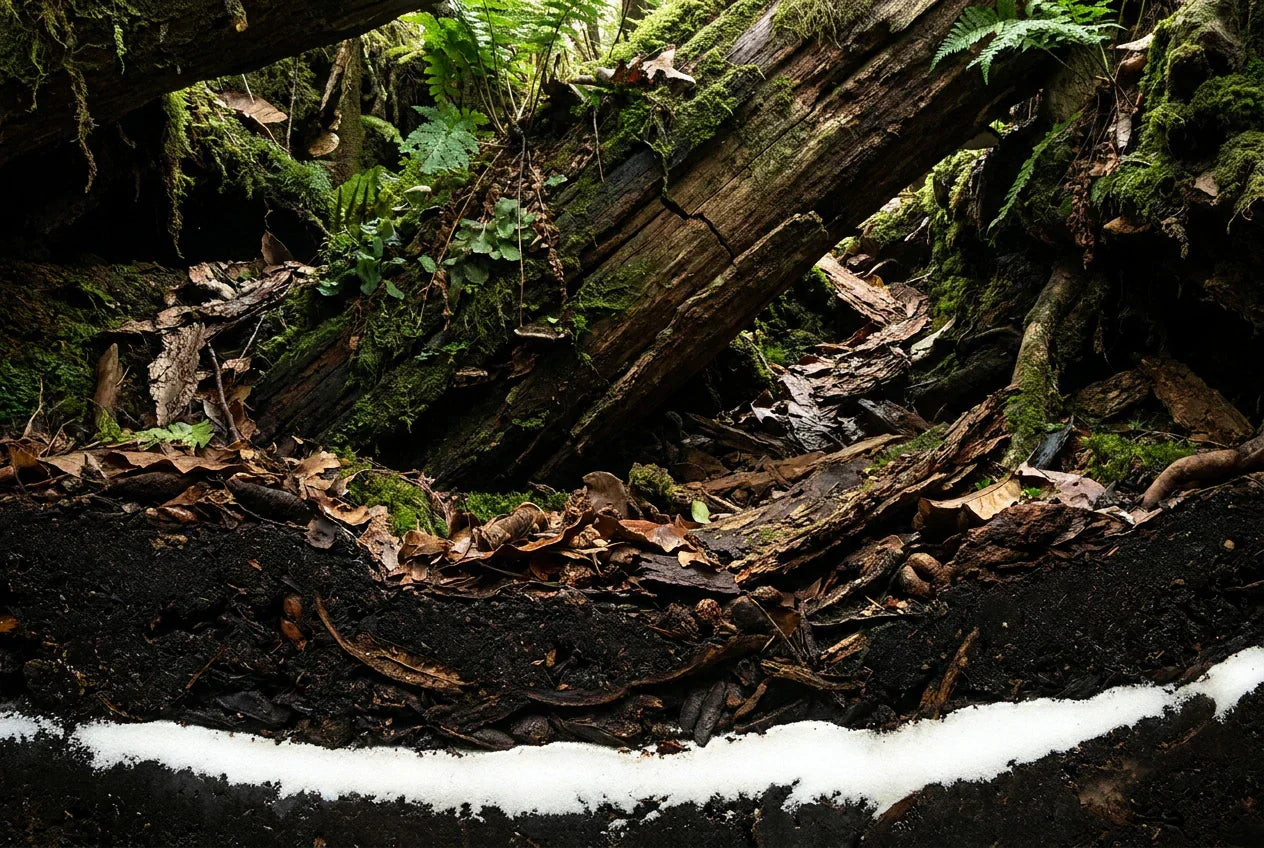
What Decay Leaves Behind
Borrowing hidden engines, clean sand, and primeval underforests from Nausicaä of the Valley of the Wind.
Remember This?
Think back to the moment Nausicaä reveals her hidden chamber beneath the castle.
Far below the surface, she has cultivated an entirely pristine ecosystem using the same spores that are poisoning the outside world.
The toxic jungle is what everyone fears, but the chamber reveals the truth beneath it.
The strange plants and towering fungi are not growing from ordinary garden dirt. They are rooted in clean white sand, fed by pure water drawn from deep below the earth.
The decay is not the disaster.
The decay is the purification mechanism.
The rot is not destruction.
It is the engine.
Observation: Nothing lives without something else decomposing first.
The Nurse Log
- Bury one side of a partially collapsed branch into the substrate.
- Leave raw, cracked timber exposed.
- Cover only selected sections with moss.
- Let the log become the biological centre of the layout.

Remember This?
Look closely at the floor of the hidden chamber.
It is not clean in the usual sense.
The surface is layered with organic matter, fallen fragments, and the remains of old growth breaking down into the next cycle.
Leaves do not simply fall and vanish.
They form paths.
They trap moisture.
They connect one living pocket to another.
The floor becomes a slow, moving network.
The Fungal Highway
- Scatter decomposing leaves and crushed bark around hardscape anchors.
- Create unbroken organic corridors from foreground to background.
- Avoid isolated decorative leaf piles.
- Let debris flow across the ground like a natural pathway.

Remember This?
The chamber floor is full of dips, hollows, and low points where material naturally collects.
Nothing is evenly spread.
Organic matter gathers where gravity sends it.
Fine bark, leaf fragments, seed pods, and soft mulch settle into dark pockets between roots and stones.
Those pockets are not mess.
They are where the forest floor becomes active.
The Detritus Basin
- Build shallow depressions behind major hardscape lines.
- Trap bark fragments, twigs, and leaf shards inside those low points.
- Keep the floor layered instead of flat.
- Let organic matter accumulate where it would naturally collect.

Remember This?
At the bottom of the chamber, beneath the strange growth and dark organic layers, there is a clean white foundation.
That sharp pale line changes everything.
Without it, the scene would feel like rot.
With it, the whole system makes sense.
The dark forest floor above is breaking down.
The white bed below is purifying.
The contrast turns decay into renewal.
The Purification Bed
- Lay a clean baseline of fine white quartz sand against the front glass.
- Build the dark bioactive layer directly above it.
- Keep the contrast sharp and visible.
- Use the pale lower line to give the dark forest floor a purpose.
If I Were Building This Today
I would start with the layers against the glass.
This build needs a visible underworld.
At the very bottom, I would create a bright, clean line of fine white quartz sand. Directly above it, I would build a dark bioactive layer using tree fern fibre, crushed charcoal, bark fragments, and damp forest soil.
That contrast is the whole point of the layout.
Next, I would install the Nurse Log. I would use a soft, weathered cork branch or gnarled timber fragment and bury one end deep into the substrate bank. The exposed side should still show raw cracked wood, not a fully moss-covered surface.
Around the base of the log, I would build the Detritus Basin with shredded magnolia leaves, oak leaves, bark chips, seed pods, and small twigs. I would not spread them evenly. I would let them collect heavily in low pockets.
From the foreground to the back shadows, I would create the Fungal Highway by linking those pockets with a continuous trail of leaf litter and bark fragments.
For planting, I would avoid cheerful decorative accents. I would look for primitive, ancient-looking textures: small ferns, liverworts, creeping mosses, and dark foliage that can grow from the log, the pockets, and the shaded debris line.
Springtails and isopods are not the visual subject here, but they matter. They are the invisible workers that keep the underforest active.
The build is not about keeping a glass tank perfectly clean.
It is about showing the hidden system that makes the forest possible.

The Final Thought
Great ecosystem design is never about hiding the decay.
The next time you build a bioactive system, let the rot become part of the landscape.
Because a forest only grows as fast as its underworld can swallow what falls into it.


