
The Worlds Remembered #04: The Tree Older Than Memory
This article is part of Chronicles of the Glass Cage, a collection of explorations into nature, imagination, ecosystems, and the worlds we carry in our minds. Each chapter begins with a question, an observation, a memory, or a possibility, then follows where that path leads.
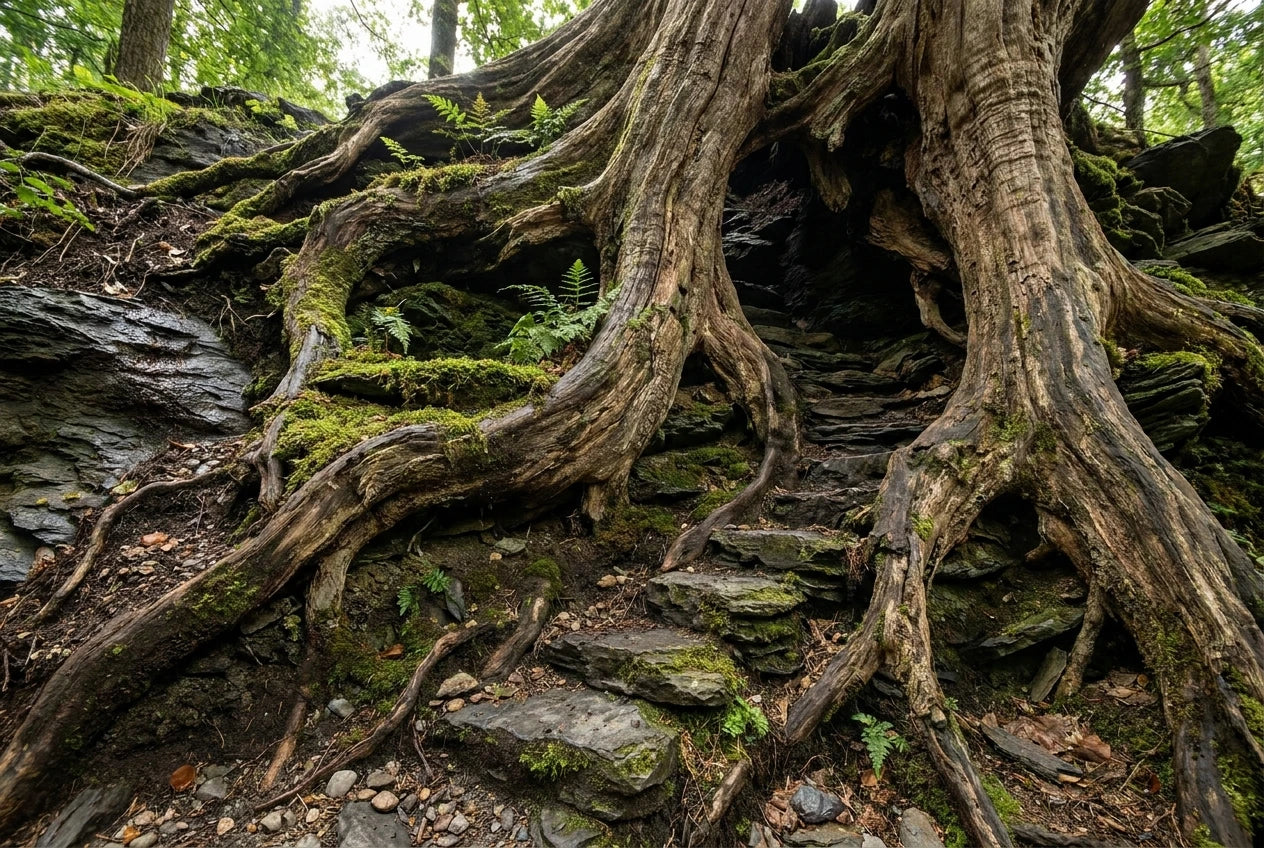
The Tree Older Than Memory
Borrowing ancient ecosystems, root cathedrals, and living hillsides from My Neighbour Totoro.
Remember This?
Think back to the moment Mei emerges from the dark tunnel.
She steps out into the hidden clearing and looks up.
Rising from the earth is the colossal bulk of the ancient camphor tree.
It is overwhelmingly massive, but it does not stand alone.
Look closely at the landscape around it.
Gigantic roots erupt from the ground like wooden walls. They grip into rocky slopes and force the earth into terraces. Moss blankets the ledges. Ferns occupy damp pockets. Stone steps disappear into the shadows beneath the roots.
At the centre of it all is a deep hollow carved directly into the timber.
Everything in the clearing exists because of the tree.
The tree is not standing inside the landscape.
The tree created the landscape.
Observation: Every great piece of wood deserves a landscape built around it.
Many terrariums are built as collections of equal ingredients.
A nice piece of wood.
A nice rock.
A few nice plants.
Everything shares equal importance.
The result often feels scattered.
Instead, start with one dominant piece of wood and treat everything else as a consequence of its existence.
The Root Grip
- Push the wood deep into the substrate.
- Wedge stones tightly against the root base.
- Make the wood appear to trap and swallow the rock.
- Avoid wood that simply sits on top of the soil.
The Root Terraces
- Use the curves of the wood to hold back substrate.
- Create elevated shelves behind roots.
- Build steep hillsides instead of flat ground.
- Let the wood determine the shape of the terrain.
The Miniature Staircase
- Use flat slate shards or weathered pebbles.
- Stack them into a narrow staircase.
- Run the steps alongside roots.
- Let the staircase disappear behind the hardscape.
The Hollow Harvest
- Use natural hollows and deep forks as planting pockets.
- Pack them with damp substrate.
- Add delicate ferns or miniature foliage.
- Let life emerge directly from the wood itself.

If I Were Building This Today
I would spend most of my time standing in front of the wood bin.
The success of this build depends almost entirely on finding the right piece of wood.
I am not looking for a branch.
I am looking for a kingdom.
I want a thick, weathered root mass with heavy buttresses, deep grain, and at least one natural hollow that can become a planting pocket.
Once I find it, I would lock it off-centre inside a wide enclosure.
Then I would start building the landscape around it.
Rough lava rock and fractured grey stone would be wedged tightly into the root base to create the Root Grip.
Next, I would pile substrate behind the roots until a steep hillside forms naturally from the shape of the wood.
The hill becomes our Root Terrace.
Then I would take tiny slate fragments and embed them into the slope one piece at a time, creating a narrow staircase that climbs into the shadows before disappearing from view.
Finally, I would pack damp substrate into the deepest forks of the timber and plant miniature ferns directly into the wood.
Sheet moss would be pressed into bark lines and allowed to creep onto the stone steps.
A few decayed leaves would be tucked between roots and rocks.
The goal is not to display a piece of driftwood.
The goal is to create a world that could only exist because that piece of driftwood exists.

What Makes This Scene Work?
The camphor tree is memorable because it feels inhabited.
Not by characters.
By time.
The roots shaped the ground.
The ground created terraces.
The terraces held moss.
The hollows sheltered ferns.
The stairs emerged where the landscape allowed them to emerge.
Every feature feels connected to every other feature.
Nothing feels randomly placed.
That is the difference between decoration and world-building.

The Final Thought
Most terrariums fail because they contain too many important things.
Most memorable landscapes succeed because they begin with one important thing and allow everything else to grow around it.
The next time you find an extraordinary piece of wood, don't just place it in a terrarium.
Build the world that grew around it.


