
The Worlds Remembered #02: The Sacred Hollow
This article is part of Chronicles of the Glass Cage, a collection of explorations into nature, imagination, ecosystems, and the worlds we carry in our minds. Each chapter begins with a question, an observation, a memory, or a possibility, then follows where that path leads.
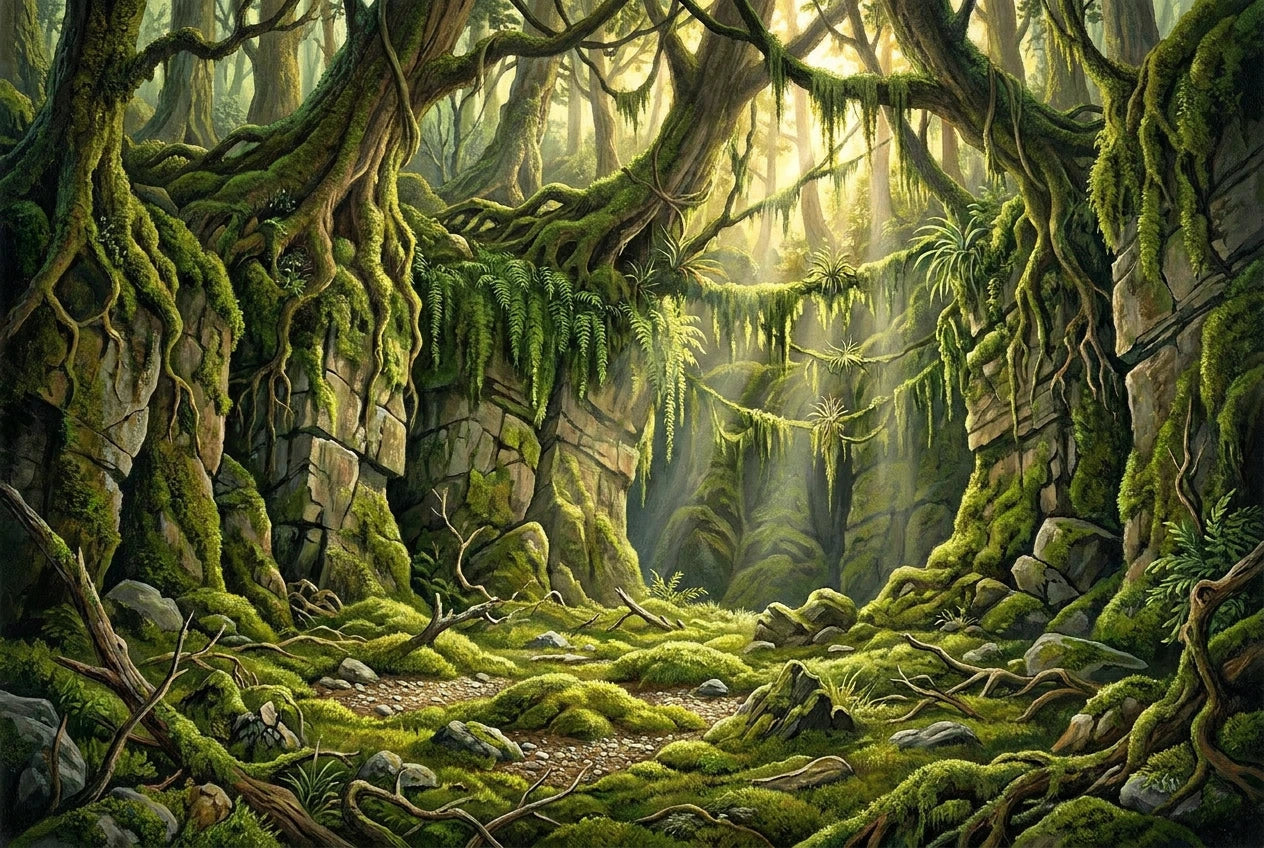
The Sacred Hollow
Borrowing enclosure, vertical growth, and ancient jungle density from Princess Mononoke.
Remember This?
Think back to the moment Ashitaka enters the deep heart of the forest to heal his curse.
He parts a curtain of ancient, hanging moss and steps into a hidden clearing.
At the centre is an enclosed, uneven basin where the ground flattens into a wild meadow, surrounded by sheer, fractured stone cliffs and towering primeval trees.
The Forest Spirit is what everyone remembers from the scene.
But the creature only works because the landscape forms a natural cathedral.
There is no human footprint here.
Nothing looks swept, arranged, or designed.
The beauty comes from age, untamed chaos, and absolute visual density.
Observation: A jungle feels larger when it grows upward instead of outward.
The Wild Meadow Floor
- Lay an uneven bed of mixed river pebble wash against the front glass.
- Interrupt carpeting moss with moss hummocks, scattered stones, and exposed gravel.
- Let gnarled accent roots emerge briefly before diving back into the substrate.
- Break the surface with tiny fern colonies and scattered twig fragments.
- Make the viewer wander across details instead of scanning a neat carpet.

Remember This?
Look at how the space is constructed.
Gnarled roots and massive vines twist across the upper canopy, blotting out the sky and dropping thick tendrils toward the wild meadow below.
The stone walls are hidden under centuries of weeping liverworts and dripping ferns.
There is no open horizon here.
The cliff faces are not smooth panels. They are broken, split, and collapsing under the weight of wet growth.
The landscape pulls your eyes from the jungle floor straight up the fractured rock walls through layers of hanging life.
The Broken Moss Cliffs
- Stack deeply textured stones into a steep, near-vertical wall.
- Use Dragon Stone, weathered lava rock, or other broken-textured stone.
- Create deep splits, uneven ledges, overhangs, and small cave mouths.
- Pack vertical joints with wet clay, soil, and creeping liverwort sheets.
- Let the cliff act as a retaining wall for the high substrate shelf behind it.

Remember This?
Look closely at the upper third of the forest clearing.
The sky is completely deleted by an interlocking mesh of old wood.
Ancient trunks and heavy vines collide across the upper frame, casting layered shadows across the floor below.
The clearing feels enclosed because the forest has built itself a ceiling.
It feels raw, humid, and slightly dangerous, like a chamber woven by centuries of uninterrupted growth.
The Root-Choked Canopy
- Interlock thick, sweeping wood pieces high in the upper third of the tank.
- Use aged mangrove, azalea root, or other gnarled branching wood.
- Let tendrils and woody vines drape downward over the open space.
- Avoid leaving open air at the top.
- Use the canopy to trap humidity, cast shadows, and stop the eye from drifting out.

Remember This?
The final layer of the jungle is the light.
Bright shafts of sun cut through the heavy wood canopy and strike a curtain of dangling foliage.
The hanging creepers catch the light like green threads suspended in mid-air.
They soften the broken cliffs behind them and force you to look through a veil of green to discover the clearing below.
It feels like the jungle is trying to reclaim the empty air.
The Weeping Invasion
- Mount micro-ferns and trailing epiphytes into high stone crevices and upper wood forks.
- Let foliage hang freely through the open vertical space.
- Create a dense curtain of green threads between viewer and background.
- Replace standard horizontal midground planting with a descending vertical filter.
- Make the viewer look through vegetation to understand the layout.
If I Were Building This Today
I would spend most of my time in front of the stone and wood bins hunting for rough, vertical pieces.
I am not building a neat, balanced terrarium display.
I am building a fragment of ancient jungle that looks completely untouched by humans.
I would start with a tall, deep enclosure.
At the front glass, I would lay an uneven bed of fine river pebble wash and break it up with moss hummocks, exposed gravel, scattered stones, tiny twigs, and small fern pockets.
A few gnarled root fragments would break through the surface before disappearing back into the substrate.
Directly behind this wild floor, I would build the Broken Moss Cliffs.
I would stack jagged lava stones or Dragon Stones upward, keeping the wall steep and irregular rather than smooth. Some sections should overhang. Some should look split. Some should create small shadowed pockets.
Behind the stone wall, I would pack the main bioactive substrate high enough to form a background shelf.
Then I would lock thick mangrove branches or aged azalea roots into the upper third of the tank, wedging them between the stone walls until they form a dense, root-choked canopy.
For planting, I would avoid typical midground stems. I would press wet clay and Riccardia chamedryfolia directly into the cliff cracks, then cover those joints with liverwort sheets, tiny ferns, and creeping moss.
Trailing epiphytes would be mounted high in the wood forks and allowed to fall downward through the open space.
Nothing in this landscape should look intentionally placed.
If the moss line looks too neat, tear it.
If a stone looks too balanced, tilt it.
If the floor looks too perfect, interrupt it with roots, gravel, and debris.
The build is about engineering a steep, enclosed jungle hollow where every broken rock, tangled root, and hanging vine forces the viewer to climb the layout with their eyes.

The Final Thought
Great jungle design is not about creating a perfect arrangement.
The next time you build a dense forest layout, break your lines, scatter the debris, and let nature conquer the grid.
A sacred hollow should not look designed.
It should look discovered.


