
The Worlds Remembered #05: The House That Grey From The Hill
This article is part of Chronicles of the Glass Cage, a collection of explorations into nature, imagination, ecosystems, and the worlds we carry in our minds. Each chapter begins with a question, an observation, a memory, or a possibility, then follows where that path leads.
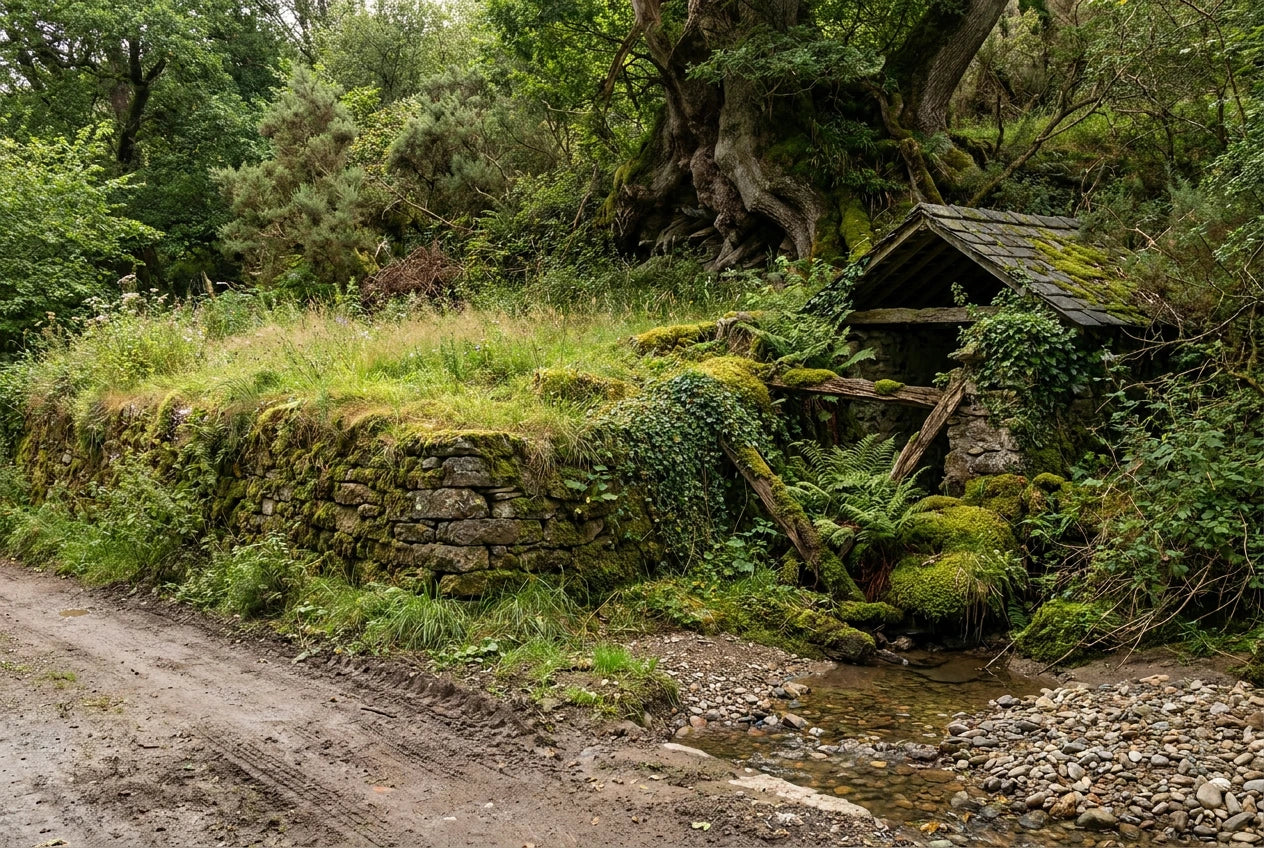
The House That Grew From The Hill
Borrowing hillside settlements, winding paths, and forgotten homesteads from My Neighbour Totoro.
Remember This?
Think back to the moment the family first arrives at their new home.
Satsuki and Mei do not simply open a front door. They run up a winding dirt road, cross a shallow drainage stream, and climb a muddy footpath cut into the hillside before finally reaching the clearing where the house stands.
The house is what people remember, but the real magic is how the landscape prepares you for it.
The road sits low in the valley. Stone retaining walls hold back the slope. The path climbs upward. The clearing opens suddenly. Behind it all rises the massive silhouette of the camphor tree and a wall of dense greenery.
The house does not sit on top of the hill.
It feels wedged into it.
The entire landscape looks as though the road, stream, walls, roots, and house have been growing together for decades.
Observation: A destination feels real when the landscape prepares you for it.
The Lowland Corridor
- Create a wide dirt road at the front glass.
- Add a shallow drainage stream beside it.
- Keep the terrain low and open.
- Use gravel, pebbles, and muddy textures.
The Sheared Embankment
- Build a stacked stone retaining wall.
- Hold back the main substrate bank.
- Create a strong elevation change.
- Leave deep crevices between stones.
The Inhabited Clearing
- Create a flat plateau above the wall.
- Bury architectural pieces into the soil.
- Allow earth to overlap foundations.
- Never let structures sit on top of moss.
The Protective Canopy
- Place a root mass behind the clearing.
- Frame the area with shrubs and ferns.
- Hide the rear wall completely.
- Make the settlement feel sheltered.

If I Were Building This Today
I would start with the terrain before I even think about the structure.
The road, stream, wall, and hillside are what make this world believable. The house fragment simply becomes the reward waiting at the end of the journey.
At the front of the enclosure, I would create a broad dirt road using fine sand, soil, and scattered pebbles. Running alongside it would be a shallow drainage stream lined with gravel and rounded stones.
Behind the road, I would build a steep retaining wall from stacked slate or weathered fieldstone. This wall would create a dramatic change in elevation and support a high substrate bank behind it.
Once the wall is complete, I would form a flat clearing at the top of the slope.
Only then would I introduce the architectural element. Instead of placing a complete house, I would use a partially buried roof corner, weathered timber frame, gate post, or wall fragment. The structure would be sunk into the hill so it feels anchored rather than displayed.
Behind the clearing, I would position a large root mass inspired by the camphor tree. Dense shrubs, ferns, and creeping plants would surround it, creating a protective backdrop that blocks the rear glass and frames the settlement.
The roofline would be covered with moss. The retaining wall would be softened with creeping plants. Ferns would emerge from corners where the structure meets the hillside.
If I were building for vampire crabs, the stream becomes a travel corridor and drinking zone while the retaining wall creates deep shelter pockets.
If I were building for dart frogs, the moss-covered roof, root canopy, and elevated clearing become humid hunting grounds.
The goal is not to build a miniature house.
The goal is to build a hillside homestead that feels inhabited by both nature and time.

Why This Landscape Feels Real
Every part of the layout serves a purpose.
The road establishes distance.
The stream creates a boundary.
The retaining wall creates height.
The clearing provides relief.
The house offers shelter.
The tree creates protection.
Each layer prepares you for the next.
By the time you reach the clearing, the destination already feels important.

The Final Thought
Many terrariums reveal everything at first glance.
The most memorable landscapes create a sense of arrival.
Build the road.
Cross the stream.
Climb the hill.
Then let the homestead reveal itself.
Sometimes the destination becomes memorable because of everything you experienced before reaching it.


