
The Worlds Remembered #01: The Hidden World Beneath the Floorboards
This article is part of Chronicles of the Glass Cage, a collection of explorations into nature, imagination, ecosystems, and the worlds we carry in our minds. Each chapter begins with a question, an observation, a memory, or a possibility, then follows where that path leads.
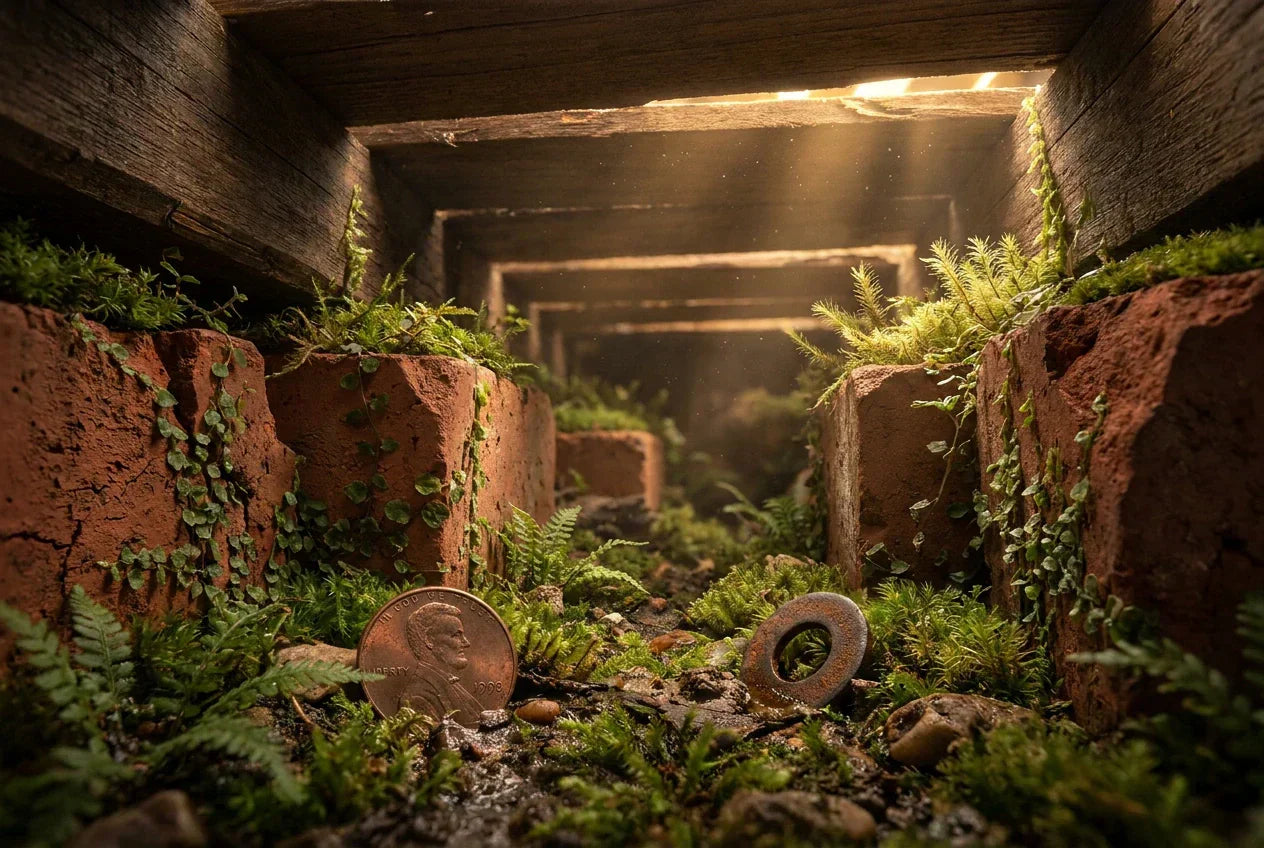
The Hidden World Beneath the Floorboards
Borrowing scale, shelter, and hidden architecture from The Secret World of Arrietty.
Remember This?
Remember the opening minutes of The Secret World of Arrietty?
The home beneath the floorboards is easily one of the most memorable places in the movie.
What makes it so fascinating is that nothing in it is actually magical.
It is built from ordinary human construction materials. Red brick foundations. Rough timber beams. Dark gaps beneath the floor.
Yet somehow, it feels like an entire hidden world.
A single brick becomes a cliff face.
A timber beam becomes a wooden sky.
A narrow gap becomes a secret valley.
The materials are ordinary.
The scale is not.
If I were trying to recreate this feeling inside a terrarium, I would start with the brick.
The house has not become smaller. The observer has.
A broken red clay brick immediately establishes the illusion. A clean brick feels manufactured. A fractured brick feels geological.
Place it vertically against the glass and let it dominate the layout.
Then introduce a low ceiling using bark, timber, or weathered wood.
The goal is not decoration. The goal is to create the feeling of being underneath something heavy.
That is where the floorboards begin to appear.

Remember This?
Later, Arrietty ventures into the garden.
Suddenly everything becomes enormous.
Leaves tower overhead.
Grass becomes a forest.
Then she encounters a simple garden pillbug.
Except it no longer feels like a harmless garden bug.
It feels like wildlife.
Large. Armored. Ancient.
The garden has not changed.
The scale has.
If I wanted this feeling in a terrarium, I would not start by searching for larger creatures.
I would start by searching for smaller plants.
Look for miniature vines, tiny leaves, and fine mosses.
The smaller the foliage, the larger everything else becomes.
Micro-vines climbing a brick wall instantly transform that brick into a towering cliff.
Fine mosses begin to feel like entire forests.
This is also one of the few concepts where real isopods become part of the visual storytelling.
Next to giant hardscape and miniature foliage, they stop looking like a cleanup crew and start looking like the creatures Arrietty encounters in the garden.
The isopod has not changed. Only the scale of the world around it has changed.

Remember This?
Later in the story, the family is forced to leave their home.
During the journey, they shelter beneath a wooden deck plank.
Outside is wilderness.
Inside is refuge.
A patch of moss.
A protected corner.
A temporary home hidden from the larger world.
Most terrariums reveal everything immediately.
Arrietty's world constantly hides things.
That is something worth stealing.
A hidden chamber is often more interesting than an exposed landscape.
Create a sheltered space using bark tunnels, root arches, slate overhangs, or cavities beneath the brick.
Inside the shelter, keep things simple and clean.
Outside the shelter, allow the landscape to become taller and more chaotic.
The contrast creates an immediate feeling of safety.
The eye discovers the refuge rather than being shown it.

If I Were Building This Today
I would leave the movie and immediately start hunting for three things.
A broken brick.
A dark piece of bark.
The smallest-leaved plant I could find.
The brick establishes the cliff.
The bark creates the floorboards.
The tiny foliage creates the illusion of scale.
Finally, I would add a familiar human object such as a coin, washer, or old button.
The moment your eye recognises that object, everything around it suddenly becomes larger.
The brick becomes a cliff.
The moss becomes a forest.
The hidden space beneath the floorboards begins to feel real.
The Final Thought
The next time you walk past a broken brick, do not look at it as construction debris.
Look at the fracture lines.
Look at the texture.
Ask yourself whether it already looks like a landscape.
If it does, you may have just found the foundation of your next hidden world.


