
Why Your Terrarium Needs Beneficial Fungi
This guide is created by Green Chapter — Nature Workshop Studio, where we focus on creating living ecosystems through hands-on experience. We share practical insights across terrariums, aquascaping, plants, and natural systems to help you build and care for your own.
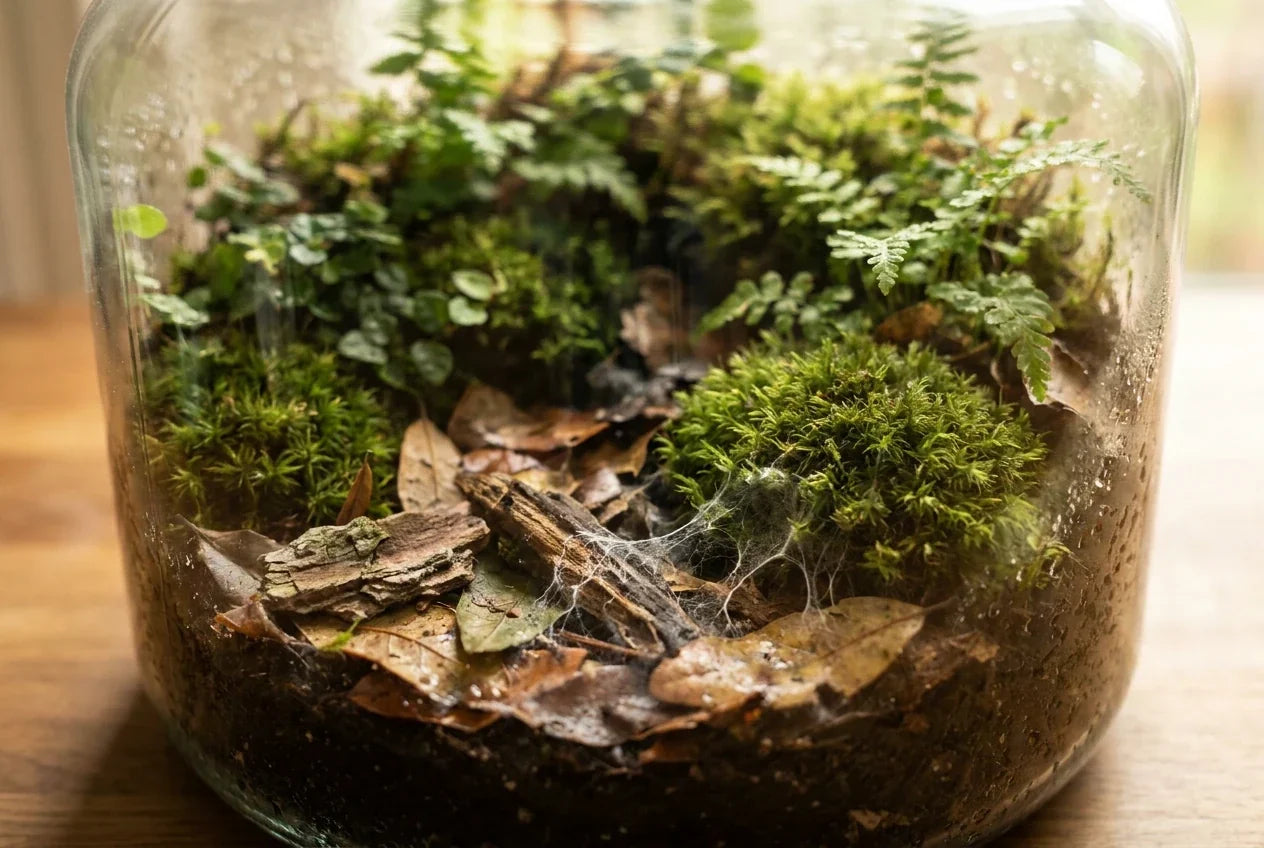
Fungus is probably one of the most misunderstood parts of a terrarium.
A patch of white fuzz appears on a piece of driftwood, and the first instinct is often to remove it before it spreads. After all, mold usually means something is rotting.
But in a healthy ecosystem, decomposition is not a problem—it is a necessity.
Walk through any rainforest and you'll find fallen leaves, decaying branches and rich forest soil. Beneath the surface, an invisible network of fungi is constantly breaking down dead organic matter, returning nutrients to the soil and supporting new plant growth.
A terrarium works in exactly the same way.
The goal isn't to create a terrarium without fungi. The goal is to create one where beneficial fungi quietly perform the work they have always done in nature.
Why Fungus Has Such a Bad Reputation
Most people associate fungi with spoiled food, damp walls and diseased plants. It's no surprise that seeing white fungal growth inside a terrarium immediately causes concern.
The truth is that fungal spores are already everywhere.
They arrive on plants, moss, driftwood, leaf litter and even the air around us. A terrarium isn't suddenly "infected" when fungus appears. The spores were usually present from the very beginning.
What changes is the environment.
Fresh wood, fallen leaves and damaged roots provide food. High humidity allows fungal colonies to grow quickly, making them visible for the first time.
This is why newly built terrariums commonly develop patches of white fungal growth during their first few weeks. In many cases, it is simply the ecosystem beginning its natural recycling process.
The important question isn't whether fungi exist.
It's which fungi are growing, what they're feeding on, and whether the ecosystem remains balanced.

Every Terrarium Needs a Recycling System
Plants continuously grow, shed old leaves and replace damaged roots.
Without decomposers, all of that dead material would simply accumulate while the nutrients locked inside it became unavailable to new growth.
Beneficial fungi prevent this from happening.
They release enzymes that break down tough organic materials such as leaves, bark and wood into simpler compounds. Bacteria continue the process, eventually returning minerals and nutrients to the substrate where plant roots can absorb them once again.
Springtails and isopods also play an important role by breaking larger pieces of organic matter into smaller fragments, allowing fungi and bacteria to work more efficiently.
Instead of seeing fungi as unwanted invaders, it's more accurate to think of them as the terrarium's recycling system.
Plants grow
↓
Leaves and roots naturally die
↓
Springtails and isopods break them into smaller pieces
↓
Beneficial fungi and bacteria recycle the nutrients
↓
Plants absorb those nutrients and continue growing
Without this cycle, even the healthiest terrarium would eventually exhaust its usable nutrients.

Not All Fungi Are the Same
The word fungus covers thousands of different species, and not all behave in the same way.
For terrarium keepers, it helps to think of fungi in three simple groups.
Beneficial Decomposers
These fungi feed on dead organic matter such as fallen leaves, bark, wood and dying roots.
Their job is to recycle nutrients that would otherwise remain trapped inside decaying material.
Many of the white fungal threads seen on new driftwood belong to this group.
Root Partners
Some fungi form natural partnerships with plant roots.
Known as mycorrhizal fungi, they exchange nutrients and water for sugars produced by the plant during photosynthesis.
This partnership can improve nutrient uptake and root health, particularly in nutrient-poor natural soils.
Not every terrarium plant relies heavily on these fungi, but they are an important part of many natural ecosystems.
Opportunistic Molds
Some fungi simply take advantage of weakened plants or excess organic waste.
They may colonise rotting leaves, uneaten food or plants already stressed by poor growing conditions.
These are the fungi most likely to become a problem if the terrarium remains overly wet, poorly ventilated or overloaded with decaying material.
The presence of visible fungus alone doesn't tell you which type you're looking at.
Understanding the surrounding conditions is far more important than reacting to the colour of the growth.

What Are Those White Threads?
When people think of fungi, they usually picture mushrooms.
In reality, mushrooms are only the reproductive structures produced by some fungi.
The main body of the fungus is a network of microscopic threads called hyphae. Together, these threads form a structure known as mycelium.
As the mycelium spreads through wood, leaves or soil, it releases enzymes that break organic matter into nutrients the fungus can absorb.
Inside a terrarium, mycelium often appears as:
- Fine white threads beneath leaf litter
- White strands running through driftwood
- Thin patches around decaying roots
- Delicate growth just below the soil surface
These thread-like networks are usually carrying out the work of decomposition.
As the available food is consumed, the visible growth often declines naturally. Springtails may also graze on the mycelium, reducing what you see without eliminating the fungal network itself.
A mature terrarium may still contain an extensive underground fungal network even when no visible fungus remains on the surface.

Why New Terrariums Often Grow More Fungus
A newly built terrarium hasn't reached biological balance yet.
Freshly planted roots are recovering from transplanting. Leaf litter has only just begun to soften, and newly added driftwood is absorbing moisture for the first time. All of these provide an excellent food source for decomposer fungi.
As a result, it's common to see a temporary fungal bloom during the first few weeks.
As the ecosystem matures, that growth often slows because:
- Easily decomposed material has been consumed.
- Springtail populations increase.
- Plants establish healthier root systems.
- The microbial community becomes more balanced.
This early phase is simply part of ecological succession—the natural process where a new ecosystem gradually becomes more stable.
A terrarium shouldn't be judged by whether fungus appears, but by whether the ecosystem settles into balance over time.
Springtails Don't Remove Fungi—They Regulate Them
Springtails are often recommended whenever mold appears in a terrarium.
That's because they feed on fungal hyphae, spores, microbial films and decaying organic matter. By constantly grazing these surfaces, they prevent fungal growth from becoming excessive.
However, springtails don't eliminate fungi—and they shouldn't.
A healthy terrarium depends on fungi to recycle nutrients. Springtails simply keep fungal populations in balance while converting part of that fungal growth into nutrients that continue moving through the ecosystem.
In smaller closed terrariums, springtails alone are usually enough to maintain this balance.
In larger terrariums, they often work alongside isopods.

Where Do Isopods Fit Into the Ecosystem?
While springtails feed mainly on fine fungal growth and microbial films, isopods specialise in larger organic material.
They consume:
- Fallen leaves
- Softened bark
- Decaying wood
- Dead plant tissue
- Animal waste
As they feed, they break larger materials into much smaller fragments.
This increases the surface area available to fungi and bacteria, allowing decomposition to happen more efficiently.
Together, fungi, bacteria, springtails and isopods form a recycling team, with each performing a different role.
Supporting Beneficial Fungi Naturally
Most terrariums don't need commercial fungal inoculants.
Beneficial fungi usually arrive naturally with plants, wood, moss and substrate. The real challenge is creating conditions that allow them to thrive without encouraging uncontrolled mold.
A healthy fungal community is supported by:
- An airy substrate that doesn't become compacted.
- Leaf litter as a slow, natural food source.
- Small pieces of bark or driftwood for long-term decomposition.
- Moist but well-drained soil rather than permanently saturated conditions.
- Springtails to regulate fungal growth.
- Patience while the ecosystem matures naturally.
Trying to sterilise every piece of fungus often disrupts the very processes that keep the terrarium healthy.

When Fungal Growth Is Perfectly Normal
Not every fungal bloom needs to be removed.
In many healthy terrariums, it's normal to see:
- Fine white threads beneath leaf litter.
- White growth on newly added driftwood.
- Small patches that gradually disappear over time.
- Springtails actively grazing fungal growth.
- An earthy forest-like smell.
- The occasional mushroom appearing for a few days.
These are usually signs that decomposition is taking place as expected.
Remember, mushrooms are only the fruiting bodies of certain fungi. The fungal network has often been living inside the substrate long before a mushroom becomes visible.
When Fungus May Be Warning You About Something Else
Fungal growth becomes more concerning when it appears alongside signs of an unhealthy ecosystem.
Watch for:
- A sour or rotten smell.
- Permanently waterlogged substrate.
- Slimy black organic material.
- Living moss becoming smothered.
- Seedlings collapsing repeatedly.
- Large amounts of uneaten food.
- Continuous heavy mold that never declines.
In these situations, the fungus is often responding to excess moisture, poor airflow or too much decaying material.
Rather than trying to kill the fungus itself, it's usually more effective to correct the underlying conditions by:
- Removing dead plant material.
- Improving drainage.
- Reducing excessive misting.
- Increasing airflow where appropriate.
- Removing leftover food.
- Allowing the substrate to dry slightly between watering cycles.
Healthy ecosystems manage decomposition.
Unhealthy ecosystems become overwhelmed by it.

Fungi Are Part of Nature's Design
When people see fungus in a terrarium, they often assume something has gone wrong.
In reality, many fungi are doing exactly what nature designed them to do.
They recycle dead leaves, break down wood, return nutrients to the soil and quietly support the ecosystem beneath the surface. Together with bacteria, springtails and isopods, they form the invisible workforce that allows a closed terrarium to function year after year.
The goal isn't to build a terrarium without fungi.
It's to build one where beneficial fungi outcompete opportunistic molds, allowing decomposition to remain balanced rather than destructive.
The next time you notice a patch of white fungal threads beneath your leaf litter, don't ask, "How do I get rid of it?"
Instead, ask:
"Is my ecosystem doing exactly what nature intended?"


