
Why Is Leaf Litter Important to an Ecosystem?
This guide is created by Green Chapter — Nature Workshop Studio, where we focus on creating living ecosystems through hands-on experience. We share practical insights across terrariums, aquascaping, plants, and natural systems to help you build and care for your own.
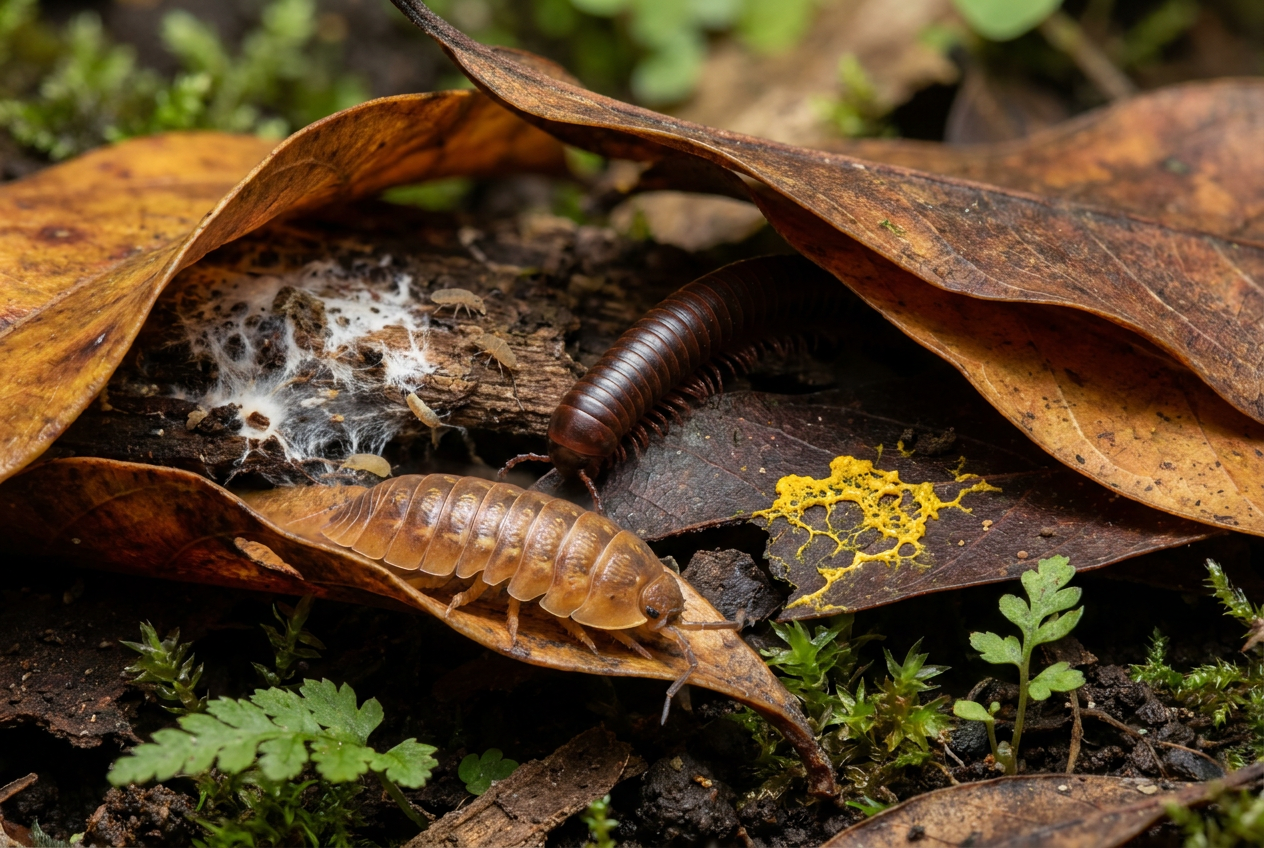
Have you ever wondered whether fallen leaves should be left on the ground or cleared away? Do they simply make the forest floor look messy, or do they serve an important purpose?
In nature, fallen leaves are part of a much larger system. They provide shelter for small animals, help the ground retain moisture, support fungi and bacteria, and gradually return nutrients to the soil.
Look beneath a layer of leaves and you might find isopods, springtails, millipedes, tiny mites or even colourful slime molds.
But how do these organisms use the leaves, and what happens as the leaves slowly disappear?
1. A Home Beneath the Leaves
A layer of fallen leaves creates many small spaces between the leaves and the soil. These spaces provide shelter from sunlight, wind, drying and some predators.
Different animals use this habitat in different ways.
-
Isopods hide beneath leaves to reduce water loss, rest and feed on decaying plant material.
-
Springtails move through damp spaces, feeding on fungi, bacteria and other organic resources, depending on the species.
-
Millipedes shelter under leaves and feed on decaying plant material.
-
Mites and other small animals live among the leaves. Some feed on fungi and organic matter, while others hunt smaller animals.
-
Frogs and other predators may use the leaf litter for shelter or hunt the small animals living there.
Not all tree frogs spend much time on the ground. Their use of leaf litter depends on the species and its natural habitat.
The overlapping leaves also make it harder for some predators to find their prey. However, leaf litter is not completely safe. Spiders, centipedes and other predators also hunt within it.

2. Why Leaf Litter Helps Keep the Ground Moist
Lift a layer of leaves in a forest and the soil underneath often feels cooler and damper than exposed ground.
This happens because the leaves shade the soil and reduce the movement of air directly across its surface. They can also slow evaporation and help maintain more stable conditions.
This is especially important for small animals such as isopods and springtails, which are sensitive to drying.
However, leaf litter does not create water. It helps conserve moisture already present from rainfall, damp soil or other sources.
A thick layer of leaves can also become too wet, particularly where water cannot drain away. Many soil animals and decomposing microorganisms still need oxygen.
The goal is not to keep every leaf permanently soaked, but to maintain suitable moisture and airflow for the organisms living there.
3. What Grows on Fallen Leaves?
When leaves fall to the ground, fungi and bacteria begin colonising them. Many are already present on the leaves before they fall.
These microorganisms are among the main organisms responsible for decomposition.
Fungi produce enzymes that break down complex plant materials, including cellulose. Some form fine threads called hyphae that spread across and through the leaves.
Bacteria break down many organic compounds and take part in nutrient recycling.
As decomposition progresses, leaves may become softer, darker and easier to tear. White fungal threads or patches may also become visible.
These changes are often normal parts of decomposition.
Other organisms join this microscopic community.
What about slime molds?
Slime molds are particularly interesting because many look like fungi, but they are not true fungi.
Some appear as yellow or white spreading masses, while others produce tiny, colourful structures that release spores.
Many slime molds feed on bacteria and other microorganisms living on decaying material. Rather than breaking down tough leaves in the same way as decomposer fungi, they participate in the microbial food web.
Not every patch of mould or coloured growth is a slime mold. Correct identification may require closer examination.

4. What Helps Leaf Litter Break Down?
Have you noticed that fallen leaves disappear more quickly in some places than others?
Decomposition depends on several environmental conditions.
Water and rainfall
Water helps microorganisms remain active and allows some soluble compounds to move out of the leaves. Rain also wets the surrounding soil, creating conditions for decomposers.
Humidity
Humid air can reduce how quickly leaves dry. However, high air humidity does not always mean the leaves or soil are sufficiently moist.
Temperature
Warm conditions generally support faster microbial activity within a suitable temperature range. Very high temperatures can instead stress or kill organisms.
Oxygen
Many decomposing fungi and bacteria need oxygen. Waterlogged, poorly aerated conditions can slow aerobic decomposition and favour different microbial processes.
Leaf type
Not all leaves break down at the same rate. Tough leaves containing more resistant compounds often last longer than soft, easily decomposed leaves.
In managed habitats, misting systems and artificial rain can provide moisture similar to natural rainfall.
Foggers mainly increase air humidity and may wet surfaces through condensation. They do not necessarily provide enough water to moisten the entire leaf-litter layer or underlying soil.
The important lesson is that moisture, temperature and oxygen must work together. More water does not always mean healthier or faster decomposition.

5. Who Actually Eats the Fallen Leaves?
It might seem that isopods and millipedes simply eat dead leaves, but the feeding process is more interesting.
A newly fallen leaf may be tough, contain defensive compounds or offer limited nutrition.
As fungi and bacteria grow on the leaf, they begin changing its tissues. This process is called microbial conditioning.
For many leaf-eating animals, microbial conditioning makes the leaf more suitable as food.
Isopods and millipedes
Many isopods and millipedes consume decaying leaves along with some of the microorganisms growing on them.
As they feed, they break larger pieces of leaf into smaller fragments.
Their waste contains partly processed organic material that microorganisms can continue breaking down.
Springtails
Springtails generally play a different role.
Many species feed on fungi, bacteria and other microscopic resources found on decaying leaves. Some also consume plant material.
They are not all doing the same job as isopods or millipedes.
By grazing on microorganisms, springtails can influence which microbes grow and how the microbial community develops.
Who eats the decomposers?
The leaf-litter habitat also supports predators.
Predatory mites, spiders, centipedes and some amphibians feed on smaller animals living among the leaves.
This means leaf litter supports more than decomposition. It also supports a food web, where organisms obtain energy by feeding on plants, microorganisms or other animals.

6. How Leaf Litter Benefits the Soil
As leaves decompose, their materials follow several different paths.
Fungi and bacteria break down organic compounds. Isopods, millipedes and other animals fragment the leaves and produce waste that microorganisms can process further.
Some of the carbon in the leaves is released into the atmosphere as carbon dioxide through respiration.
Some becomes part of living microorganisms, while another portion can contribute to soil organic matter.
Nutrients such as nitrogen, phosphorus and potassium may gradually be released into forms that plants and other organisms can use.
However, not all nutrients become available immediately. Some are temporarily held within microorganisms or organic material before being released later.
This process is called nutrient cycling.
The leaves that once grew on a plant become part of the material supporting life on the forest floor. Through decomposition and nutrient cycling, some of their nutrients can eventually be taken up by plants again.

7. How to Maintain a Healthy Leaf-Litter Habitat
The same ecological processes can be encouraged in terrariums, vivariums and other bioactive enclosures.
The objective is not to make leaves disappear as quickly as possible. It is to provide a suitable habitat where decomposition can take place gradually.
Choose suitable leaves. Use clean, pesticide-free leaves from correctly identified plants that are appropriate for the animals being kept. Avoid unknown or potentially toxic plant material.
Create overlapping layers. Allow leaves to overlap naturally, forming spaces where small animals can hide and move. The appropriate thickness depends on the enclosure and its inhabitants.
Maintain suitable moisture. Provide damp refuges without leaving the entire substrate permanently waterlogged. Misting or artificial rainfall can help, but the amount and frequency should match the species and enclosure conditions.
Allow some decomposition. Partially decomposed leaves support microorganisms and provide food for many detritivores. They do not need to be removed simply because they look old.
Provide airflow and drainage. These help prevent prolonged saturation and support organisms that require oxygen.
Replenish the leaves. Leaf litter is gradually consumed and broken down. In a contained enclosure, new organic material must be added when needed.
A healthy leaf-litter layer may contain fungal growth, small animals and partially decomposed leaves. These are not automatically signs of poor maintenance.
However, persistent foul odours, severely waterlogged substrate or unhealthy animals should prompt closer inspection.
8. What Have We Learned?
Leaf litter is much more than a layer of dead leaves.
It provides shelter, helps retain moisture, supports fungi and bacteria, supplies food for small animals and creates habitat for predators.
As microorganisms and soil animals process the leaves, organic matter is broken down and nutrients move through the ecosystem.
Rainfall, humidity, temperature and oxygen all influence how these processes develop.
For anyone maintaining a terrarium or vivarium, the lesson is simple: leaf litter is part of the living habitat, not just decoration or waste.
Choose suitable leaves, provide the right environmental conditions, and allow the organisms beneath them to carry out their natural roles.
The next time you lift a fallen leaf, look closely at what is happening underneath. The animals and microorganisms you find are part of the system that keeps the forest floor functioning.


