
Excess Water in Terrariums
This guide is created by Green Chapter — Nature Workshop Studio, where we focus on creating living ecosystems through hands-on experience. We share practical insights across terrariums, aquascaping, plants, and natural systems to help you build and care for your own.
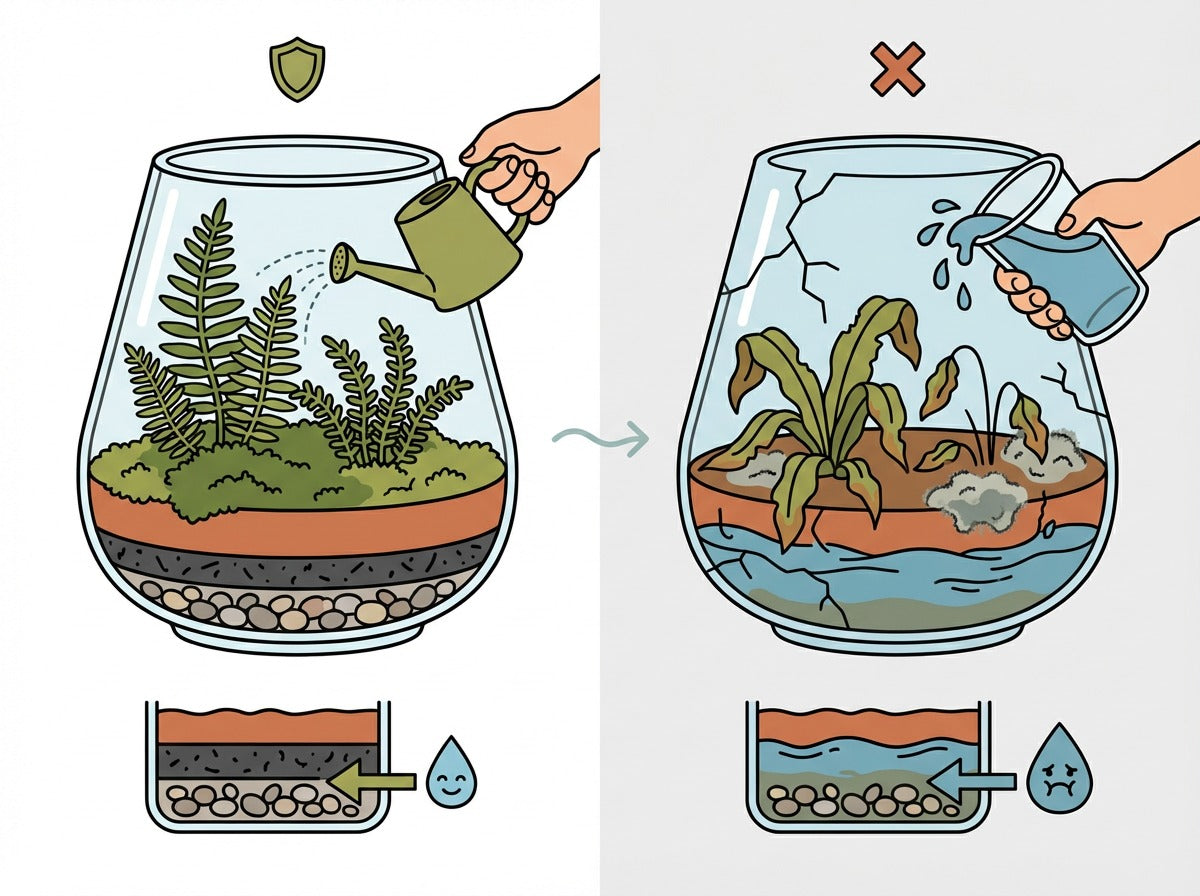
Excess Water in Terrariums: Why Prevention Matters More Than Cure

One of the most common terrarium problems is also one of the hardest to reverse: excess water.
Once water starts pooling beneath the soil, roots remain too wet, airflow drops, and the entire system can drift toward rot, mold, and imbalance.
At first, everything may still look beautiful — the moss is green, the glass is clear, and the landscape looks healthy. But beneath the surface, the system may already be struggling.
This is why experienced terrarium builders follow one important principle:
Prevention matters more than cure.
Why Excess Water Is So Hard to Fix
A closed terrarium behaves like a miniature water cycle.
- Water evaporates from the soil and plants
- It condenses on the glass
- It flows back into the soil
- The cycle repeats
This means the water inside a terrarium does not really leave the system.
If you add too much water, it usually ends up collecting at the bottom of the container.
Many people try to fix this by opening the lid to “air it out,” but this only reduces humidity temporarily and does not remove the pooled water. Others try using a syringe or turkey baster to remove water from the bottom, but this is often difficult and inconsistent, especially in a fully planted terrarium.
So instead of asking: How do I remove excess water?
A better question is: How do I prevent excess water in the first place?
The Drainage Layer: Your Terrarium’s Safety Net

A proper terrarium should always include a drainage layer at the bottom.
This layer is usually made of gravel, pumice, lava rock, or expanded clay balls.
Its purpose is simple:
- It allows excess water to move away from the soil
- It prevents roots from sitting in constantly wet soil
- It acts as a failsafe zone for extra water
As a general guide:
- The drainage layer should be about 20–30% of the container height
- Larger containers should have thicker drainage layers
- But remember — the drainage layer is a safety buffer, not an excuse to overwater
Good terrariums are not built by adding more water.
They are built by controlling water.
4 Simple Habits That Prevent Overwatering

1. Start Slightly Dry, Not Wet
When building a terrarium, the soil should feel slightly moist — not soaked.
If you squeeze the soil and water drips out, it is too wet.
2. Mist, Don’t Pour
Use a spray bottle instead of pouring water directly.
Pouring water often creates hidden water pockets that collect at the bottom.
3. Watch the Glass
Your terrarium glass tells you what is happening inside:
- Light mist in the morning that clears later → Good balance
- Heavy condensation all day → Too much water
- No condensation → Too dry
4. Use a Loose, Airy Soil Mix
A good terrarium soil should be:
- Loose
- Well-draining
- Airy
- Not compact like garden soil
This prevents roots from sitting in stagnant moisture.
A Simple Rule to Remember
If you remember only one thing, remember this:
| Situation | Result |
|---|---|
| Too little water | Easy to fix |
| Too much water | Very hard to fix |
| Balanced water | Terrarium thrives |
So when in doubt:
Always add less water than you think you need.
Because in terrariums, the most common mistake is not underwatering —
it is overwatering.
Final Thoughts

A beautiful terrarium is not just about plants, moss, or stones.
It is about balance — especially water balance.
Beginners focus on how a terrarium looks.
Experienced builders focus on how a terrarium works.
And the difference between a terrarium that lasts 3 months and one that lasts 3 years is often just one thing:
Water control. Prevention matters more than cure.


