
Understanding Arcadia Reptile Lighting
Practical guides to understanding products, comparing options, and choosing what fits your setup. Each guide explains what products do, where they differ, and how to use them effectively.
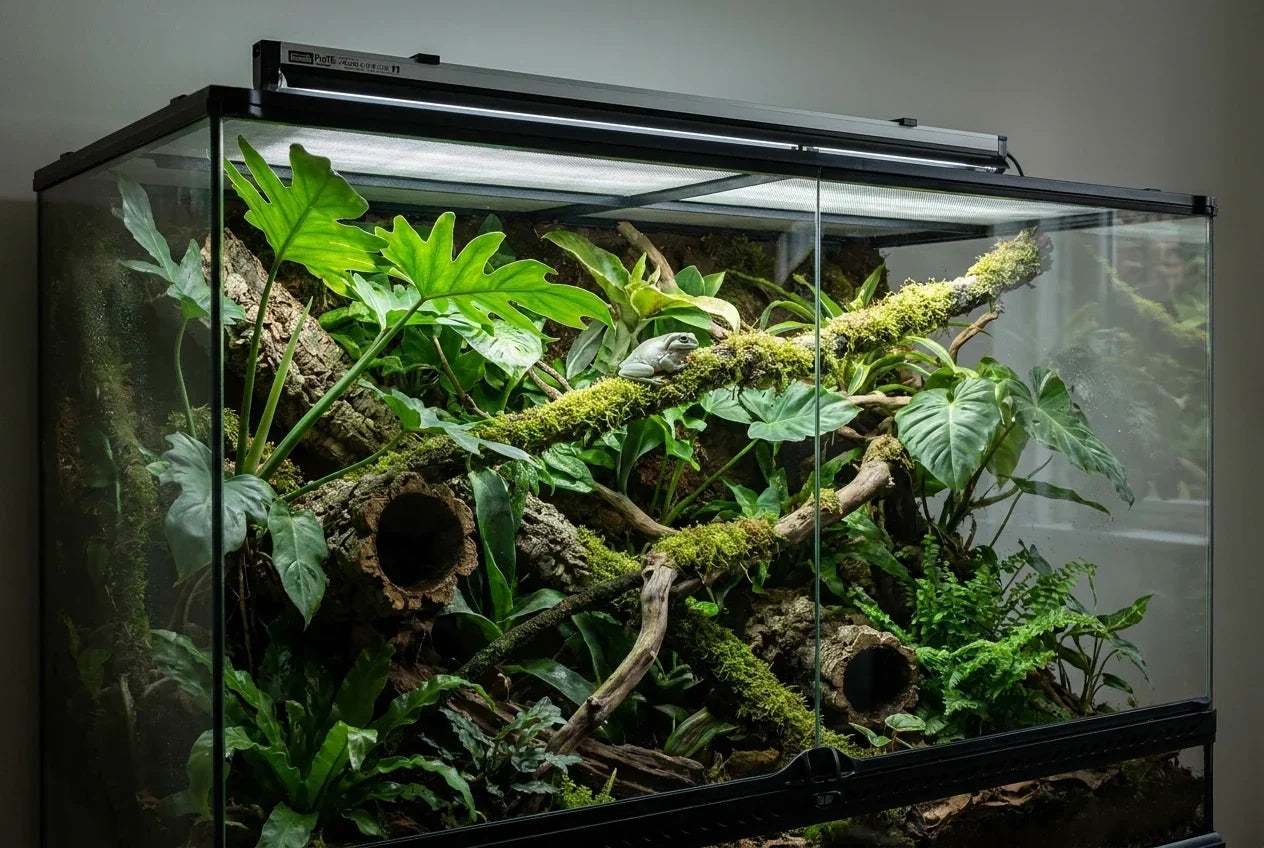
UVB, basking heat and plant lighting do different jobs. This beginner's guide explains Arcadia ShadeDweller, ProT5, Jungle Dawn and LumenIZE — what the different UVB percentages mean, which system to consider for different animals, and how to use the lighting correctly.
In This Guide
UNDERSTAND
What UVB, heat and plant lighting actually do.
COMPARE
Understand ShadeDweller, ProT5, Jungle Dawn and LumenIZE — and what 2.4%, 6%, 7%, 12% and 14% actually mean.
CHOOSE
Start with the animal, then consider enclosure size, distance and mesh.
USE
Position the light correctly, provide shade, replace UVB lamps on time and protect the equipment.
1. First: Not All Lights Do the Same Job
It is easy to look at a reptile or amphibian enclosure and think it simply needs a "reptile light."
In reality, an enclosure can have several different lighting requirements.
| What is needed? | What does it do? | Typical Arcadia solution |
|---|---|---|
| UVB | Provides appropriate ultraviolet exposure for the animal | ShadeDweller or ProT5 |
| Basking heat | Creates a warm area where animals can raise their body temperature | Appropriate heat/basking source |
| Visible daylight | Creates a bright daytime environment | Jungle Dawn / suitable full-spectrum lighting |
| Plant light | Provides strong usable light for plant growth | Jungle Dawn |
The important point is simple:
UVB light, heat and plant light are not the same thing.
A UVB tube does not automatically provide enough basking heat.
A heat lamp does not automatically provide the UVB an animal requires.
And an enclosure can provide suitable UVB for its animal while still being too dim for healthy plant growth.
A planted vivarium may therefore use several lights because each is doing a different job.

2. What Do 2.4%, 6%, 7%, 12% and 14% UVB Mean?
This is usually the most confusing part of choosing an Arcadia UVB lamp.
You may encounter:
2.4% · 6% · 7% · 12% · 14% UVB
The percentage tells you how much of the lamp's light output is in the UVB part of its spectrum.
A higher percentage means a greater proportion of UVB in that lamp's output.
But there is an important catch.
They are not five simple strength levels
It is tempting to read:
2.4% → 6% → 7% → 12% → 14%
as:
Very Low → Low → Medium → High → Very High
and simply choose a number according to the animal.
That does not work reliably.
Different lamps can have different:
-
wattages;
-
overall light output;
-
reflectors;
-
lengths and coverage;
-
intended working distances.
And once the lamp is installed, the distance between the lamp and animal also changes the UV intensity reaching it.
A good example is Arcadia's ShadeDweller range.
The standard ShadeDweller is 8W / 7% UVB.
ShadeDweller Max is 14W / 2.5% UVB.
Despite having a much lower UVB percentage, the more powerful ShadeDweller Max is designed to achieve a similar target UVI at its intended working distance.
So:
UVB percentage tells you something about the lamp. It does not, by itself, tell you how much UV your animal receives.

3. Understanding the Arcadia Range
Rather than memorising percentages, it is easier to understand what each Arcadia product family is designed to do.
ShadeDweller Arboreal 2.4%
ShadeDweller Arboreal is an 8W / 2.4% UVB system designed to provide gentle UV for suitable shade-associated, crepuscular and climbing species.
Arcadia specifically positions it for animals such as crested geckos where climbing positions can bring the animal relatively close to the lamp.
Think:
Gentle UV + arboreal/climbing animal + relatively close working distance.
ShadeDweller 7%
The standard ShadeDweller is an 8W / 7% UVB system.
It is designed around suitable lower-UV and crepuscular species and compact enclosure applications.
Arcadia uses the leopard gecko as one of the principal examples for this system, with the lamp designed around an appropriate basking distance.
Think:
Controlled UV + relatively compact enclosure + suitable lower-UV species.
ShadeDweller Max 2.5%
ShadeDweller Max is a useful product to understand even if it is not the lamp you are considering.
It is 14W / 2.5% UVB.
Why is the percentage lower than the 8W ShadeDweller's 7%?
Because the entire lamp is more powerful. It can therefore produce a useful UV level at its intended distance without requiring the same UVB percentage.
This is one of the clearest demonstrations that:
2.5% does not automatically mean weaker than 7%.
ProT5 Forest 6%
ProT5 is Arcadia's higher-output T5 system, available in longer lengths and designed to provide UV across larger usable areas.
The Forest version uses a 6% UVB lamp.
Think:
Moderate UV + larger enclosure and/or greater working distance.
ProT5 Desert 12%
The Desert lamp provides 12% UVB and is intended for applications requiring greater UV exposure.
Think:
Higher UV requirement + appropriate working distance.
It should not be selected simply because an enclosure is tall. The animal's requirement and actual distance from the lamp still come first.
ProT5 Dragon 14%
Dragon provides 14% UVB and is the highest-UV option within this ProT5 group.
Think:
High-UV basking species + appropriate working distance.
Higher UVB is not an upgrade if the animal does not require it.
4. Where Does Jungle Dawn Fit?
Jungle Dawn performs a different job.
It is a powerful full-spectrum LED lighting system primarily used to provide bright visible light and strong plant-growing light.
So a planted vivarium might use:
ShadeDweller / ProT5
→ selected for the animal's UV requirement
+
Jungle Dawn
→ selected for visible light and plant growth
A UVB lamp does not become unnecessary because Jungle Dawn is installed, and Jungle Dawn does not replace a required UVB lamp.
They complement each other.
5. What Is LumenIZE?
LumenIZE can initially make the Arcadia range look more complicated, but the basic idea is simple:
LumenIZE is not another type of UVB. It gives you greater control over compatible lighting.
Arcadia offers LumenIZE versions of its ProT5 UVB and Jungle Dawn lighting.
Instead of the light simply switching:
OFF → ON → OFF
compatible LumenIZE lighting can be programmed through the Arcadia app to change its output gradually through the day.
For example:
Morning → gradually brighter → daytime → gradually dimmer → night
This allows a more gradual daily lighting schedule instead of an abrupt transition from darkness to full output.
Standard or LumenIZE?
| Standard system | LumenIZE system |
|---|---|
| Conventional ON/OFF operation | Programmable output |
| External timer can control the daily photoperiod | Schedule controlled through the LumenIZE system |
| Full operating output when switched on | Output can change gradually through the day |
| Simple lighting setup | Greater control over the daily lighting cycle |
Neither is automatically the "correct" choice.
A standard system can provide the required lighting perfectly well when correctly selected and positioned.
LumenIZE adds control and programmability.
An important point about dimming UVB
Dimming a Jungle Dawn changes the visible/plant lighting.
Dimming a LumenIZE UVB fixture also changes the UV being delivered.
So:
Do not use LumenIZE dimming to compensate for choosing the wrong UVB lamp.
Choose the appropriate lamp and working distance first. LumenIZE then gives you control over how that light operates through the day.

6. Which Light Should I Use for My Animal?
The best starting point is the animal — not the percentage printed on the lamp.
For international readers: This guide discusses reptiles, amphibians and other animals commonly kept in different countries in order to explain lighting choices. Wildlife ownership and trade laws vary by location. In Singapore, some species mentioned below may be prohibited or subject to regulatory requirements. Inclusion in this guide does not indicate that a species may legally be kept or traded locally. Always check current local wildlife regulations before acquiring an animal.
Quick Lighting Guide
| Animal / group | General starting point | Arcadia UVB family to consider | Heat / basking | Jungle Dawn |
|---|---|---|---|---|
| White's tree frog | Lower controlled UV exposure | ShadeDweller / suitable low-output arrangement | Depends on enclosure temperature | Useful if planted |
| Pacman frog | Low UV exposure | Gentle ShadeDweller-type provision where UVB is used | Usually controlled environmental heating rather than intense basking | If planted |
| Dart frogs | Low UV exposure | Gentle low-output provision where appropriate | Generally no intense basking lamp | Very useful for planted vivaria |
| Crested gecko | Low, arboreal exposure | ShadeDweller Arboreal 2.4% / ShadeDweller depending on distance | Usually modest heat requirement | Useful if planted |
| Leopard gecko | Low–moderate controlled exposure | ShadeDweller 7% / appropriate ProT5 arrangement | Warm/basking zone required | Optional |
| Small day geckos | Moderate, species dependent | ShadeDweller / ProT5 6% depending on species and distance | Species dependent | Useful |
| Larger day geckos | Moderate UV exposure | Often ProT5 6%, adjusted for species and distance | Species dependent | Useful |
| Anoles / similar diurnal lizards | Moderate–higher, species dependent | ProT5 6% / 12% depending on target exposure and distance | Usually basking heat | If planted |
| Chameleons | Moderate–higher, strongly species dependent | Commonly ProT5 6% / appropriate higher-output arrangement | Basking heat generally required | Useful in planted enclosures |
| Bearded dragon | High-UV basking species | ProT5 12% / 14% depending on distance and setup | Basking heat required | Optional |
| Red-eared slider | Strong basking exposure | Appropriate ProT5 selected according to basking distance | Basking heat required | Only if plants require it |
| Mudskipper | Species and setup dependent | Do not select solely from a generic reptile UV chart | Species/setup dependent | Useful in planted paludarium |
| Vampire crab / similar crabs | UV requirements less established than for basking reptiles | Strong reptile UVB should not automatically be assumed necessary | Usually environmental warmth rather than intense basking | Often useful |
| Stick insects | Species dependent | Do not automatically treat as a UV-basking reptile | Usually no dedicated basking system | Useful for planted display |
This table is a starting point, not an automatic lamp prescription.
The exact species matters. So do distance, mesh, climbing behaviour and enclosure layout.
"Gecko", "frog" or "lizard" alone is not enough information to select a lamp.

7. Next, Look at the Enclosure
Once you know approximately what the animal requires, ask four simple questions.
1. How far is the animal from the lamp?
Measure the distance between the lamp and the animal's actual usable position.
Do not simply use the total enclosure height.
A 90 cm tall vivarium with a branch 25 cm below the lamp does not have a 90 cm working distance.
2. Is there mesh between them?
Mesh blocks some of the light and UV entering the enclosure.
Different mesh materials and densities can have different effects.
A lamp above mesh should therefore not automatically be treated the same as the same lamp operating unobstructed.
3. Can the animal climb closer?
This is particularly important for arboreal frogs, geckos, chameleons and other climbing animals.
Branches, cork and plants can dramatically change the closest distance between the animal and lamp.
4. Can the animal move away?
Correct lighting does not mean exposing the entire enclosure to maximum UV.
The animal should have access to lower-exposure and shaded areas.
8. One Useful Term: UVI
You do not need to understand lighting physics to use UVI as a practical concept.
Think of it this way:
UVB %
= tells you about the lamp
UVI
= tells you about the UV intensity at a particular position
That is why distance matters.
The same UVB lamp can provide substantially different exposure at 20 cm, 30 cm and 60 cm.
And that is why:
7% nearby
is not automatically comparable with:
12% much farther away
The practical lesson is more important than memorising UVI numbers:
Choose the lamp according to the UV exposure required at the animal's actual usable position.

9. UVB Does Not Replace Basking Heat
Another common misunderstanding is assuming that a UVB tube is also the animal's heat source.
They perform different jobs.
A species requiring a heated basking area may therefore need:
UVB + BASKING HEAT
Example: Red-Eared Slider
A red-eared slider needs access to a dry basking area.
That area should provide the appropriate combination of:
UVB exposure
and
basking warmth
The turtle can climb out of the water, warm itself and receive the appropriate light at the same usable basking area.
UVB positioned over one location while the useful heated basking area is somewhere completely different does not create the same functional basking zone.
10. Planted Vivariums May Need Another Light Again
Now consider a planted White's tree frog, dart frog or gecko enclosure.
The animal may already have appropriate UVB.
But the enclosure could still be too dim for healthy plant growth.
This is where Jungle Dawn serves another purpose.
A planted enclosure may therefore use:
UVB
ShadeDweller / ProT5
→ chosen around the animal
PLANT / VISIBLE LIGHT
Jungle Dawn
→ chosen around the plants and enclosure brightness
HEAT, IF REQUIRED
Appropriate heat source
→ chosen around the animal's temperature requirement
These lights can work together because they are solving different problems.

11. Give the Animal Light — and Shade
More light everywhere is not necessarily better.
A useful enclosure should provide choices.
BRIGHT / UV ZONE → PARTIAL SHADE → SHADE
Branches, cork, foliage and enclosure structure can create these different areas.
The animal can then regulate its exposure by changing position instead of being continuously exposed to the strongest part of the lamp.
For climbing animals, remember that the highest branch may also be the point receiving the greatest UV exposure.
Always consider the enclosure in three dimensions.
12. How Long Does a UVB Tube Last?
Do not wait for a UVB tube to stop glowing before replacing it.
A tube can still produce visible light even when it is time to replace it for reliable UV performance.
For Arcadia T5 UVB lamps, use the current replacement guidance supplied for the specific lamp. Current Arcadia ShadeDweller documentation, for example, states up to 12 months of UV potency under its specified operating conditions.
For a beginner, the simplest habit is:
Record the installation date and plan replacement according to Arcadia's stated interval for that lamp.
For example:
Installed: September 2026
12-month replacement point: September 2027
If you use a suitable UV meter, measurements can provide additional information, but owning a meter is not necessary simply to follow the manufacturer's replacement schedule.
13. Protect the Lighting Equipment
A T5 fixture is more than a tube.
It contains electronic components that start and regulate the lamp.
Arcadia's ProT5 fixtures already incorporate internal protection against conditions including over-voltage, over-current, overheating and short circuits.
Even so, we recommend connecting electronic lighting equipment to a good-quality surge-protected power source as an additional layer of protection.
Electrical disturbances can occur around:
-
electrical faults;
-
power interruptions;
-
sudden blackouts;
-
restoration of power;
-
voltage spikes elsewhere in the supply.
A surge protector can help reduce the risk of damaging voltage spikes reaching connected electronic equipment.
This is particularly worthwhile for T5 and controllable lighting systems containing electronic control components.
Surge protection is not waterproofing
A surge protector does not protect equipment from water ingress and does not replace normal electrical safety.
Around vivariums, paludariums and aquariums:
-
keep plugs and power distribution away from water and mist;
-
do not overload sockets or power strips;
-
keep electrical connections dry;
-
use appropriate drip loops where cables run toward wet enclosures;
-
disconnect equipment if electrical components become wet;
-
follow the manufacturer's instructions for the specific fixture.
14. Common Lighting Mistakes
Choosing only by UVB percentage
"My animal needs more UV, so I should buy the highest percentage."
Not necessarily.
The animal, complete lamp system, distance, reflector, mesh and enclosure layout all matter.
Thinking 7% must be stronger than 6%
ShadeDweller 7% and ProT5 Forest 6% are different lighting systems.
The printed percentage alone does not compare their complete performance.
Assuming 2.4% or 2.5% must be extremely weak
Again, look at the complete lamp.
ShadeDweller Max demonstrates why a more powerful lamp can use a lower UVB percentage while still producing useful UV at its intended distance.
Using enclosure height as the working distance
Measure to the animal's actual usable position.
Ignoring mesh
Mesh changes how much UV reaches the enclosure.
Assuming UVB provides basking heat
UVB and heat perform different jobs.
Assuming UVB is enough for plants
A heavily planted enclosure may also require strong visible plant lighting such as Jungle Dawn.
Buying LumenIZE because the animal "needs better UVB"
LumenIZE adds programmable control.
It does not replace correct lamp selection.
Using LumenIZE dimming to fix an unsuitable lamp
Changing UVB output changes the exposure being delivered.
Select the correct lamp and working distance first.
Lighting the whole enclosure equally
Animals should be able to move into lower-light and shaded areas.
Waiting until the UVB tube stops glowing
Visible brightness is not a reliable replacement indicator.
Follow the manufacturer's replacement guidance.
Choosing Your Arcadia Lighting in 30 Seconds
STEP 1 — Start with the animal
What species is it, and what type of UV exposure does it require?
↓
STEP 2 — Look at the enclosure
How far will the animal actually be from the lamp?
Is there mesh?
Can it climb closer?
↓
STEP 3 — Choose the UVB family
Gentler / shade-oriented applications
→ consider the ShadeDweller family
Moderate or greater output / larger working distances
→ consider the appropriate ProT5 system
↓
STEP 4 — Choose the appropriate lamp
Do not choose 2.4%, 6%, 7%, 12% or 14% from the percentage alone.
Match the complete lamp system to the required exposure at the actual working distance.
↓
STEP 5 — Does the animal require basking heat?
If yes:
Add an appropriate heat source.
↓
STEP 6 — Is the enclosure planted?
If the plants require stronger illumination:
Add suitable plant lighting such as Jungle Dawn.
↓
STEP 7 — Standard or LumenIZE?
Standard
→ simple ON/OFF daily operation
LumenIZE
→ programmable control and gradual changes through the day
↓
STEP 8 — Use and maintain it correctly
Correct distance.
Account for mesh.
Provide shade.
Replace UVB lamps on schedule.
Protect electronic equipment.
The Main Idea
You do not need to memorise every Arcadia lamp specification to choose reptile lighting correctly.
Remember three things:
Different lights do different jobs.
UVB percentage alone does not tell you what reaches the animal.
Choose the animal first, the enclosure second, and the lighting system third.
Once those principles are understood, ShadeDweller, ProT5, Jungle Dawn and LumenIZE become much easier to compare, select and use correctly.


