
Not All Beneficial Bacteria Do the Same Job
Practical guides to understanding products, comparing options, and choosing what fits your setup. Each guide explains what products do, where they differ, and how to use them effectively.
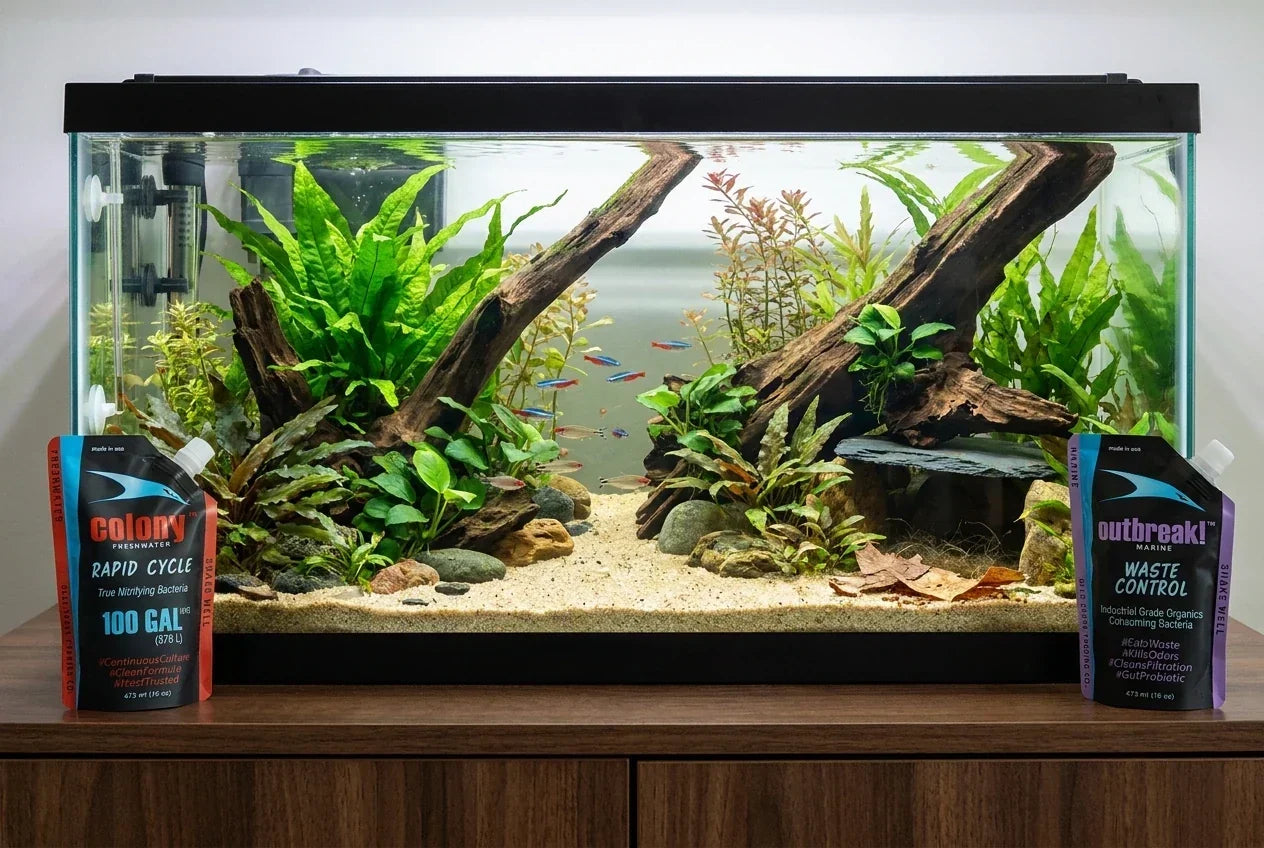
The 3 Types of Aquarium Bacteria Products — and When to Use Each
Walk into an aquarium shop and the bacteria shelf can be surprisingly confusing.
Blue Shark Colony, Blue Shark Outbreak, Seachem Stability, Tetra SafeStart, JBL Denitrol and API Quick Start may all sit within the broad category of “beneficial bacteria”, yet they are not necessarily designed around exactly the same job.
Some are strongly focused on establishing the biological filter. Some take a broader, multi-purpose approach. Others are intended primarily to help process accumulated organic waste.
The more useful question, therefore, isn't simply:
“Which beneficial bacteria should I use?”
It is:
“What do I need the bacteria to do in my aquarium right now?”
Once that distinction is clear, choosing and using bacterial products becomes much easier.
First: The 3 Broad Types of Aquarium Bacteria Products
Commercial formulations vary, and some products perform across more than one category. But from an aquarist's point of view, most bacterial products can be understood through three broad approaches.
| Type | Main purpose | Easy way to think about it | Examples |
|---|---|---|---|
| Cycling / Nitrification | Establish or reinforce ammonia and nitrite processing | Build & support the biofilter | Blue Shark Colony, Tetra SafeStart, API Quick Start |
| Broad-Spectrum / Multi-Purpose | Provide several biological functions within one formulation | General biological support | Seachem Stability, JBL Denitrol |
| Organic-Waste Decomposition | Help process food residues, feces, detritus and other accumulated organic matter | Manage organic load | Blue Shark Outbreak |
These are practical product categories rather than rigid microbiological classifications.
For example, Seachem describes Stability as a blend of aerobic, anaerobic and facultative bacteria involved in processing waste organics as well as ammonia, nitrite and nitrate. JBL similarly describes Denitrol as containing autotrophic and pollutant-degrading bacterial strains.
So there can be considerable overlap.
The important point is that “beneficial bacteria” is an umbrella term.
It does not automatically mean “cycling bacteria”, and two bacterial products sitting beside each other on a shelf may have quite different intended uses.

Why Cycling and Waste Breakdown Aren't the Same Job
We don't need to go deeply into microbiology to understand the difference.
Fish are fed. Fish produce waste. Food is left behind. Old plant material dies. All of this contributes organic matter to the aquarium.
Microorganisms involved in decomposition help break that material down. During the broader process of mineralisation, nitrogen contained within organic matter can eventually enter the inorganic nitrogen pool as ammonium.
The biological filter then has another job:
Ammonia / ammonium → nitrite → nitrate
That is nitrification.
So the simplified relationship is:
FOOD • FECES • DEAD ORGANIC MATTER
↓ decomposition
SIMPLER COMPOUNDS + AMMONIUM
↓ nitrification
NITRITE
↓ nitrification
NITRATE
The processes are connected, but they are not identical.
This explains something aquarium keepers sometimes encounter:
A cycled aquarium can still accumulate organic waste.
Its biological filter may be perfectly capable of processing the ammonia being produced, while mulm, food particles and other organic material continue accumulating elsewhere.
The reverse distinction matters too.
Breaking down organic waste does not automatically mean a new aquarium has sufficient nitrification capacity.
This is why it is useful to distinguish between bacteria intended primarily for cycling and bacteria intended primarily for organic-waste processing.

The Bacteria You Need Can Change as the Aquarium Ages
This is where choosing bacteria by brand alone becomes less useful.
An aquarium doesn't have the same biological needs throughout its life.
A new aquarium, a six-month-old aquarium, an aquarium that has just received ten more fish and an aquarium whose filter has been heavily disturbed are four very different situations.
Follow one aquarium through its life and the distinction becomes much clearer.
| Aquarium stage | What's happening? | Main bacterial consideration | Blue Shark approach |
|---|---|---|---|
| 1. New aquarium setup | The biological filter is not yet established | Establish nitrification | Colony |
| 2. First livestock introduced | Biological load begins increasing | Allow/support nitrification capacity to develop | Colony, where additional support is appropriate |
| 3. Aquarium becomes established | Food and waste continuously enter the system | Organic processing becomes increasingly relevant | Outbreak, where organic loading warrants support |
| 4. More fish / heavier feeding | More food enters and more waste is produced | Increased organic processing; reassess biofilter capacity | Outbreak, with Colony where nitrification also needs reinforcement |
| 5. Mulm and organic waste accumulate | Organic input is exceeding removal or processing in parts of the system | Organic-waste management | Outbreak + normal maintenance |
| 6. Filter is heavily cleaned or media is substantially replaced | Part of the established biological community may have been removed | Reinforce nitrification | Colony |
| 7. Aquarium suffers a major biological disturbance | Medication, prolonged filtration failure or another event may destabilise biological processing | Identify which biological function has been affected | Colony for biofilter recovery; Outbreak where excess organic material is part of the problem |
| 8. Major rescape or reset | Much of the established biological environment may have been disturbed | Re-establish biological filtration | Colony |
There is an important pattern here.
Colony and Outbreak aren't really alternatives to each other.
They become relevant at different moments because they are intended for different jobs.

How the Popular Bacterial Products Approach These Jobs
Once we understand the different functions, the differences between familiar products become easier to appreciate.
Blue Shark Colony — Dedicated Cycling Logic
Blue Shark Colony takes a relatively focused approach.
Blue Shark identifies its freshwater Colony formulation around Nitrosomonas and Nitrobacter and positions it specifically for establishing biological filtration. Its application guidance also emphasises dechlorinating tap water before use.
That makes its intended role straightforward:
Need to establish or reinforce nitrification? Think Colony.
It is especially easy to understand during initial setup, after substantial loss of biological filter media, or following a significant disruption where nitrification capacity needs to be rebuilt.
Blue Shark Outbreak — A Different Job
Outbreak should not be understood simply as another version of Colony.
Its role is centred on organic-waste processing: the accumulating food residues, fecal material, detritus and other organic load produced as an aquarium operates.
That becomes particularly relevant in established and heavily fed systems.
This distinction is also why using Outbreak shouldn't be treated as a substitute for physical maintenance. Large accumulations of detritus may still need to be siphoned, filters still require appropriate servicing, and excessive feeding remains excessive feeding.
The bacterial product supports the biological processing of organic material; it does not make husbandry unnecessary.
Tetra SafeStart — Cycling-Focused
Tetra SafeStart is another clear example of the cycling category.
Tetra describes SafeStart as containing live proprietary strains of Nitrosomonas, Nitrosospira and Nitrospira, with the purpose of accelerating establishment of the bacteria involved in aquarium cycling and reducing dangerous ammonia.
For an aquarist wanting a familiar, straightforward bacterial product specifically around aquarium startup and cycling, its role is easy to understand.
API Quick Start — Cycling-Focused
API Quick Start follows a similarly recognisable cycling approach.
API describes Quick Start as containing live nitrifying bacteria that consume ammonia and nitrite, positioning it for starting the nitrogen cycle in new aquariums as well as supporting biological filtration in established systems.
Again, the primary question being addressed is:
How do I establish or support the aquarium's nitrifying biofilter?
Seachem Stability — Broad Biological Support
Stability takes a broader formulation approach.
Rather than presenting itself only around dedicated nitrification, Seachem describes a synergistic blend of aerobic, anaerobic and facultative bacteria involved in processing waste organics, ammonia, nitrite and nitrate. It is marketed both for establishing the biofilter and for continued biological support.
This gives Stability a different appeal:
one bacterial formulation covering a broader range of biological functions.
For aquarists who prefer a general-purpose bacterial supplement rather than separating individual functions, that simplicity can be useful.
JBL Denitrol — Broad Starter Approach
JBL Denitrol also spans multiple functions.
JBL describes Denitrol as containing beneficial autotrophic and pollutant-degrading bacterial strains, together with enzymes, for degradation of pollutants. Its guidance includes new aquarium startup as well as use following medication and major cleaning.
This places Denitrol naturally between a narrowly defined cycling product and a broader biological-support formulation.

One Broad Product — or Separate the Jobs?
There isn't only one way to formulate a useful aquarium bacterial product.
Broad-spectrum products such as Stability and Denitrol offer an understandable advantage:
Simplicity.
One formulation can provide broader biological support without requiring the aquarist to separate every microbial function.
Blue Shark takes a different approach.
It separates two important jobs.
COLONY
Cycling & nitrification
OUTBREAK
Organic-waste processing
That separation changes the way bacterial products can be used.
Instead of asking:
“When should I add beneficial bacteria?”
you can ask:
“Which biological function needs support?”
If a new aquarium needs its biofilter established, the answer points toward Colony.
If an established aquarium is dealing with increasing organic loading, the answer points toward Outbreak.
If both processes require attention, they can be approached separately.
Neither philosophy makes the other incorrect. But once cycling and organic decomposition are understood as different jobs, function-specific products make it easier to apply bacteria with a clear purpose rather than simply dosing a general bacterial product by habit.

Already Using Stability, SafeStart, Quick Start or Denitrol?
There is no need to regard your existing product as the “wrong bacteria”.
Instead, identify what role it is already serving.
If you use SafeStart or Quick Start for cycling, you are already using a product strongly centred on nitrification. You can continue to think of that as your cycling tool while recognising that organic-waste management is a separate bacterial function.
That is where a product such as Blue Shark Outbreak can serve a different purpose rather than simply duplicating what you already use.
If you use Stability or Denitrol, you may prefer their broader one-product approach.
Alternatively, as you become more deliberate about aquarium maintenance, you may choose to separate the functions: using Colony when nitrification support is specifically required and Outbreak when organic loading is the issue.
The point isn't necessarily to replace one bottle with another.
It is to know why you are adding it.
Don't Add Bacteria Automatically Every Time Something Changes
Understanding bacterial products also means knowing when not to rely on them.
A normal water change does not automatically mean an established aquarium has lost its biological cycle.
A gently cleaned filter does not necessarily need to be “recycled”.
And repeatedly adding cycling bacteria won't correct every ammonia problem if the underlying issue is excessive stocking, inadequate filtration, damaged filter media or another unresolved cause.
Similarly, repeatedly dosing an organic-waste product should not replace removing excessive accumulated detritus or correcting chronic overfeeding.
Bacterial products work as part of the aquarium system.
Filtration, oxygenation, water movement, accessible biological media and sensible maintenance still determine how effectively that system operates.
Those physical factors deserve their own discussion; the important point here is simply that the bottle supplies or supplements microorganisms—the aquarium still has to provide an environment in which they can function.
A Practical Guide: What Should You Reach For?
| If your aquarium needs... | Product direction |
|---|---|
| A new biofilter established | Blue Shark Colony; Tetra SafeStart or API Quick Start are other cycling-focused options |
| Nitrification support after significant biofilter disturbance | Blue Shark Colony; an appropriate cycling or broad-spectrum bacterial product can also be used |
| Broad bacterial support from one formulation | Seachem Stability or JBL Denitrol |
| Help processing accumulated organic material | Blue Shark Outbreak, together with appropriate maintenance |
| Support after substantially increasing feeding or livestock | Blue Shark Outbreak for increased organic loading; assess whether Colony is also appropriate for increased nitrification demand |
| Separate control over nitrification and organic-waste processing | Blue Shark Colony + Outbreak |

The Better Question Isn't “Which Bacteria Is Best?”
All of these products exist because bacterial communities are fundamental to a functioning aquarium.
The difference is how each product approaches that biology.
Cycling-focused products concentrate on establishing or supporting the biofilter. Broad-spectrum products combine several functions into a more general biological treatment. Organic-waste products focus further upstream on the material continually entering and accumulating within an established aquarium.
Once you recognise those differences, bacterial supplementation becomes less about repeatedly adding a bottle labelled “beneficial bacteria” and more about matching the product to the job.
That is also the logic behind the Blue Shark approach:
Colony when the biofilter and nitrification need support.
Outbreak when organic-waste processing needs support.
Both when both functions genuinely need attention.
It is a simple distinction, but it changes beneficial bacteria from a generic aquarium additive into something that can be applied with much greater purpose.


