
How to Use Benibachi Foods for Shrimp, Crabs & Isopods
Practical guides to understanding products, comparing options, and choosing what fits your setup. Each guide explains what products do, where they differ, and how to use them effectively.
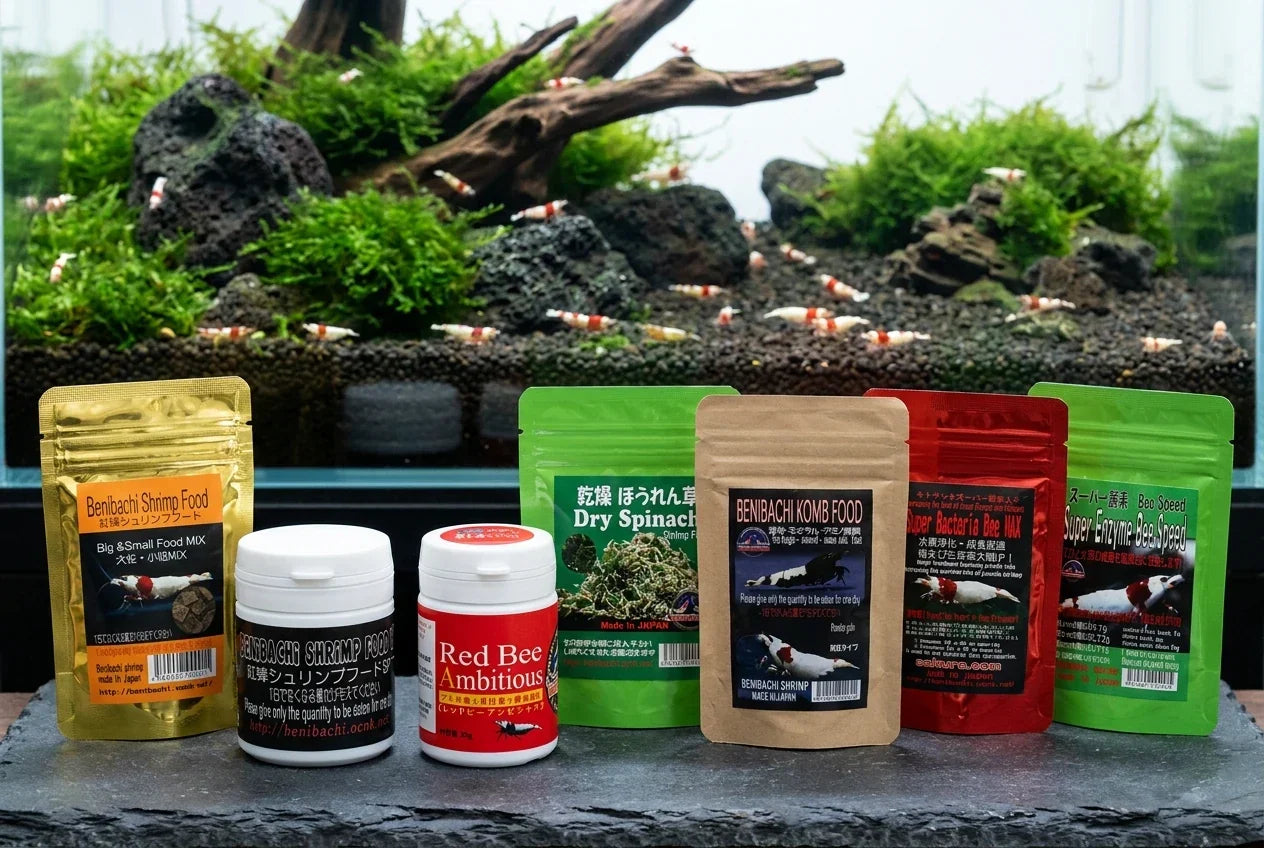
Benibachi has foods for everyday feeding, protein supplementation, plant-based nutrition, colour and growth, alongside bacterial and enzyme products. Looking at the entire range at once, it is easy to assume that a good feeding routine means using more of them.
It doesn't.
A display tank with a modest adult shrimp population has very different needs from a breeding colony full of berried females. Once shrimplets appear, food accessibility becomes important. As the colony grows, heavier feeding also means more organic material for the aquarium to process.
The better question is therefore not “Which Benibachi products should I buy?”
It is:
“What does my colony need right now?”
Understanding the range by purpose makes it much easier to build a feeding system without unnecessarily feeding everything at once.
The Benibachi System at a Glance

The range can be divided into a few practical roles:
- Shrimp Food — everyday staple nutrition
- Shrimp Food SP — additional protein
- Red Bee Ambitious — targeted growth and colour nutrition
- Dry Spinach — plant-based dietary variety
- Komb Food — fine grazing nutrition
- Bee Max 2 — bacteria, enzymes and chitosan support
- Bee Speed — concentrated enzyme support
The first five primarily address what the animals eat.
Bee Max 2 and Bee Speed address another side of keeping: the biological processes surrounding feeding and organic matter.
That distinction becomes increasingly important as a colony develops.
Which Kind of Shrimp Keeper Are You?
Rather than building one feeding schedule for every aquarium, it is more useful to consider the stage and purpose of the colony.
1. Everyday Keeping & Maintaining Colour

For a stable display colony, feeding does not need to be complicated.
Shrimp Food can provide the everyday nutritional foundation, while Dry Spinach or Komb Food adds dietary variety. Red Bee Ambitious can be introduced when maintaining or developing ornamental colour is a particular objective.
But prepared food is only one part of what shrimp eat.
Watch a mature shrimp aquarium between feedings and the shrimp rarely stop eating. They move continuously across moss, wood, rock, substrate and plant leaves, grazing biofilm, microorganisms and fine organic material.
This natural grazing means a mature aquarium can provide food long after the visible pellet has disappeared.
The objective for an everyday colony is therefore not to keep adding food until the shrimp stop grazing. It is to supplement what the ecosystem already provides.
If food repeatedly remains untouched for long periods, reducing the portion is generally more useful than adding another food to the rotation.
Focus: Maintain condition, colour and dietary variety without unnecessary feeding.
2. Conditioning Shrimp for Breeding

Once breeding becomes the objective, nutritional priorities change.
Mature shrimp still need a balanced foundation, but reproduction and subsequent growth create greater nutritional demands. This is where a broader rotation becomes useful.
Shrimp Food can remain the base, while Shrimp Food SP provides a more protein-focused supplement. Dry Spinach or Komb Food maintains plant-based variety, while Red Bee Ambitious can be incorporated where growth and colour development are important.
The important distinction is between better nutrition and simply more food.
Increasing protein does not mean every meal needs to become protein-heavy. A varied rotation allows the keeper to change the nutritional emphasis without continuously increasing the total amount entering the aquarium.
This matters because any food that is not consumed does not disappear—it becomes part of the system's organic load.
Focus: Broaden nutrition and provide targeted supplementation while keeping overall feeding controlled.
3. Raising Shrimplets

Once shrimplets appear, the feeding problem changes again.
An adult shrimp can locate a pellet, travel across the aquarium and compete for it. A newly hatched shrimplet is far more dependent on whatever happens to be available around the surface it is already grazing.
This means food accessibility can become as important as food composition.
Fine foods such as Komb Food and the smaller particles within Shrimp Food can spread nutrition over a wider area instead of concentrating the entire meal at one feeding point.
At the same time, a mature aquarium rich in biofilm becomes particularly valuable.
Moss, porous rock, wood, substrate and textured surfaces provide countless small grazing areas. Instead of requiring every shrimplet to reach a pellet, food is effectively distributed throughout the habitat.
This is also where biological support such as Bee Max 2 becomes easier to understand. Its role is not to replace feeding, but to support the biologically active environment surrounding the colony.
So when a tank suddenly fills with babies, the solution is not necessarily:
“Feed much more.”
A better question is:
“Can the shrimplets reach enough food throughout the aquarium?”
Focus: Increase accessible grazing opportunities rather than simply increasing meal size.
4. Managing a Growing Colony

A successful colony eventually creates another change.
Twenty shrimp becoming one hundred shrimp does not simply mean five times as many mouths.
It can also mean substantially more prepared food entering the aquarium, more faeces, more fragmented food and more organic material settling into the substrate and filtration system.
At this stage, feeding and ecosystem management become increasingly connected.
The nutritional rotation can remain similar: Shrimp Food as the foundation, with SP, Komb Food, Dry Spinach and Red Bee Ambitious used according to purpose.
But Bee Max 2 and Bee Speed now occupy a clearer role.
Bee Max 2 combines beneficial bacteria, enzymes and chitosan as biological support.
Bee Speed is more strongly focused on enzyme activity and the processing of organic material.
They should not be interpreted as products that make overfeeding harmless. If uneaten food is accumulating, the first response should still be to reconsider feeding quantity, maintenance and circulation.
Instead, these products address a different part of the equation:
Food enters the system → animals consume part of it → the ecosystem must process what remains.
As a colony becomes more productive, understanding both sides becomes increasingly important.
Focus: Manage the biological consequences of feeding as well as the nutritional needs of the shrimp.
Beyond the Shrimp Tank
 The same products can have useful applications beyond shrimp, but the feeding strategy should follow the animal rather than simply copying a shrimp routine.
A vampire crab is not a large shrimp, and an isopod is not simply a terrestrial shrimp.
Their natural dietary foundations remain different.
Vampire Crabs: Think Omnivorous Rotation
Vampire crabs consume a mixture of animal and plant-derived foods, so several Benibachi foods can fit naturally into a broader diet.
Shrimp Food provides convenient prepared nutrition, while Shrimp Food SP can serve as a more protein-oriented option. Dry Spinach introduces plant material, and Komb Food provides another supplementary food that can be rotated through the diet.
Where the food is placed also matters.
Unlike shrimp, vampire crabs spend much of their time on land. Food can therefore be offered on accessible terrestrial areas or moist margins rather than automatically placing everything into the water.
Bee Max 2 and Bee Speed play a different role. A paludarium often contains a relatively small volume of water beside a much larger terrestrial environment. Food particles, animal waste and decomposing organic material can eventually enter that aquatic section.
Biological and enzyme support can therefore be useful as part of environmental management, but they remain supplements to sensible feeding, filtration and maintenance.
Isopods: Start With the Detrital Food Base
Isopod feeding should begin somewhere completely different.
Leaf litter and decomposing botanical material remain the dietary foundation.
Appropriate decaying wood and other organic materials can contribute further to this detrital food system. Commercial foods should therefore supplement the enclosure rather than become its primary diet.
Within that framework, Dry Spinach can provide additional plant material. Komb Food can be used sparingly as fine supplementary nutrition, while Shrimp Food and SP can provide more concentrated nutrition when required.
This is especially important with protein-rich foods: a small amount can go a long way in an isopod enclosure.
Because a humid terrarium behaves differently from an aquarium, persistent leftovers should be removed rather than allowed to accumulate and mould.
Bee Max 2 and Bee Speed are primarily aquatic products. Any terrestrial application should therefore be regarded as an adapted use and approached conservatively rather than transferring aquarium dosage directly to the enclosure.
Benibachi Food & Support Matrix
The matrix is best used after identifying what your animals need. It is a reference, not a checklist of products that should all be used together.
| Product | Main Purpose | When to Use | How to Use | Shrimp | Crab | Isopod |
|---|---|---|---|---|---|---|
| Shrimp Food | Everyday nutrition | Regular maintenance | Controlled feeding; pads + granules help distribute food | ●●● | ●● | ●● |
| Shrimp Food SP | Protein supplementation | Breeding, growth or protein rotation | Small controlled portions as part of a varied diet | ●●● | ●●● | ●●● |
| Red Bee Ambitious | Growth & colour nutrition | When ornamental colour and development are priorities | Rotate with the staple diet rather than using as the sole food | ●●● | ● | ● |
| Dry Spinach | Plant matter & fibre | General dietary rotation | Offer a small portion and remove persistent leftovers | ●●● | ●●● | ●●● |
| Komb Food | Fine grazing nutrition | Juveniles and broad food distribution | Apply lightly across the feeding/grazing area | ●●● | ●● | ●● |
| Bee Max 2 | Bacteria + enzymes + chitosan | Biological conditioning and increasing colony activity | Use as biological support rather than a replacement for food or maintenance | ●●● | ●●● | ●●* |
| Bee Speed | Enzyme support | Increased organic processing demand | Dose conservatively as enzyme support | ●●● | ●● | ●●* |
●●● Strong fit · ●● Useful · ● Limited / specialised
- Terrestrial application differs from normal aquarium use and should be approached conservatively.
You Don't Need the Whole Range
The easiest mistake is to treat a complete product range as a complete feeding schedule.
It isn't.
For everyday shrimp keeping, start with a reliable staple and introduce dietary variety.
For breeding, protein and targeted nutrition become more relevant.
When shrimplets arrive, think about particle size, food distribution and natural grazing surfaces—not simply feeding more.
As the colony becomes larger and more productive, pay increasing attention to what heavier feeding means for the biological system.
For vampire crabs and isopods, start with their own natural dietary requirements before deciding which Benibachi products have a useful supplementary role.
Every gram of food entering an enclosure ultimately goes somewhere. Some becomes animal growth. Some is consumed by microorganisms. Some becomes waste and must be processed by the ecosystem.
That is why a good feeding system is not measured by how many different products are used.
It is about having the right nutritional or biological tool available when the need changes.
Instead of asking:
“Which Benibachi products should I use?”
Start with:
“What does my ecosystem need right now?”


