
Choosing the Right Bonding Materials for Aquariums, Terrariums & Paludariums
Practical guides to understanding products, comparing options, and choosing what fits your setup. Each guide explains what products do, where they differ, and how to use them effectively.
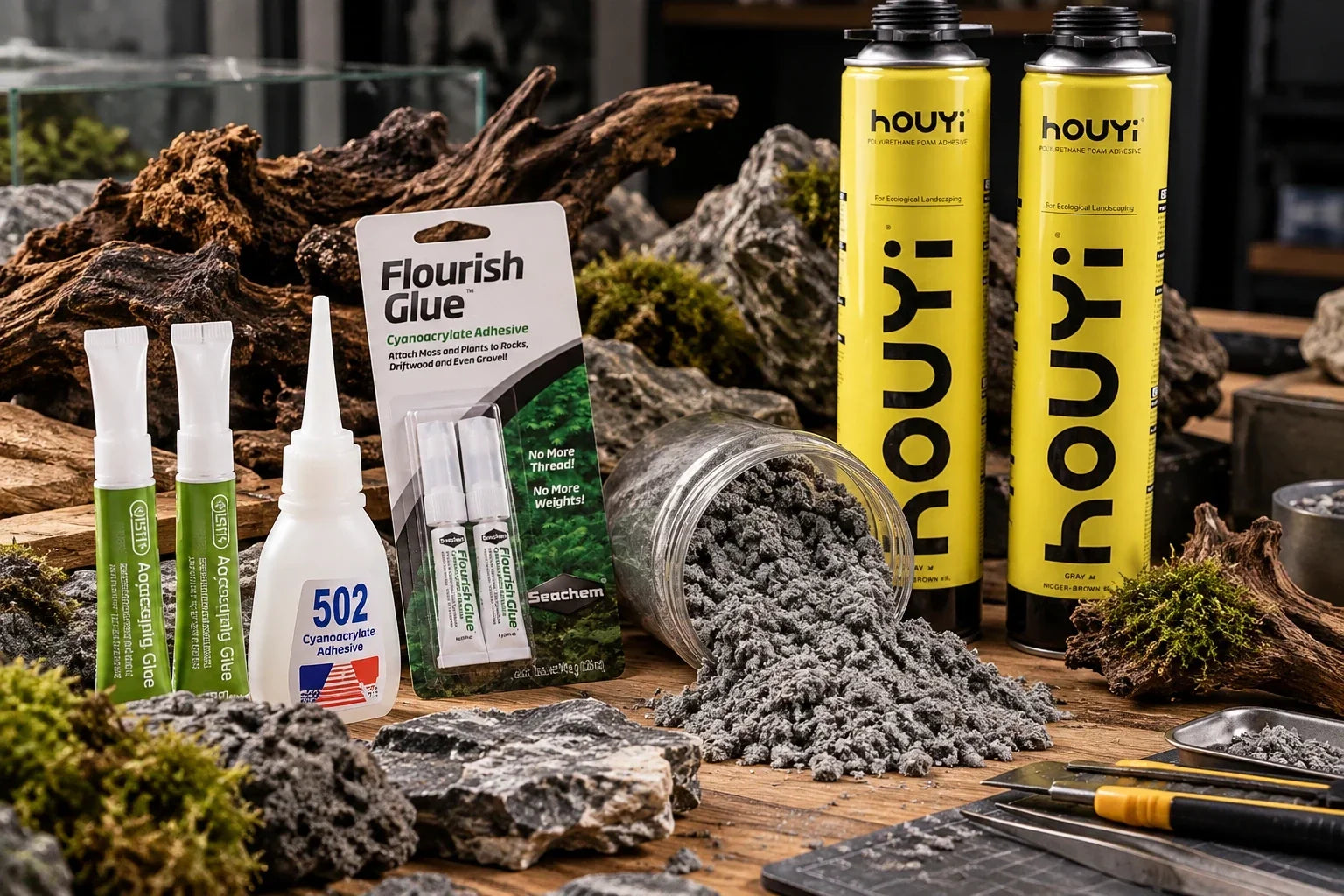
Different Jobs Need Different Bonding Materials
Attaching moss to driftwood is not the same job as joining two heavy rocks.
Building a paludarium background is different again. And when constructing a stream or waterfall, the objective may not simply be to hold something in place — it may be to stop water from finding another path.
There is therefore no single “best aquarium glue”.
The right material depends on what you are joining, the load it must support, the available contact area, whether you need a precise bond, structural joint, space filler or waterproof seal, and how the completed construction will be used.
Quick Guide: What Should You Use?
| Application | Recommended material | Why? | Not ideal for |
|---|---|---|---|
| Plant/moss → rock or wood | Aquarium plant glue / CA gel | Small, precise attachment | Heavy hardscape or large gaps |
| Rock → rock | 502 + GeoShape Scape Filler | Filler bridges irregular gaps and increases bonding area | Large cavities or sealing water paths |
| Wood → wood / rock | 502 + GeoShape Scape Filler | Creates a larger rigid bonding interface | Large void filling |
| Background construction | Suitable expanding PU foam | Fills space, creates volume and embeds hardscape | Precise attachment |
| Hardscape → background | Suitable expanding PU foam | Supports irregular rocks and wood | Small visible joints |
| Stream/waterfall pathway | Aquarium-safe silicone | Seals gaps and controls water pathways | Replacing structural hardscape support |
These are not simply stronger and weaker versions of the same glue. They solve different construction problems.
1. Aquarium Plant Glue — For Attaching Plants
Aquarium plant glues are commonly cyanoacrylate-based gels. Their thicker consistency makes them useful for controlled attachment because a small drop stays approximately where it is placed.
They are particularly useful for attaching moss, Bucephalandra, Anubias, Java fern and other epiphytic plants to rock or wood.

Why Not Use Plant Glue to Join Rocks?
If aquarium plant glue sticks a plant to a rock, it seems logical that using more should also join two rocks together.
The problem is not necessarily weak glue. It is the joint.
Two irregular rocks may appear to have a large contact area while actually touching at only a few high points. A thick gel does not become an effective structural gap filler simply because more is applied.
A lightweight plant also creates very little load. A heavy rock subjected to weight and leverage is a different mechanical problem.
Bond strength depends not only on the adhesive, but also on contact area, joint geometry, load and mechanical support.
Heavy hardscape should therefore still be positioned so its weight is mechanically supported wherever practical. Adhesive should stabilise a sensible structure rather than compensate for an inherently unstable one.
2. 502 + GeoShape Scape Filler — For Building Hardscape
“502” commonly refers to fast cyanoacrylate adhesive, although formulations can vary between manufacturers.
For hardscape construction, we combine thin 502 with GeoShape Scape Filler, a porous coloured material placed between pieces of rock or wood.
Why Add Scape Filler?
With irregular hardscape:
ROCK → a few contact points → ROCK
Adding more glue does not necessarily create more useful contact.
Instead:
ROCK → SCAPE FILLER + 502 → ROCK
The filler conforms to the irregular gap. Thin 502 penetrates the porous material and polymerises through it, creating a much larger interconnected bonding interface.
This is useful for rock-to-rock, wood-to-rock and wood-to-wood construction, including arches, elevated structures and complex compositions assembled from multiple pieces.

The distinction is therefore not simply:
Plant glue = weak / 502 = strong
It is:
Plant glue + small controlled joint → plant attachment
Thin 502 + porous filler + larger bonding interface → hardscape construction
Why Does 502 Irritate the Eyes and Nose?
Before curing, cyanoacrylate can produce vapour that irritates the moist tissues around the eyes, nose and respiratory tract.
The same vapour can migrate away from the joint and polymerise on nearby surfaces, producing the familiar white haze known as blooming.
For occasional small-scale work, use good ventilation, keep your face away from the bonding point and consider protective goggles.
Large hardscape projects can involve repeatedly saturating filler with 502, creating much greater exposure. Strong ventilation or local extraction, eye protection and suitable gloves become more important. Where respiratory protection is required, it should be properly fitted and use cartridges appropriate for the vapours specified by the adhesive SDS. A normal dust mask should not automatically be assumed to provide this protection.
Be particularly careful when working inside a deep or enclosed paludarium, where vapours can accumulate instead of dispersing freely.
One Easily Missed Risk: Cotton
Cyanoacrylate reacts very rapidly with cotton, wool and some cellulose-rich materials and can generate considerable heat.
Avoid cotton gloves when handling fresh 502, and do not wipe a substantial spill with cotton material.
Is Cured 502 Safe for Fish and Crabs?
This requires more explanation than simply saying “super glue is aquarium safe.”
During curing:
LIQUID CYANOACRYLATE → POLYMERISATION → SOLID POLY(CYANOACRYLATE)
Cyanoacrylate adhesives have established aquarium applications, including purpose-made products used for attaching plants underwater.
However, generic products sold as “502” can vary in formulation and additives. We should therefore not assume that every unknown 502 product is identical to an aquarium-specific cyanoacrylate.
What About Long-Term Degradation?
Cured cyanoacrylate, like many polymers, can gradually degrade during prolonged exposure to water.
But:
“The polymer can gradually degrade”
does not automatically mean:
“The joint releases enough harmful material to poison an aquarium.”
These are different claims.
For practical construction, appropriate product selection, proper curing and sensible commissioning are more useful considerations than treating the existence of polymer degradation itself as evidence of aquarium toxicity.
What About Moss and Plants?
Cyanoacrylate aquarium glues are routinely used for attaching aquatic plants.
The main concern is excessive fresh glue directly contacting living tissue. Too much can coat delicate moss and leave the covered portion unable to function normally.
Use several small attachment points rather than saturating the moss.
A cured structural 502 joint elsewhere in the hardscape is a different situation from directly covering living tissue with fresh adhesive.
3. Expanding PU Foam — Build, Fill and Embed
Expanding polyurethane foam solves a different problem:
BOND + FILL SPACE + CREATE VOLUME
It is useful for paludarium backgrounds, embedding wood and rock, filling cavities behind hardscape and securing larger components where appropriate.

Expansion Is Both Its Strength and Its Risk
PU foam expands after application. Too much can push hardscape out of position, block intended openings or create unnecessarily large masses.
A firm exterior also does not necessarily prove that a deep mass has completely cured.
Follow the curing requirements for the particular foam being used.
Cured Foam Is Not Necessarily Finished Foam
Depending on formulation and exposure, prolonged light can affect exposed polyurethane foam.
In decorative paludarium backgrounds, cured foam is therefore commonly trimmed, shaped and covered or finished rather than left as the final exposed surface.
Specific Safety Considerations
Uncured PU foam can contain reactive ingredients requiring skin and eye protection and adequate ventilation. Follow the particular product's SDS rather than assuming all expanding foams have identical requirements.
Once cured, carving the foam introduces a different hazard: dust and particles. Avoid breathing these and clean the construction thoroughly afterwards.
Most importantly, a hardware-store foam should not automatically be considered suitable for aquatic construction merely because it has hardened. The particular formulation and intended application matter.
4. Aquarium Silicone — Sealing and Controlling Water
Silicone has another job.
In a paludarium stream or waterfall, water can find small gaps between rocks and the background, disappear behind the structure and emerge somewhere unintended.
Aquarium-safe silicone can seal these pathways.
A useful distinction is:
502 + filler → rigidly join hardscape
Expanding foam → build, fill and embed
Aquarium silicone → seal and control water pathways

Not Every Silicone Is Aquarium Silicone
General construction or bathroom silicones may contain different additives, including formulations designed to resist mould or fungal growth.
For aquatic construction, use silicone explicitly specified for aquarium or appropriate aquatic use.
Cure Depth Matters
A thin exposed silicone bead and a deep mass filling a large stream-bed cavity will not necessarily cure at the same rate.
Depending on its chemistry, silicone can also release volatile by-products during curing. Acetoxy silicone, for example, produces the familiar vinegar-like smell associated with acetic acid.
Follow the manufacturer's full-cure requirements before prolonged water exposure or livestock introduction.
Do not use smell alone as a cure test. A thick joint can require further curing even after the obvious odour has disappeared.
Curing, Cleaning and Cycling Are Three Different Things
This distinction is particularly important for large builds.
Curing
The bonding material completes the relevant chemical process:
-
cyanoacrylate polymerises;
-
PU foam forms cured polyurethane;
-
silicone forms an elastic cured sealant.
Cleaning and Flushing
Rinsing, circulation and water changes help remove construction dust, loose particles and mobile residues from the completed build.
Cycling
Biological filtration develops the capacity to process waste in the living aquatic system.
These processes should not be confused.
A material being cured does not automatically mean the entire new aquarium or paludarium is ready for livestock.
Can I Add Fish the Next Day After Gluing?
There is no universal “next day” rule.
A few small drops of aquarium plant glue used according to its directions are very different from a newly constructed paludarium containing substantial amounts of 502, expanding foam and silicone.
For a substantial build, use the following sequence:
FULLY CURE → RINSE / FLUSH → FILL → CIRCULATE & FILTER → WATER CHANGES → ESTABLISH BIOFILTRATION → TEST → LIVESTOCK
Running a major new construction for one to two weeks with circulation, filtration and appropriate water changes can provide an additional safety margin and allow the aquatic system to stabilise.
This does not mean that 502 itself requires two weeks to become safe. Curing and commissioning are separate processes.
Before introducing fish, shrimp or crabs, confirm that the materials have met their curing requirements and check important water parameters, particularly ammonia and nitrite.
Why Does a New Stream Sometimes Produce Lots of Surface Bubbles?
Persistent surface bubbles are sometimes immediately blamed on glue, but bubbles alone do not prove that cured 502 or silicone is releasing ammonia.
A new system can contain dissolved organics and residues from wood, substrate, dust and numerous construction materials. Some of these can make bubbles persist longer at the surface.
This can explain why bubbling sometimes decreases substantially after circulation, filtration, water changes and biological establishment.
Biological filter media improves the system's processing capacity, but disappearing bubbles should not be interpreted as proof that bacteria have specifically removed “502 toxins”.
If ammonia is suspected, test for ammonia.
Bubbles are an observation, not an ammonia test.
What Does “Aquarium Safe” Actually Mean?
“Aquarium safe” should not be interpreted as:
safe in every formulation + safe while uncured + suitable for every job.
Instead, consider five things:
Appropriate material — Is this the right type of material for the job?
Appropriate formulation — Is this particular product suitable for the intended aquatic application?
Correct application — Is it being used in a mechanically sensible way?
Full cure — Has it actually completed its required curing process?
Proper commissioning — Has the completed system been cleaned, circulated, filtered and tested as appropriate?
In short:
APPROPRIATE MATERIAL + APPROPRIATE FORMULATION + CORRECT APPLICATION + FULL CURE + PROPER COMMISSIONING
The Simple Rule
Attaching plants → Aquarium plant glue
Small, controlled attachment of moss and epiphytic plants.
Building rock and wood structures → 502 + GeoShape Scape Filler
The filler bridges irregular surfaces and creates a larger effective bonding interface.
Building backgrounds → Suitable expanding PU foam
For filling space, creating volume and embedding larger pieces.
Sealing streams and water pathways → Aquarium-safe silicone
For closing gaps and keeping flowing water on its intended route.
The best bonding material is not simply the product labelled “aquarium glue.”
It is the material whose physical behaviour, chemistry and application method match the job — used safely during construction, properly cured, and appropriately commissioned before becoming part of a living aquatic system.


