
Are All Aquarium Water Conditioners Basically the Same?
Practical guides to understanding products, comparing options, and choosing what fits your setup. Each guide explains what products do, where they differ, and how to use them effectively.
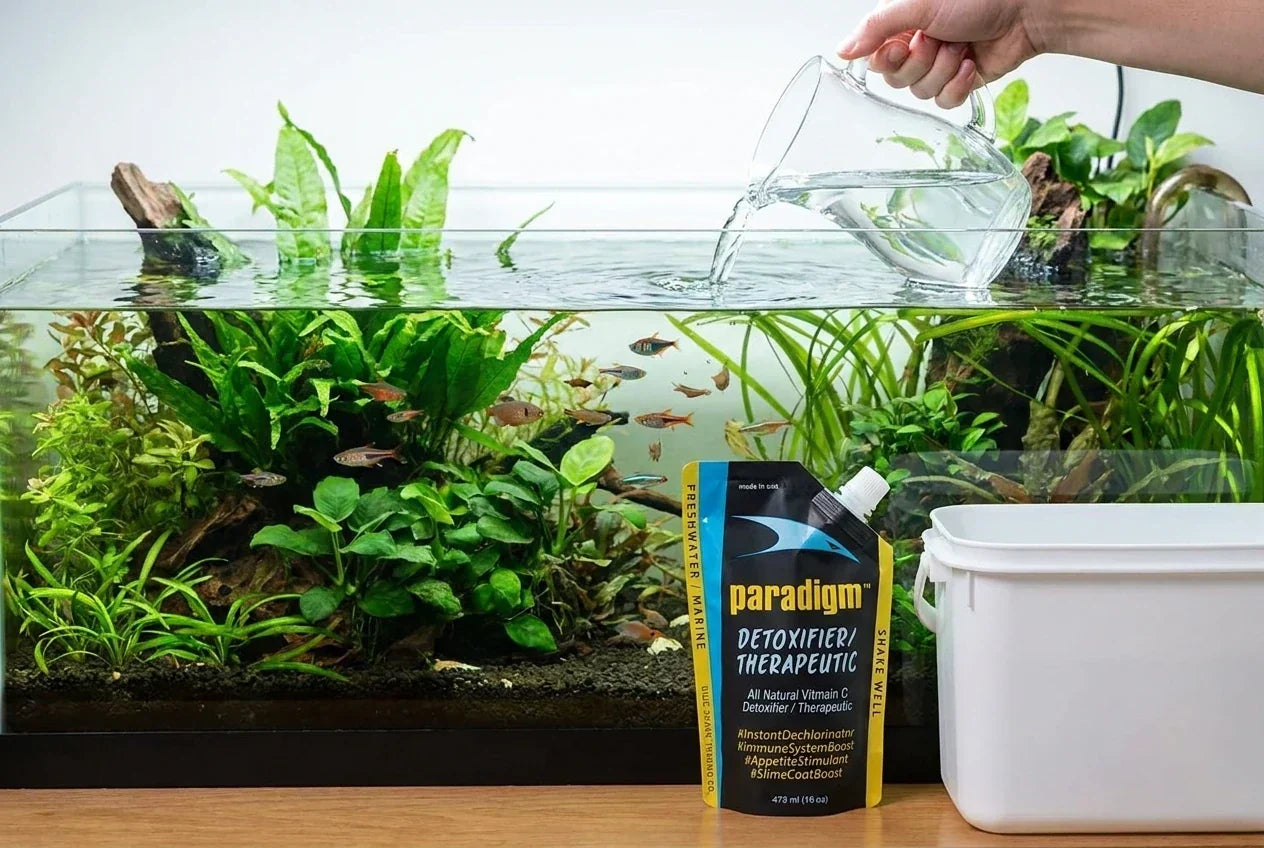
Why anti-chlorine, Prime, Paradigm and species-specific conditioners don't all take the same approach
Walk into an aquarium shop and the choice can seem unnecessarily complicated.
There is basic anti-chlorine. There are conditioners for bettas, shrimp and other supposedly sensitive livestock. Then there are highly concentrated multi-purpose products such as Seachem Prime. And there are less conventional products such as Blue Shark Paradigm, which uses a vitamin-C-based approach.
If all we need to do is make tap water safe, why are there so many versions?
The answer is that dechlorination itself is only part of what modern water conditioners may be designed to do.
Some concentrate on removing disinfectants. Others combine dechlorination with additional chemical intervention. Some add ingredients intended for skin or slime-coat conditioning. And some of the apparent specialisation is simply a different way of packaging or dosing a similar basic function.
Understanding those differences makes choosing a conditioner much easier.
First: Why Do We Need Water Conditioner at All?
Tap water is treated so that it remains microbiologically safe while travelling through the public water system.
That is good for us, but the disinfectant residual is not something we want to introduce untreated into an aquarium.
In Singapore, this is particularly relevant because PUB states that residual chlorine is supplied predominantly in the form of monochloramine, with ammonia deliberately added during treatment to form the more stable chloramine residual.
So for local aquarists, looking only for a product that says “removes chlorine” isn't enough.
A suitable aquarium conditioner should also deal with chloramine.

Chlorine and Chloramine Are Not Quite the Same Problem
Free chlorine is relatively straightforward to neutralise.
Chloramine is chlorine chemically associated with ammonia. It is more stable than free chlorine, which is precisely why water utilities use it to maintain a disinfectant residual through the distribution system.
For the aquarist, however, there is an important consequence.
When a conditioner deals with chloramine, neutralising its chlorine component can leave ammonia behind.
That leads to one of the biggest differences between water conditioners:
What should happen to that ammonia next?
Different products answer that question differently.
One Problem, Several Conditioning Philosophies
It is useful to stop thinking of every bottle as simply “anti-chlorine.”
Instead, aquarium conditioners can broadly take several approaches.
| Type | Main Approach | What Makes It Different |
|---|---|---|
| Basic conditioner | Neutralise chlorine/chloramine | Simple, straightforward water preparation |
| Multi-purpose conditioner | Dechlorination plus additional detoxification functions | Designed to deal with several water-quality concerns at once |
| Species-labelled conditioner | Dechlorination plus livestock-specific positioning or additives | May offer convenient dosing or extra ingredients, but formulation varies |
| Alternative dechlorination chemistry | Uses a different reducing chemistry to remove disinfectants | Same essential objective, different chemical approach |
None of these categories is automatically superior.
The important question is:
What do you actually want your water conditioner to do?
A Familiar Approach: Seachem Prime
Seachem Prime is probably one of the best-known aquarium water conditioners, and its popularity is understandable.
It isn't marketed merely as an anti-chlorine.
Prime is a highly concentrated, multi-purpose conditioner.
According to Seachem, Prime removes chlorine and chloramine and also detoxifies ammonia and heavy metals at concentrations normally found in tap water. The manufacturer additionally claims temporary detoxification of nitrite and nitrate.
Seachem explains that when Prime treats chloramine, the chlorine is removed and the resulting ammonia is bound into a form that remains available to beneficial bacteria.
That gives Prime a very broad role.
It can be used for routine water changes, but its additional functions can also be attractive during situations such as cycling or elevated ammonia/nitrite.
And because the product is highly concentrated, a relatively small quantity treats a large volume of water.
Prime is therefore best understood as a multitool.
You may not need every function during every water change, but those functions are available when you do.

Another Approach: Blue Shark Paradigm
Blue Shark Paradigm begins from a somewhat different philosophy.
Rather than trying to make the conditioner perform several nitrogen-management functions, Paradigm focuses on dechlorination using vitamin-C-based chemistry.
Its manufacturer describes Paradigm as an all-natural vitamin C formula that neutralises chlorine and chloramine.
This isn't merely a marketing use of the word “vitamin.”
Ascorbic acid — vitamin C — is an established dechlorinating agent.
The US Environmental Protection Agency has documented ascorbic acid as a recognised dechlorinating agent capable of reacting with both chlorine and chloramine.
So Paradigm genuinely uses a different route to achieve the essential job of making disinfected tap water suitable for aquarium use.

The Important Difference Comes After Chloramine
This is where the philosophy behind Paradigm becomes easier to understand.
When chloramine is treated:
CHLORAMINE
↓
chlorine component neutralised
↓
residual ammonia may remain
Paradigm does not position itself as an ammonia-detoxifying product.
In fact, Blue Shark specifically warns users that residual ammonia may remain after treatment and recommends biological ammonia removal.
In a mature aquarium, that points back to something the system should already possess:
the biological filter.
Nitrifying microorganisms process ammonia as part of the aquarium's nitrogen cycle.
Paradigm therefore follows a relatively focused philosophy:
Condition the incoming water, then allow biological filtration to perform biological filtration.
That doesn't make additional ammonia detoxification undesirable.
It simply represents a different approach.
Prime and Paradigm: Same Essential Job, Different Philosophy
Rather than asking which product is “better,” it is more useful to look at what each product is designed to accomplish.
| Seachem Prime | Blue Shark Paradigm | |
|---|---|---|
| Chlorine | Neutralises | Neutralises |
| Chloramine | Neutralises | Neutralises |
| Main positioning | Multi-purpose conditioner | Focused natural dechlorination |
| Dechlorination chemistry | Proprietary reducing/binding chemistry | Vitamin-C-based |
| Ammonia after chloramine treatment | Manufacturer says it is temporarily detoxified/bound while remaining bioavailable | May remain for biological filtration to process |
| Nitrite | Manufacturer claims temporary detoxification | Not its intended function |
| Heavy metals | Manufacturer claims detoxification at typical tap-water levels | Not a principal advertised function |
| Concentration | Very high | Lower concentration |
| Additional positioning | Broad water conditioning | Vitamin C, Vitamin E and slime-coat support claims |
| Best way to understand it | Multitool | Focused conditioner |
This is why choosing between them shouldn't be treated as choosing a winner.
They reflect two different ideas about how much work a conditioner should perform.

Is Doing More Always Better?
Not necessarily.
But neither is doing less automatically better.
Consider two very different situations.
An established aquarium receiving a routine water change
The aquarium has mature biological filtration. Ammonia and nitrite are normally undetectable. The objective is simply to replace some water safely.
In this situation, an aquarist may reasonably prefer a conditioner whose primary role is to neutralise chlorine/chloramine and then leave nitrogen processing to the established biofilter.
This is where the philosophy behind Paradigm becomes particularly easy to understand.
A new aquarium or an abnormal ammonia/nitrite situation
Here, an aquarist may appreciate having additional temporary detoxification functions available.
A multifunction conditioner such as Prime may therefore be particularly useful.
The correct choice depends less on the animal printed on the bottle and more on what is happening inside the aquarium.
So What About “Betta Water Conditioner”?
A bottle labelled specifically for bettas can easily create the impression that bettas require their own form of dechlorination.
The same happens with shrimp conditioners.
But chlorine doesn't become chemically different because the aquarium contains a betta.
And chloramine doesn't behave differently because the tank contains Crystal Red Shrimp.
What can differ is the formulation around the dechlorinating function.
A species-specific product might:
-
use a lower concentration that is easier to measure in very small aquariums;
-
include slime-coat or botanical ingredients;
-
include additional mineral or water-conditioning ingredients;
-
make livestock-specific claims;
-
or simply package an existing conditioning approach for a particular audience.
So the label alone doesn't tell us whether the underlying dechlorination is meaningfully different.
Read what the product actually does.

Are Shrimp-Specific Conditioners More Necessary?
Shrimp are sensitive to poor water quality, but this does not automatically mean they require a bottle labelled “shrimp conditioner.”
For shrimp keeping, several separate questions are often mixed together:
Is the water properly dechlorinated?
Are chlorine and chloramine both addressed?
Are GH, KH and TDS appropriate for the shrimp being kept?
Are potentially harmful metals present?
Is the replacement water sufficiently close to the aquarium's existing parameters?
Those are different issues.
A conditioner can make chlorinated tap water safe from disinfectants without automatically making its mineral composition appropriate for every shrimp species.
Likewise, a remineraliser is not a replacement for dechlorination.
This distinction is especially important with Caridina shrimp, where aquarists may use RO water and intentionally rebuild the mineral profile rather than simply conditioning tap water.
Water conditioning and water remineralisation solve different problems.
What About Heavy Metals?
This is another area where product labels need to be read carefully.
Some conditioners specifically claim to detoxify heavy metals. Prime, for example, makes this claim for heavy metals found in tap water at typical concentrations.
Other products concentrate primarily on chlorine and chloramine.
Whether heavy-metal detoxification is an important purchasing criterion therefore depends on the water source and the aquarium.
It should not simply be assumed that every aquarium needs every available conditioning function during every water change.
Is Vitamin C Really a Better Dechlorinator?
A more accurate question is:
Is vitamin C a legitimate dechlorinator?
Yes.
Ascorbic acid is established chemistry for neutralising chlorine compounds, including chloramine.
That makes Paradigm technically interesting.
But it would be misleading to jump from this to:
“Natural vitamin C is safe, while conventional conditioners are dangerous.”
Correctly used aquarium conditioners have been successfully used for decades.
Blue Shark argues that strong reducing agents can interfere with some test methods and, under extreme conditions, contribute to oxygen depletion. There is chemistry behind concerns about excessive reducing-agent loads, but that should not be interpreted to mean that a normal dose of conventional conditioner is inherently dangerous.
The stronger reason to consider Paradigm is simpler:
It offers a genuinely different dechlorination chemistry and a deliberately focused conditioning philosophy.
That is enough.
What About Paradigm's Vitamin E, Slime Coat and Fish-Health Claims?
Blue Shark also positions Paradigm's vitamin C and vitamin E around fish health, stress, healing and slime-coat support.
These are additional manufacturer claims.
They may be attractive features, particularly around fish handling and transport, but they shouldn't distract from the strongest and most easily understood reason Paradigm is different:
its vitamin-C-based approach to chlorine and chloramine neutralisation.
For routine aquarium use, we would regard the additional wellness positioning as secondary to its primary role as a water conditioner.
Which Type of Conditioner Makes Sense?
Instead of choosing according to the animal printed on the bottle, start with the situation.
Routine water changes in a mature aquarium
A focused chlorine/chloramine conditioner may be all that is required.
Paradigm is particularly interesting here for aquarists who prefer vitamin-C-based dechlorination and want their established biological filter to handle normal nitrogen processing.

One bottle with broad functionality
A multi-purpose conditioner makes sense.
Prime remains a very practical choice, especially for aquarists who value concentration and want additional ammonia/nitrite detoxification functions available when needed.
New aquarium or temporary ammonia/nitrite problem
Additional detoxification can be useful as a temporary management tool while the underlying biological problem is addressed.
This is one of the situations where Prime's broader functionality can be valuable.
Betta aquarium
Look for appropriate chlorine/chloramine treatment first.
A bottle doesn't need to say “Betta” to make water suitable for a betta.
Shrimp aquarium
Dechlorination is essential when using chlorinated/chloraminated tap water, but don't confuse it with mineral management.
GH, KH, TDS and the suitability of the source water remain separate considerations.
RO water
If properly produced RO water contains no chlorine/chloramine residual, dechlorination of that finished water may not be necessary.
But the water may require remineralisation depending on the animals and system.
Perhaps We Have Been Asking the Wrong Question
When comparing water conditioners, aquarists often ask:
“Which anti-chlorine is strongest?”
But that isn't necessarily the most useful question.
A better one is:
“What do I want my water conditioner to do?”
If you want an extremely concentrated conditioner with a broad range of additional functions, a product such as Seachem Prime makes considerable sense.
If you want the conditioner to focus on chlorine and chloramine while relying on an established aquarium's biological filtration for nitrogen processing, Blue Shark Paradigm offers a genuinely different approach.
And if a bottle says Betta, Shrimp or Goldfish on the front, look beyond the animal photograph and examine what is actually different about the formulation.
Because although every conditioner starts with the same basic objective — making tap water safe —
they don't necessarily take the same route to get there.
The Practical Takeaway
Dechlorination is essential. Extra conditioning functions are situational.
Choose a water conditioner according to your water source, aquarium maturity and what you actually need the product to accomplish.
For established aquariums where the biological filter is already doing its job, there is a compelling simplicity to the Paradigm philosophy:
neutralise the disinfectant, then let the aquarium's biology do what it was built to do.


